International Publisher of Science, Technology and Medicine


Articles in Press      
Volume 2, Issue 1
The Lebanese Sunnis: A Community in Disarray   Review Article
Andrew Kirkby
J Def Stud Resour Manage 2013, 2:1    doi: 10.4172/2324-9315.1000105
 Preview

The Lebanese Sunnis: A Community in Disarray

As Lebanon celebrated its sixty-ninth anniversary on November 22 it also, more ominously, marked roughly one month since the assassination of the Internal Security Forces (ISF) Intelligence Chief, Wissam al-Hassan. In that month, two disconcerting trends have become apparent. First, the traditional board game of Lebanese politics—with strong political chiefs—is becoming a harder game to manage, particularly for the Sunni community. And second, with the Sunni community increasingly in disarray, a leadership vacuum has developed.

|  Full Text |   PDF   
Wage Bargaining and Behaviour of Talented Labour in the Defence Market   Research Article
Sami Chraa
J Def Stud Resour Manage 2013, 2:1    doi: 10.4172/2324-9315.1000106
 Preview

Wage Bargaining and Behaviour of Talented Labour in the Defence Market

One of the enduring issues of business cycle theory has been the search for a theoretical framework that would aid apprehending the behaviour of wage rates in times of undulations in employment with respect to output. There has been a focus on how real wage movements can be affected by a business cycle and studies showed that there is no systematic pattern . The demand for labour would naturally, ceteris paribus result in a rise in employment but not necessarily in the wage rates.

|   PDF   
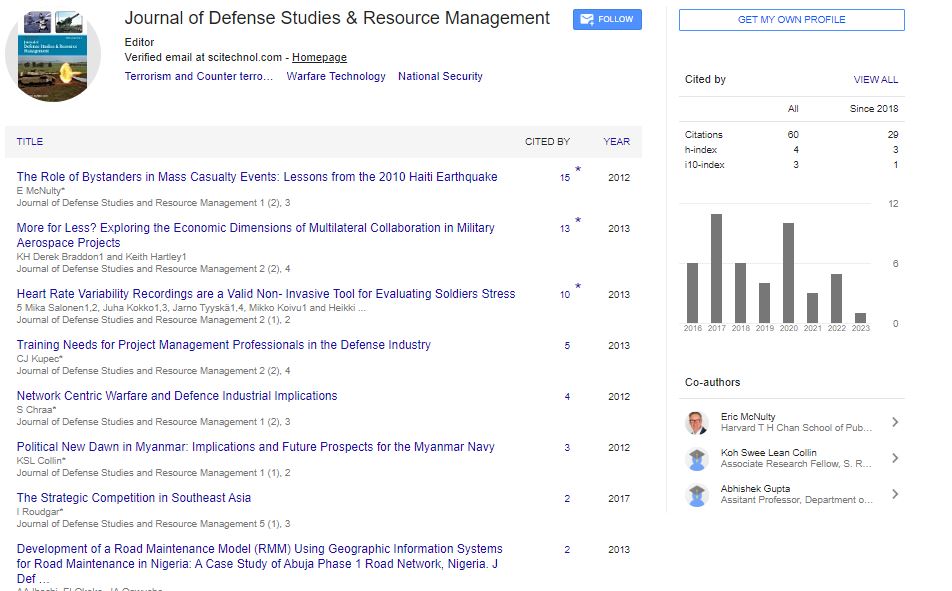
Heart Rate Variability Recordings are a Valid Non- Invasive Tool for Evaluating Soldiers’ Stress   Research Article
Mika Salonen, Juha Kokko, Jarno Tyyskä, Mikko Koivu and Heikki Kyröläinen
J Def Stud Resour Manage 2013, 2:1    doi: 10.4172/2324-9315.1000107
 Preview

Heart Rate Variability Recordings are a Valid Non- Invasive Tool for Evaluating Soldiers’ Stress

The purpose of the present study was to investigate physiological responses and to evaluate heart rate variability as a non-invasive stress indicator during a 72-hour military field training (MFT). Ten healthy male soldiers (age 20 ± 1 yr.) participated in MFT. They slept approximately 2 h/day and ate only army field rations. During MFT, the soldiers’ mean (±SD) energy expenditure was 4646 ± 674, energy intake 2200 ± 326, and energy deficit (ED) 2405 ± 890 kcal⋅day-1.Throughout the entire training period, serum total testosterone (TES) reduced from 19.0 ± 3.0 to 12.6 ± 6.2 nmol⋅l-1 (p<0.001)

|  Full Text |   PDF