Spanish
  Chinese
  Russian
  German
  French
  Japanese
  Portuguese
  Hindi
Hindi Research Article, J Biodivers Manage Forestry Vol: 14 Issue: 1
A Survey on Heronries (Nesting Colonies) of Eight Waterbird Species at the Bank of Ujani Reservoir, Maharashtra, India
DS Kumbhar1, DK Mhaske2*, RS Suryawanshi3 and GZ Jamdade3
1Department of Zoology, D.P. Mahavidyalaya, Karjat, Ahmednagar, India
2Department of Zoology, MJS Mahavidyalaya, Shrigonda, Ahmednagar, India
3Department of Zoology, PVP College, Pravaranagar, Ahmednagar, India
*Corresponding Author: DK Mhaske
Department of Zoology, MJS Mahavidyalaya, Shrigonda, Ahmednagar, India
E-mail: dnyandeomhaske@gmail.com
Received date: 09 November, 2024, Manuscript No. JBMF-24-152129; Editor assigned date: 13 November, 2024, PreQC No. JBMF-24-152129 (PQ); Reviewed date: 27 November, 2024, QC No. JBMF-24-152129; Revised date: 04 April, 2025, Manuscript No. JBMF-24-152129 (R); Published date: 11 April, 2025, DOI: 10.4172/2327-4417.1000078.
Citation: Kumbhar DS, Mhaske DK, Suryawanshi RS, Jamdade GZ (2025) A Survey on Heronries (Nesting Colonies) of Eight Waterbird Species at the Bank of Ujani Reservoir, Maharashtra, India. J Biodivers Manage Forestry 14:1.
Abstract
A heronry is a place where aquatic birds (mostly herons) nest together. The nesting behaviour in birds extremely ranges from widely spaced solitary nesting birds to densely packed colonies of hundreds of individuals. The nesting colonies of these aquatic birds represent spatial and temporal distribution of nests is popularly referred to as Heronries. The characteristics of good nesting sites include protection from predators, favourable climatic conditions and offers adequate stability. Colonial water birds choose the nesting sites after careful observation and evaluation of the safety condition. The present survey was conducted for three years, from September 2020 to August 2023 at fifteen sampling sites distributed among Ujani reservoir. The waterbird species selected for study are Phalacrocorax niger (Little Cormorant), Platalea leucorodia (Eurasian Spoonbill), Mycteria leucocephala (Painted Stork), Ardea cinerea (Grey Heron), Ciconia episcopus (White-naked Stork), Pseudibis papillosa (Black Ibis), Ardea purpurea (Purple Heron) and Plegadis falcinellus (Glossy Ibis). Nest diversity indices include, Dominance, Simpson, Shannon, Evenness, Brillouin, Margalef and two similarity indices viz. Bray Curtis and Jaccard were computed. The maximum count of nests 2679 was recorded during 2022-23, whereas minimum nest count 2139 was recorded during 2020-21. The nesting dominance was of Ardea cinerea during entire study period from all sampling sites under study.
Keywords: Aquatic birds; Diversity indices; Heronries; Nesting behavior; Ujani reservoir
Introduction
The nesting places of waterbirds are termed as Heronries. These places are generally very dirty and smelly with bird droppings in large extent, including leaves of the trees shaded with these droppings. The air at heronry sites is suffocating. The nesting may be solitary or densely packed colonies. Presence of aquatic birds is an indicator of healthy environmental conditions which reflect on health of the habitat in terms of ecological conditions like productivity, tropic structure, anthropogenic disturbances and contamination of wetland ecosystem. Different species of aquatic birds vary in their micro-habitat preferences, diet and ethology, but they have certain common fundamental requirements for nesting. Heronry birds are wetland dependent birds, but most of their breeding sites are seen in towns and highly crowded areas little away from wetland sites. Wetlands are the important bird habitats as they use them for feeding, nesting and roosting purposes. Aquatic avifauna is considered as one of the most important biotic component of wetland, occupy several trophic levels in the food web and maintain heterogeneity of the ecosystem. There are over 553 nesting sites in India and most of them are wetlands or the places close to water body. Heronries are especially communal nesting and breeding habitat for aquatic birds and play an important role to meet sustainable development in ecosystem [1].
Different species of waterbirds vary in their microhabitat preferences viz. shallow water, open water, mudflats, marshy places or dry banks. These waterbirds also vary in their diet, herbivores, piscivores, insectivores or omnivores and ecological aspects; but they share common fundamental requirements for nesting and fledging success. Abundance of food resources around the heronry sites and minimal disturbance considered as principal factors in large assemblage of breeding birds. The nesting site which provides protection from predators, seasonal climatic conditions, adequate stability, adequate foraging areas, low pollution level and undisturbed ambience are considered as the good nesting sites. Selection of nesting sites depends upon the proximity of reservoir body, which acts as prominent source of food for nesting birds and their young ones. The vegetation structure around the bank of reservoir including nesting tree features like size, height, canopy and number of branches is also considered as important criterion for the choice of nesting site among heronries. The breeding success in aquatic birds depends remarkably on inter and intra-specific relationships within the colony, food resources and predator pressure. Predator pressure is considered as the most important controlling factor in ‘shaping’ the assemblages. The heronries of all the aquatic birds studied preferred various types of trees viz. Tamarind (Tamarindus indica), Acacia (Vachellia nilotica), Banyan (Ficus benghalensis), Rain tree (Samanea saman) and Sacreed fig (Ficus religeosa) for nesting purpose as per their availability [2].
Material and Methods
Study area
Study area is located around Ujani reservoir, Ujani, Tahsil Madha, Dist Solapur, Maharashtra, India. Sampling sites are distributed among three different districts Solapur, Ahmednagar and Pune were selected for study. Fifteen sampling sites were selected around Ujani reservoir (Figure 1). The selection of sampling sites was made after miscellaneous survey of Ujani reservoir including terminal Bhima basin. Habitat structure and geographical locations were considered for site selection so that selected sites cover every type of habitat available in the study area. Among fifteen selected sites five sampling sites represents backwater wetland sites in Bhima river basin and remaining ten sites represents proper Ujani reservoir area [3].
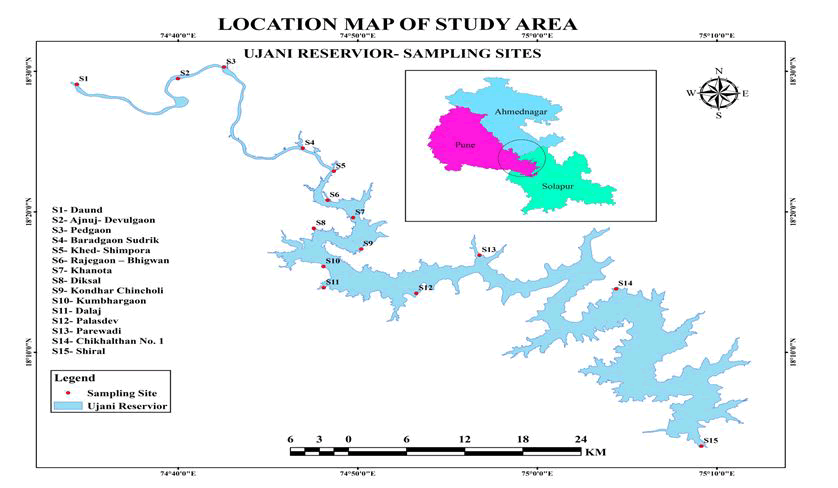
Figure 1: Location map of study area.
Sampling surveys
Heronries were surveyed twice in a month by walking along the bank of reservoir and river. Heronries away from the water body were also surveyed by counting the nests; suitable sites for nesting were also elaborated. Nests of 8 different species of aquatic birds were counted from all selected sampling sites during three years 2020-21, 2021-22 and 2022-23 [4].
Statistical analysis
The data obtained was subjected to computation of various nest diversity indices in various heronry sites. Various nest diversity indices include, Dominance D, Simpson’s D, Shannon H, Evenness, Brillouin and Margalef were computed in PAST Ver. 4.04. Similarity indices based on nest abundance and richness or nest variety (variety of nest is the nest of single species) were also computed to find out similarity among various heronry sites based on similarity in aquatic bird nest diversity. Nest diversity is the nests of different species of aquatic birds. Two similarity indices computed were Bray-Curtis similarity index based on nest abundance and Jaccard similarity index based on nest varieties by using unweighted pair-group average (UPGMA) algorithm. The similarity indices computation was performed in PAST ver. 4.04. Similarity trees were also constructed based on these similarity indices matrixes. The output indices values are presented in tables and similarity trees are presented in figures [5].
Results and Discussion
The nest count from September 2020 to August 2023 was recorded from fifteen sampling sites under study and found that, the maximum average nest count was of Gray Heron 375 (75.20 ± 103.380) whereas minimum nest count was of Purple Heron 2 (0.47 ± 0.640). The average nest count of Little Cormorant was 45 ± 73.395), Painted Stork 27.47 ± 82.152, White-naked Stork 3.27 ± 2.890, Black Ibis 1.27 ± 2.374, Glossy Ibis 2.53 ± 2.800 and Eurasian Spoonbill 0.67 ± 1.175 (Table 1). Average nesting diversity indices along with Taxa S and Individuals were computed for the study period. Daund (S-1) was rich site for both i.e., number of nesting species and total number of nests, 7 and 1001 respectively. The nesting dominance (0.92) was recorded at Khanota (S-7). The Simpson and Shannon diversity indices were recorded higher, 0.67 and 0.98 respectively at Daund (S-1). The evenness in nesting number was higher (0.68) at Khanota (S-7). The Brillouin and Margalef indices were higher, 0.98 at Daund (S-1) and 0.96 at Khed Shimpora (S-5) respectively (Table 2) [6].
| Sr. no. | Bird species | S-1 | S-2 | S-3 | S-4 | S-5 | S-6 | S-7 | S-8 | S-9 | S-10 | S-11 | S-12 | S-13 | S-14 | S-15 | Mean | SD |
| 1 | Little Cormorant | 280 | 70 | 74 | 0 | 0 | 88 | 0 | 37 | 7.3 | 40 | 82 | 0 | 2 | 0 | 0 | 45.35 | 73.395 |
| 2 | Purple Heron | 1 | 1 | 1 | 0 | 2 | 1 | 0 | 0 | 0 | 0 | 1 | 0 | 0 | 0 | 0 | 0.47 | 0.64 |
| 3 | Gray Heron | 375 | 110 | 139 | 42 | 49 | 208 | 55 | 9 | 10 | 106 | 23 | 2 | 0 | 0 | 0 | 75.2 | 103.38 |
| 4 | Painted Stork | 320 | 0 | 52 | 12 | 23 | 0 | 5 | 0 | 0 | 0 | 0 | 0 | 0 | 0 | 0 | 27.47 | 82.152 |
| 5 | White-naked Stork | 8 | 11 | 5 | 5 | 2 | 3 | 1 | 2 | 1 | 3 | 1 | 2 | 2 | 2 | 1 | 3.27 | 2.89 |
| 6 | Black Ibis | 7 | 7 | 1 | 1 | 1 | 1 | 0 | 0 | 1 | 0 | 0 | 0 | 0 | 0 | 0 | 1.27 | 2.374 |
| 7 | Glossy Ibis | 10 | 4 | 6 | 3 | 5 | 2 | 1 | 2 | 1 | 3 | 1 | 0 | 0 | 0 | 0 | 2.53 | 2.8 |
| 8 | Eurasian Spoonbill | 0 | 3 | 0 | 3 | 2 | 2 | 0 | 0 | 0 | 0 | 0 | 0 | 0 | 0 | 0 | 0.67 | 1.175 |
| Note: Sampling sites: S-1 (Daund), S-2 (Ajnuj-Devulgaon), S-3 (Pedgaon), S-4 (Baradgaon Sudrik), S-5 (Khed Shimpora), S-6 (Rajegaon Bhigwan), S-7 (Khanota), S-8 (Diksal), S-9 (Kondhar Chincholi), S-10 (Kumbhargaon), S-11 (Dalaj), S-12 (Palasdeo), S-13 (Parewadi), S-14 (Chikhalthan No.1), S-15 (Shiral) | ||||||||||||||||||
Table 1: Average nest count at all sampling sites from September 2020 to August 2023.
| Sr. no. | S-1 | S-2 | S-3 | S-4 | S-5 | S-6 | S-7 | S-8 | S-9 | S-10 | S-11 | S-12 | S-13 | S-14 | S-15 | |
| 1 | Taxa_S | 7 | 6 | 6 | 5 | 6 | 6 | 2 | 3 | 2 | 4 | 3 | 1 | 2 | 1 | 1 |
| 2 | Individuals | 1001 | 206 | 243 | 107 | 72 | 327 | 56 | 53 | 20 | 152 | 108 | 4 | 5 | 1 | 1 |
| 3 | Dominance_D | 0.32 | 0.41 | 0.44 | 0.4 | 0.53 | 0.51 | 0.92 | 0.68 | 0.37 | 0.58 | 0.8 | 0.5 | 0.85 | 1 | 0.33 |
| 4 | Simpson_1-D | 0.67 | 0.58 | 0.56 | 0.6 | 0.46 | 0.48 | 0.08 | 0.31 | 0.3 | 0.42 | 0.2 | 0.17 | 0.15 | 0 | 0 |
| 5 | Shannon_H | 0.98 | 0.96 | 0.94 | 0.95 | 0.93 | 0.84 | 0.16 | 0.58 | 0.49 | 0.72 | 0.33 | 0.29 | 0.27 | 0 | 0 |
| 6 | Evenness_e^H/S | 0.5 | 0.51 | 0.46 | 0.56 | 0.46 | 0.41 | 0.68 | 0.58 | 0.5 | 0.51 | 0.62 | 0.6 | 0.91 | 1 | 0.33 |
| 7 | Brillouin | 0.98 | 0.95 | 0.93 | 0.92 | 0.83 | 0.81 | 0.14 | 0.53 | 0.41 | 0.68 | 0.31 | 0.22 | 0.2 | 0 | 0 |
| 8 | Margalef | 0.82 | 0.93 | 0.91 | 0.93 | 0.96 | 0.81 | 0.27 | 0.57 | 0.46 | 0.6 | 0.41 | 0.28 | 0.29 | 0 | 0 |
| Note: Key to diversity indices: Dominance: 0=no dominance, 1=one taxa dominate; Simpson: 0=no even, 1=perfectly even; Shannon: 0=no diversity, > 0=increase in diversity; Brillouin: 0=no diversity, >0= increase in diversity; Margalef: 0=no richness, > 0=increase in richness. Sampling sites: S-1 (Daund), S-2 (Ajnuj-Devulgaon), S-3 (Pedgaon), S-4 (Baradgaon Sudrik), S-5 (Khed Shimpora), S-6 (Rajegaon Bhigwan), S-7 (Khanota), S-8 (Diksal), S-9 (Kondhar Chincholi), S-10 (Kumbhargaon), S-11 (Dalaj), S-12 (Palasdeo), S-13 (Parewadi), S-14 (Chikhalthan No.1), S-15 (Shiral) |
||||||||||||||||
Table 2: Average nesting diversity indices at all sampling sites from September 2020 to August 2023.
The Bray-Curtis and Jaccard similarity indices were computed to evaluate the similarity based on nest abundance and richness of nests respectively. The Bray Curtis index was maximum between Ajnuj Devulgaon with Pedgaon (0.80) and Dalaj (0.77) followed by pedgaon with Rajegaon Bhigwan (0.76), Ajnuj Devulgaon with Kumbhargaon (0.75) and Kumbhargaon with Dalaj (0.75); while negligible between Shiral, Parewadi and Palasdeo with all the sampling sites. Jaccard similarity index was maximum at Shiral with Chikhalthan No.1 (1.0) followed by Pedgaon with Daund (0.86) and Khed Shimpora with Baradgaon Sudrik (0.86), followed by Dalaj with Pedgaon (0.83), Diksal with Pedgaon (0.83), Kumbhargaon with Diksal (0.80), Dalaj with Kumbhargaon (0.80), Ajnuj Devulgaon with Daund (0.75), Khed Shimpora with Daund and Ajnuj Devulgaon (0.75) and Palasdeo and Parewadi with Kondhar Chincholi (0.75). Negligible similarity was recorded between Parewadi, Dalaj, Kumbhargaon (except with Dalaj) and Khanota with other sampling sites (Table 3) [7].
| S-1 | S-2 | S-3 | S-4 | S-5 | S-6 | S-7 | S-8 | S-9 | S-10 | S-11 | S-12 | S-13 | S-14 | S-15 | ||
| Daund | 0.39 | 0.45 | 0.23 | 0.18 | 0.61 | 0.11 | 0.17 | 0.11 | 0.26 | 0.27 | 0.02 | 0.02 | 0 | 0 | Bray-Curtis | |
| Ajnuj/Devulgaon | 0.75 | 0.8 | 0.39 | 0.46 | 0.66 | 0.39 | 0.44 | 0.37 | 0.75 | 0.77 | 0.09 | 0.08 | 0.01 | 0.02 | ||
| Pedgaon | 0.86 | 0.63 | 0.47 | 0.5 | 0.76 | 0.35 | 0.48 | 0.32 | 0.69 | 0.67 | 0.07 | 0.06 | 0.01 | 0.01 | ||
| Baradgaon-Sudrik | 0.63 | 0.63 | 0.5 | 0.74 | 0.43 | 0.6 | 0.39 | 0.36 | 0.44 | 0.41 | 0.15 | 0.04 | 0.02 | 0.03 | ||
| Khed/Shimpora | 0.75 | 0.75 | 0.63 | 0.86 | 0.35 | 0.74 | 0.46 | 0.42 | 0.57 | 0.56 | 0.18 | 0.05 | 0.02 | 0.04 | ||
| Rajegaon/Bhigwan | 0.63 | 0.63 | 0.5 | 0.71 | 0.63 | 0.24 | 0.34 | 0.23 | 0.51 | 0.52 | 0.05 | 0.05 | 0 | 0.01 | ||
| Khanota | 0.29 | 0.29 | 0.33 | 0.33 | 0.29 | 0.14 | 0.37 | 0.5 | 0.58 | 0.55 | 0.2 | 0 | 0 | 0 | ||
| Diksal | 0.71 | 0.5 | 0.83 | 0.57 | 0.5 | 0.57 | 0.4 | 0.69 | 0.59 | 0.6 | 0.18 | 0.18 | 0.02 | 0.04 | ||
| Kondhar Chincholi | 0.57 | 0.57 | 0.43 | 0.43 | 0.38 | 0.67 | 0.2 | 0.5 | 0.53 | 0.5 | 0.33 | 0.3 | 0.04 | 0.07 | ||
| Kumbhargaon | 0.57 | 0.57 | 0.67 | 0.43 | 0.38 | 0.43 | 0.5 | 0.8 | 0.6 | 0.75 | 0.13 | 0.12 | 0.01 | 0.03 | ||
| Dalaj | 0.71 | 0.71 | 0.83 | 0.38 | 0.5 | 0.38 | 0.4 | 0.67 | 0.5 | 0.8 | 0.1 | 0.1 | 0.01 | 0.01 | ||
| Palasdeo | 0.43 | 0.43 | 0.29 | 0.5 | 0.43 | 0.5 | 0.25 | 0.33 | 0.75 | 0.4 | 0.33 | 0.29 | 0.17 | 0.31 | ||
| Parewadi | 0.43 | 0.43 | 0.29 | 0.29 | 0.25 | 0.5 | 0 | 0.33 | 0.75 | 0.4 | 0.33 | 0.5 | 0.18 | 0.33 | ||
| Chikhalthan No.1 | 0.14 | 0.14 | 0.17 | 0.17 | 0.14 | 0.17 | 0 | 0.2 | 0.25 | 0.25 | 0.2 | 0.33 | 0.33 | 0.67 | ||
| Shiral | 0.14 | 0.14 | 0.17 | 0.17 | 0.14 | 0.17 | 0 | 0.2 | 0.25 | 0.25 | 0.2 | 0.33 | 0.33 | 1 | ||
| Jaccard | ||||||||||||||||
| Note: 0=No similarity/Perfectly dissimilar; 1=Perfectly similar | ||||||||||||||||
Table 3: Average similarity indices at all sampling sites from September 2020 to August 2023.
Bray Curtis similarity tree was constructed based on nest abundance between sites. Average cluster analysis from September 2020 to August 2023 shows four strong clusters with more than 50%similarity. Cluster A includes Chikhalthan No.1 and Shiral, Cluster B is strong and includes Ajnuj Devulgaon, Pedgaon Kumbhargaon, Dalaj and Rajegaon Bhigwan. Cluster C includes Baradgaon sudrik, Khed Shimpora and Khanota, while cluster D includes Diksal and Kondhar Chincholi. Remaining sites showed less similarity in their abundance of nests with other sites resulting in the formation of solitary branches (Figure 2). Jaccard similarity tree showed four clusters with more than 50% similarity in nesting varieties. Cluster A includes Chikhalthan No.1 and Shiral with 1 and 2 nests respectively. Cluster B includes Kondhar Chincholi, Palasdeo and Parewadi, Cluster C includes Baradgaon sudrik, Khed Shimpora, Ajnuj Devulgaon and Rajegaon Bhigwan, while cluster D includes Pedgaon, Daund, Dalaj, Diksal and Kumbhargaon. Khanota remain unclustered as it showed less similarity in nest diversity with other sampling sites (Figure 3) [8].
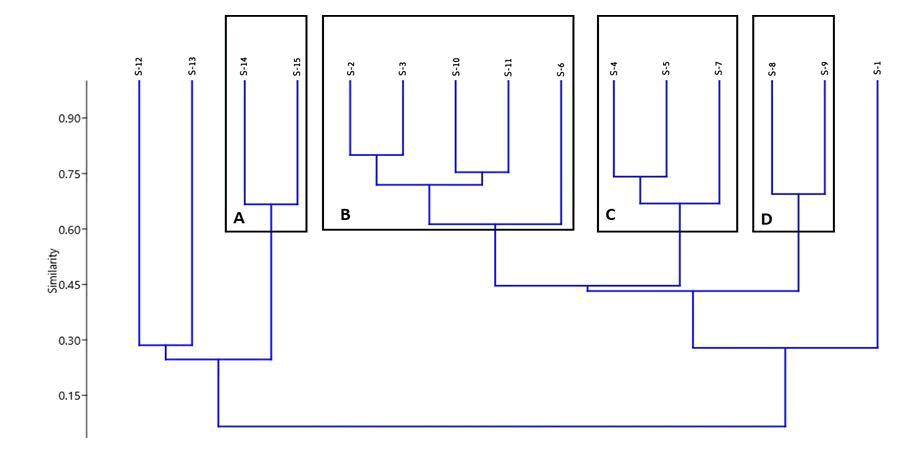
Figure 2: Cluster analysis-Bray Curtis similarity tree based on nests abundance between sites. Note: Sampling sites: S-1 (Daund), S-2 (Ajnuj-Devulgaon), S-3 (Pedgaon), S-4 (Baradgaon Sudrik), S-5 (Khed Shimpora), S-6 (Rajegaon Bhigwan), S-7 (Khanota), S-8 (Diksal), S-9 (Kondhar Chincholi), S-10 (Kumbhargaon), S-11 (Dalaj), S-12 (Palasdeo), S-13 (Parewadi), S-14 (Chikhalthan No.1), S-15 (Shiral).
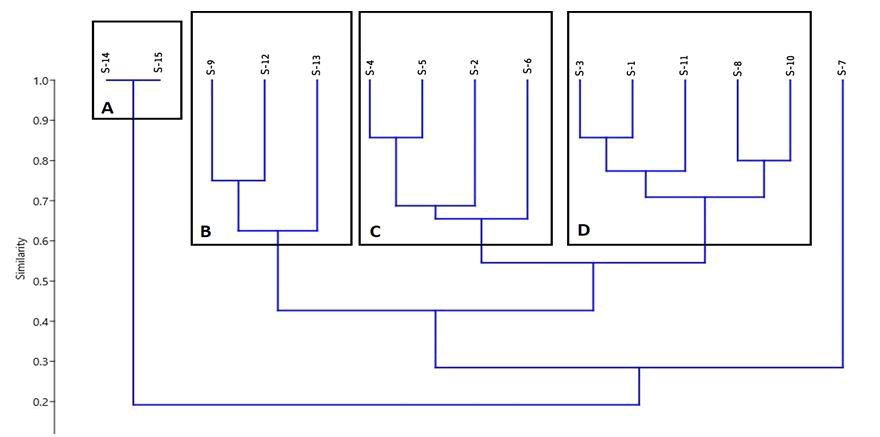
Figure 3: Cluster analysis-Jaccard similarity index based on variety/richness of nests. Note: Sampling sites: S-1 (Daund), S-2 (Ajnuj-Devulgaon), S-3 (Pedgaon), S-4 (Baradgaon Sudrik), S-5 (Khed Shimpora), S-6 (Rajegaon Bhigwan), S-7 (Khanota), S-8 (Diksal), S-9 (Kondhar Chincholi), S-10 (Kumbhargaon), S-11 (Dalaj), S-12 (Palasdeo), S-13 (Parewadi), S-14 (Chikhalthan No.1), S-15 (Shiral).
Number of nests of each bird species reported during study period was different in different seasons. The nesting behaviour of eight species of waterbirds was documented in different seasons of the year from September 2020 to August 2023. The nesting of Little Cormorant (Phalacrocorax niger), Eurasian Spoonbill (Platalea leucorodia) and Painted Stork (Mycteria leucocephala) was reported during November to February, Grey Heron (Ardea cinerea) and White-naked Stork (Ciconia episcopus) was reported from December to March, Black Ibis (Pseudibis papillosa) from March to October, Purple Heron (Ardea purpurea) from November to March every year. Glossy Ibis (Plegadis falcinellus) from September to December [9].
Subramanya, 1996, 1997 from Tamil Nadu reported single species nesting sites and fewer nesting species reported by Sashikumar and Jayarajan. Sashikumar et al., reported 12 species of waterbirds nesting in 102 different heronries from Malbar region of Northern Kerala. The Painted stork (Mycteria leucocephala), categorized in schedule IV of wildlife (Protection) Act, 1972 and listed under near threatened species (Birdlife International, 2012) is seen in almost all states of India except Kerala, Bihar, West Bengal, Assam, Jharkhand and North-Eastern states. The factors affecting nesting success were poorly understood. Painted storks build their nest on trees or areas that are near the water body. The nest building behavior of the Painted Stork was reported in Lucknow districts (near Lucknow Zoo) of Uttar Pradesh, India durig July 2013-March 2014 Adesh Kumar and Amita Kanaujia. The Grey Heron is the winter visitor, not only use the reservoir as feeding site, but also fields, water sources as ponds and rivers as well as xeric flat lands. The diet of Grey Heron during breeding season was well documented by several workers, however information related to seasonal diet is meagre. The Grey Heron was recorded breeding inland during August 2018 at Nanodara village of Ahmedabad district, Gujarat, India. Nesting was done on large Banyan trees located at the edge of the village pond.
The nesting sites of Little Cormorant were easily reported from sampling sites. Highest number of Little Cormorant nests was recorded by Jayson at Mangalavamam mangroves and Kumarakam heronries by Narayan and Vijayan. Habibon Naher, recorded breeding season during May to October from sampling sites in Bangladesh. The Black Ibis (Pseudibis papillosa) is widespread species found throughout India. Maximum population is found in India with 60% of it in Gujarat and Maharashtra. Ali et al., reported the nests of Balck Ibis between September and October from Jangi, Gujrat. Oudman et al., studied Colony-breeding Eurasian Spoonbills from Netherlands and limits to population growth with expansion in new areas. The Eurasian Spoonbill (Platalea leucorodia) has a fragmented distribution from the East Atlantic to India and China. They are recognized, differing in their distribution, migration routes and wintering areas. The information related nesting and breeding of Eurasian Spoonbill is scarce in Indian subcontinent.
Nedjah et al., recorded the egg laying period of Purple Herons toward the end of March and early April from selected sampling sites at North-eastern Algeria. Glossy Ibis is supposed to be a non-breeding, winter migrant in India and mostly use agricultural landscapes for nesting. Tiwari and Rahmani, reported Glossy Ibis nesting during September and October in Gujarat. White-necked stork (Ciconia episcopus) is a large wader in family Ciconiidae. It breeds singly, or sometimes in small loose colonies. It is distributed in almost all types of habitats including marshes in forests, agricultural areas, and freshwater wetlands across Asia. Vaghela et al., reported nesting period of White-naked heron during the months of September and October on mobile towers from Pune, Maharashtra.
Conclusion
The present study aims to explore the heronries along the backwater of Ujani reservoir and prepare the baseline data in order to detailed survey and monitoring of these heronries in future and conserve their habitats.
The nesting colonies of these aquatic birds represent spatial and temporal distribution of nests. Presence of aquatic birds is an indicator of healthy environmental conditions which reflect on health of the habitat in terms of ecological conditions like productivity, tropic structure, anthropogenic disturbances and contamination of wetland ecosystem; So, conservation of these heronries is the need of time.
References
- Ajitha KV, Jose B (2015) Kallettumkara Heronry, an ideal breeding site for waterbirds in Kerala, South India. Int J Sci Res 4: 923-927.
- Chakraborty DC, Majumder S (2018) Urban heronries of Kolkata metropolitan: An insight to nest stratification, resource based guilds and conservation priorities. Asian J Conserv Biol 7: 106-112.
- Jayson EA (2001) Structure, composition and conservation of birds in Mangalavanam mangroves, Cochin, Kerala. Zoos’ Print J 16: 471-478.
- Fenqi HE, Xiaojun Y, Xuejian D, Kaiming ZH, Li L, et al. (2023) The White-eared Night Heron (Gorsachius magnificus): From behind the bamboo curtain to the front stage. Avian Res 2: 163-166.
- Frederick PC, Collopy MW (1989) The role of predation in determining reproductive success of colonially nesting wading birds in the Florida Everglades. Condor 91: 860-867.
- Gibbs JP (1991) Spatial relationships between nesting colonies and foraging areas of Great Blue Herons. The Auk 108: 764-770.
- Gibbs JP, Woodward S, Hunter ML, Hutchinson AE (1987) Determinants of Great Blue Heron colony distribution in coastal Maine. The Auk 104: 38-47.
- GV G, Pandav B (2007) Observations on breeding biology of three stork species in Bhitarkanika mangroves, India. Indian Birds 3: 45-50.
- Hafner H, Britton RH (1983) Changes of foraging sites by nesting Little Egrets (Egretta garzetta L.) in relation to food supply. Colonial Waterbirds 6: 24-30.