Spanish
 Chinese
 Russian
 German
 French
 Japanese
 Portuguese
 Hindi
Short Communication, Biomater Med Appl Vol: 10 Issue: 3
Chemical Resistance Evaluation of Various Medical-Grade Materials Exposed to a Stabilized and Isotonic 0.057% Sodium Hypochlorite Antimicrobial Solution (Anasept®).
Inés Jiménez-Palomar1*, Ramón González-Lemus2 and AlfonsoBarajas-Cervantes1
1 inMateriis S.A. de C.V, Guadalajara, Jalisco-México
2 BIVIUM INTERNATIONAL, INC San Antonio Texas-United States of America
- *Corresponding Author:
- Inés Jiménez-Palomar
Inés Jiménez-Palomar, Chief Executive Officer inInMateriis-Scientific Innovation Center, Guadalajara, Jalisco - México
E-mail: ines.jimenez@inmateriis.com
Received: 22-July-2026, Manuscript No: BMA-26-192850, Editor Assigned: 24-Jul-2026, Pre-QC No: BMA-26-192850 (PQ), Reviewed: 07-Aug-2026, QC No: BMA-26-192850, Revised: 12-Aug-2026, Manuscript No: BMA-26-192850 (R), Published: 19-Aug-2026, DOI: 10.4172/2577-0268.1000508
Citation: Jiménez-Palomar I, González-Lemus R, Barajas-Cervantes A (2026) Chemical Resistance Evaluation of Various Medical-Grade Materials Exposed to a Stabilized and Isotonic 0.057% Sodium Hypochlorite Antimicrobial Solution (Anasept®). Biomater Med Appl 16: 508
Abstract
Device-associated healthcare-associated infections (HAIs) are a major health problem that requires development of new treatments options. A chemical resistance evaluation was conducted on a set of medical-grade materials (316L stainless steel, polyglycolic acid, polyetheretherketone, polyethylene, polylactide, polypropylene, polyurethane, and silicone), following ASTM D543-14 standards. A set of 8 medical-grade materials were exposed to various immersion times (30 seconds, 1 minute, 5 minutes, and 24 hours) in a stabilized and isotonic 0.057% sodium hypochlorite antimicrobial solution (Anasept®). All the set of evaluated medical-grade materials demonstrated consistent chemical resistance across all immersion times in Anasept®. The above results demonstrate that stabilized and isotonic 0.057% sodium hypochlorite antimicrobial solution (Anasept®) could be used together with all the set of medical-grade materials tested in all the immersion times without affecting his chemical resistance.
Keywords: Sodium hypochlorite, Antimicrobial, Stabilized & Isotonic
Introduction
Antimicrobial agents are substances that are used to reduce the risk of sepsis and infection; those are classified into two main groups: 1.- Antibiotics: Natural or synthetic, absorbable agents with bactericidal or bacteriostatic activity [1] The antibiotics prophylactic use prior to surgery is increasingly supported by evidence and is considered standard of care in procedures involving implants. [2] Nevertheless, the overuse of antibiotics has led to an increased prevalence of bacterial resistance, a recognized global health issue. [3] 2.- Antiseptics: Substances applied topically with minimal systemic absorption, which effectively reduce infection risk. [1] Compared to antibiotics, antiseptics exhibit broader antimicrobial spectra and a lower potential for bacterial resistance. [4] In surgery, antiseptics reduce infection sources [5] but are associated with cytotoxic effects and impaired wound healing. [6] Additionally, some antiseptics adversely affect common medical-grade materials (e.g., iodine deteriorates silicone; alcohol and polyethylene glycol degrade polyurethane and silicone). [7] Recent efforts aim to enhance conventional antiseptic therapies by developing formulations with minimized drawbacks and improved efficacy. [8] Dakin’s solution, first introduced during World War I, significantly reduced wound-related disabilities. [9] Its full-strength form contains 0.5% NaOCl, and the medium-strength form contains 0.25% NaOCl; both demonstrate antimicrobial efficacy but are limited by cytotoxic effects and delayed wound healing. [10] A “modified Dakin’s solution” containing only 0.025% NaOCl was published in 1991, that new version retained bactericidal properties without development cytotoxic effects. [11] Recent research comparing antiseptic effects on human fibroblast and keratinocyte cultures found that NaOCl in low concentration had the lowest detrimental effects, making it the least aggressive from different antiseptics studied options. [12] Saline solution (NaCl–based) is widely used in clinical practice due to its isotonicity, which helps avoid disrupting the wound healing process. [13] The World Health Organization recently recommended the use of 0.015% HOCl for wound management, citing its minimal impact on the structural integrity of healing tissue. [14]
Anasept®, an isotonic modified solution containing only 0.057% NaOCl (being below cytotoxic concentrations) [15, 16], demonstrated superior effectiveness in reducing bacterial load and promoting healing compared to saline solution in a controlled, randomized, double-blind pilot study in hard-to-heal wounds in adult patients [16], a recent comparative study associates intra-abdominal lavage with Anasept® with more favourable outcomes (less 1 month follow up complications) a shorter hospital stay and a reduction in hospital cost in adult patients with complicated appendicitis [17], finally also a cross sectional study associated the use of Anasept® with a reduction in the infection rates associated to haemodialysis catheters in adult patients under the current international recommendations. [18]. Due to its benefits in controlling bioburden [16-19] without cytotoxicity [15] Its potential use is proposed as a new treatment option in device-associated healthcare-associated infections (DA-HAIs).
Materials and Methods
Following the ASTM D543-14 guidelines for polymer material resistance, [19] the evaluation assessed visible physical changes, dimensional changes, and weight variations through a series of measurements performed before and after immersion in Anasept® (Bravida Medical; Genova, Illinois, USA) for various immersion times (30 seconds, 1 minute, 5 minutes, and 24 hours). Immersion times were selected based on the standard intervals used to assess the antimicrobial efficacy and residual effects of Anasept® (Bravida Medical; Genova, Illinois, USA). [15] The following medical-grade materials were tested: 316L stainless steel, polyglycolic acid, polyetheretherketone, polyethylene, polylactide, polypropylene, polyurethane, and silicone.
Results
After subjecting all medical-grade materials to all immersion times in Anasept® as is specified in the Materials and Methods section and after making all the corresponding subsequent reviews, it was determined that: All materials demonstrated good resistance at all evaluated immersion times. Based on the findings, implant irrigation may be safely performed with Anasept® for the evaluated materials in the immersion times tested, as the materials demonstrate good chemical resistance (Table 1).
| Material | 30 seconds | 1 minute | 5 minutes | 24 hours |
|---|---|---|---|---|
| 316L Stainless Steel | A | A | A | A |
| Polyglycolic Acid | A | A | A | A |
| Polyetheretherketone | A | A | A | A |
| Polyethylene | A | A | A | A |
| Polylactide | A | A | A | A |
| Polypropylene | A | A | A | A |
| Polyurethane | A | A | A | A |
| Silicone | A | A | A | A |
Table 1: Medical-degree grade material resistance at different times
A = Good resistance
Discussion
Further studies are required to evaluate additional materials, material combinations and different clinical scenarios. The use of medical implants is critical in the treatment of patients with functional deficits or tissue loss across a range of anatomical sites. However, implantable devices are associated with an elevated risk of biofilm-associated infections. One current strategy to reduce this risk involves intraoperative irrigation of implants with antimicrobial solutions. [20] Evaluation of degradation through analysis of physical, mechanical, and chemical properties is a key factor in the selection of clinically appropriate materials. [21] This work establishes a first precedent that Anasept® does not interfere with the proved medical-degree materials at the tested immersion times; future research could consider the above (Figure 1).
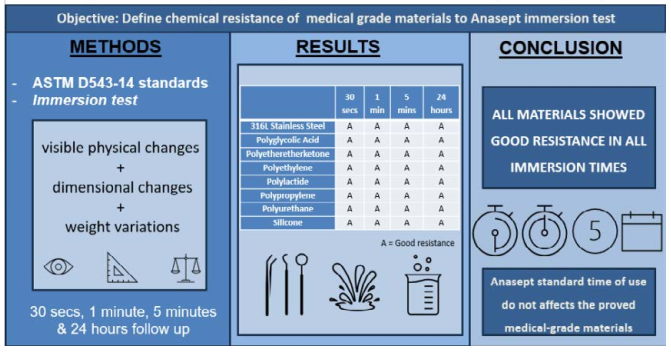
Figure 1: Graphical abstract
Acknowledgement
This work is dedicated to the memory of the master’s in science Alfonso Barajas-Cervantes who very unfortunately left this world shortly after completing the experiments mentioned in this article. Those of us who have the privilege of knowing Alfonso are grateful for the good fortune of having been able to share the laboratory, experiences, and a part of life with him. The authors also wish to thank Moises Carvente-Ochoa and his company BIVIUM International for having fully funded this study.
Significance of Research
Infections associated with medical devices, or device-associated healthcare-associated infections (DA-HAIs) are a serious public health problem commonly associated with a complex treatment which frequently requires device removal increasing dramatically health cost by hospital stays, readmissions and utilization of specialized treatments. This study demonstrates a good resistance between the interaction of the antimicrobial agent (Anasept®) and the most used medical materials; this could favor a future possible integration of this agent in therapeutic schemes for management of (DA-HAIs).
Alignment with Journal Scope
This study reports new information about the physical properties (chemical resistance) of an antimicrobial solution (Anasept®) to the most common medical materials. This result creates an opportunity of a treatment for device-associated healthcare-associated infections (HAIs) offering a novel emerging Biomaterial applications to Medical Sciences.
Publication Agreement
All the authors approved the manuscript and agree with the content and its submission to the Biomaterials and Medical Applications journal. This manuscript is original, has not been published previously, and has not currently been submitted to any other journal.
References
- Nankervis H, Thomas KS, Delamere FM, Barbarot S, Rogers NK et al. (2016) Scoping systematic review of treatments for eczema. Southampton (UK): NIHR Journals Library.
- Crader MF, Varacallo MA (2026) Preoperative Antibiotic Prophylaxis. In: Stat Pearls [Internet]. Treasure Island (FL): Stat Pearls Publishing.
- Tahmasebi H, Arjmand N, Monemi M, Babaeizad A, Alibabaei F et al. (2025) From Cure to Crisis: Understanding the Evolution of Antibiotic-Resistant Bacteria in Human Microbiota. Biomolecules Jan 15: 93.
- Lachapelle JM, Castel O, Casado AF, Leroy B, Micali G, et al. (2013) Antiseptics in the era of bacterial resistance: a focus on povidone iodine. Clin Pract 10: 579-592.
- Arsalan A, Sabah A, Ahmad I, Naqvi SBS, Ali SI (2010) The role of antiseptics in surgery. J Baqai Med Univ 13: 47-54.
- Slaviero L, Avruscio G, Vindigni V, Tocco-Tussardi I (2018) Antiseptics for burns: a review of the evidence. Ann Burns Fire Disasters Sep 3: 198-203.
- Huriaux L, Costille P, Quintard H, Journois D, Kellum JA et al. (2017) Haemodialysis catheters in the intensive care unit. Anaesth Crit Care Pain Med 36: 313-319.
- Calle-Moriel A & González-Rodríguez ML (2021) Avances en las formulaciones de los antisépticos [Advances in Antiseptic Formulations]. Ars Pharm. 62: 451-470.
- Georgiadis J, Nascimento VB, Donat C, Okereke I, Shoja MM (2019) Dakin’s Solution: “One of the most important and far-reaching contributions to the armamentarium of the surgeons” Burns 45: 1509-1517.
- Haesler E, Carville K (2023) WHAM evidence summary: traditional hypochlorite solutions. WCET Journal 43: 35-40.
- Heggers JP, Sazy JA, Stenberg BD, Strock LL, McCauley RL et al. (1991) Bactericidal and wound-healing properties of sodium hypochlorite solutions: the 1991 Lindberg Award. J Burn Care Rehabil 12: 420-424.
- Ortega-Llamas L, Quiñones-Vico MI, García-Valdivia M, Fernández-González A, Ubago-Rodríguez A et al. (2022) Cytotoxicity and wound closure evaluation in skin cell lines after treatment with common antiseptics for clinical use. Cells 11: 1395.
- Fernandez R, Green HL, Griffiths R, Atkinson RA, Ellwood LJ (2022) Water for wound cleansing. Cochrane Database Syst Rev Sep 9: CD003861.
- Sulaiman S, Advisor E (n.d.) Hypochlorous Acid (HOCl) for antisepsis, disinfection, and wound care in Core Categories 15.1, 15.2, and 13 cell text and Signal.
- ANACAPA TECHNOLOGIES (2025) anasept Antimicrobial Skin & Wound Cleanser. anasept Antimicrobial Skin and Wound Care Products. Accessed.
- Serena TE, Serena L, Al-Jalodi O, Patel K, Breisinger K. (2022) The efficacy of sodium hypochlorite antiseptic: a double-blind, randomised controlled pilot study. J Wound Care 31: S32-S35.
- Muñoz-Leija MA, Alemán-Jiménez MC, González-Lemus R, Martínez-Carvajal RD, Tóvar-López S, et al. (2026) Saline solution vs. stabilized isotonic sodium hypochlorite lavage in complicated appendicitis: a comparative study. Eur J Trauma Emerg Surg 52: 44.
- Gil-Romero D (2026) Use of 0.057% Sodium Hypochlorite (NaOCl) Isotonic, Stabilized, Antimicrobial and Non-Cytotoxic Solution (Anasept®) in Cathether Care and Low Vascular Access-Associated Infections (Vaai) Rates in a Mexican Hemodialysis (Hd) Unit. A Retrospective Cross-Sectional Study. Int J Nephrol Kidney Fail 2(1).
- Standard Practices for Evaluating the Resistance of Plastics to Chemical Reagents. Astm.org. (2025) Published 2020.
- Kadirvelu L, Sivaramalingam SS, Jothivel D, Chithiraiselvan DD, Govindarajan DK et al. (2024) A review on antimicrobial strategies in mitigating biofilm-associated infections on medical implants. Curr Res Microb Sci Mar 7;6: 100231.
- Mndlovu H, Kumar P, du Toit LC, Choonara YE (2024) A review of biomaterial degradation assessment approaches employed in the biomedical field. npj Mater Degrad 8: 66.