Spanish
  Chinese
  Russian
  German
  French
  Japanese
  Portuguese
  Hindi
Hindi Review Article, J Comput Eng Inf Technol Vol: 14 Issue: 314112024
Dukan Daari Inventory Management System
Devansh Goyal, Dhruv Tandon, Harsh Patel*, Hritik Patel, Kaustubh Kaushal and Ritika Bhatt
Department of Computer Science and Engineering, Acropolis Institute of Technology and Research, Indore, India
*Corresponding Author: Harsh Patel
Department of Computer Science and Engineering, Acropolis Institute of Technology and Research, Indore, India
E-mail: harshpatel210802@acropolis.in
Received date: 14 November, 2024, Manuscript No. JCEIT-24-152513; Editor assigned date: 19 November, 2024, PreQC No. JCEIT-24-152513 (PQ); Reviewed date: 03 December, 2024, QC No. JCEIT-24-152513; Revised date: 20 October, 2025, Manuscript No. JCEIT-24-152513 (R); Published date: 27 October, 2025, DOI: 10.4172/2324-9307.1000347
Citation: Goyal D,Tandon D, Patel H, Patel H, Kaushal K, et al. (2025) Dukan Daari Inventory Management System. J Comput Eng Inf Technol 14:3.
Abstract
Small retail businesses, particularly in emerging markets, face persistent challenges in inventory management, often due to the lack of cost-effective digital solutions. This paper presents Dukan Daari, a desktop-based inventory management system designed specifically to meet the needs of Small and Medium- Sized Enterprises (SMEs). Built with Java and MySQL, Dukan Daari provides a user-friendly interface and robust functionality, including real-time stock updates, role-based access control, transaction logging and integrated supplier and customer management. By automating key business functions, the system significantly reduces manual errors and enhances operational efficiency. This study details the architecture, design and development of Dukan Daari, evaluates its performance and discusses potential future advancements to support scalability and integration with online retail platforms.
Keywords: Inventory; Management; Small business; JAVA Spring; MySQL
Introduction
Background and motivation
Inventory management is crucial to the operational success of any retail business, directly affecting profitability, customer satisfaction and overall business efficiency. Small and mid-sized businesses, often constrained by limited resources, typically rely on manual tracking systems or outdated software, resulting in inefficiencies and errors. Given the increasing digitization of retail, Dukan Daari was developed to address these challenges by providing an affordable, comprehensive inventory management solution specifically designed for smaller businesses that lack access to sophisticated enterprise-level tools [1].
Problem statement
Small businesses frequently struggle with accurate stock management due to the absence of automated systems, leading to common problems such as stock discrepancies, inadequate order forecasting and inefficient sales tracking. The resulting operational bottlenecks impact sales and profitability, emphasizing the need for a streamlined, technology-driven inventory management system that aligns with the specific needs of small to mid-sized businesses [2].
Objectives
The Dukan Daari project aims to:
• Automate inventory tracking and ensure real-time stock updates.
• Improve data accuracy through automated transaction logging and user management.
• Enhance user security with role-based access controls.
• Simplify the user experience through an intuitive graphical interface.
Literature Review
Small retail businesses, especially in developing regions, often rely on manual inventory management systems. These practices are susceptible to errors and inefficiencies, affecting stock control, sales forecasting and resource allocation.
• Challenges with traditional methods: Traditional inventory practices are labor-intensive and time-consuming, frequently leading to issues such as stockouts or excess inventory. Without automation, small businesses struggle to maintain accurate records and face difficulties adapting to fluctuations in demand.
• Emergence of digital inventory solutions: The rise of digital solutions for inventory management has transformed larger retail operations, enhancing efficiency and accuracy. However, these solutions often remain inaccessible to smaller businesses due to their cost and complexity, necessitating the development of simplified, affordable options.
• Technological benefits in inventory management: Research indicates that digital inventory systems can reduce inaccuracies, optimize stock levels and facilitate faster responses to market changes. Digital tools allow for real-time stock tracking, which helps prevent loss due to overstocking or stockouts, improving overall business performance.
• Gap in solutions for SMEs: While large-scale enterprises benefit from integrated inventory management platforms, Small and Medium-Sized Enterprises (SMEs) lack access to scalable, costeffective solutions tailored to their needs. The literature highlights the need for systems that balance functionality with affordability for small business contexts.
• Impact on small retail growth: Studies suggest that affordable, user-friendly inventory management tools can positively impact small businesses by enabling them to better manage resources, improve customer satisfaction and compete with larger retail entities. This gap presents an opportunity for solutions like Dukan Daari to address the unique challenges faced by these businesses.
System design and architecture
Overview: Dukan Daari is a desktop-based inventory management application designed using Java for application logic and MySQL as the database backend. It offers essential functionalities such as product, customer and supplier management, along with transaction tracking. Java Swing provides a responsive and intuitive GUI, allowing even non-technical users to navigate the system with ease [3].
System components:
• User roles: The application supports two primary roles.
• Administrator: Full access, including user management, data modification, and oversight of system activities.
• Employee: Limited access focused on transaction and day-to-day inventory management.
• Core Functionalities
• Inventory management: Automatic tracking and updating of stock levels.
• Transaction management: Accurate logging of sales and purchases.
• Customer and supplier data management: Streamlined recordkeeping for all business transactions and contacts.
System architecture: Dukan Daari uses a client-server architecture. JDBC (Java Database Connectivity) enables data interactions between the Java-based client interface and the MySQL database. Data Access Object (DAO) and Data Transfer Object (DTO) patterns are applied to enhance code modularity, making the system scalable and maintainable [4].
Feasibility study:
• Technical feasibility: The system leverages Java and MySQL, known for their stability and broad compatibility with small business infrastructure.
• Economic feasibility: Open-source technologies minimize costs, making the solution affordable for small business adoption.
• Operational feasibility: The interface’s simplicity reduces training requirements, allowing for seamless integration into existing operations with minimal disruption (Figure 1).
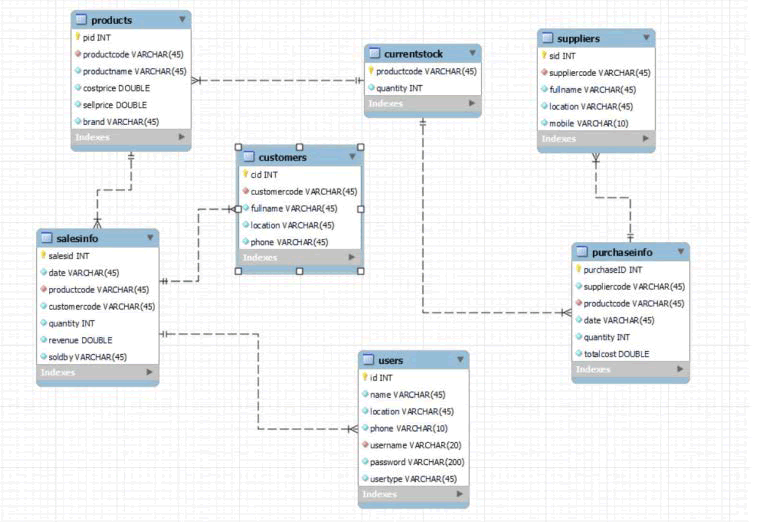
Figure 1: E-R diagram.
Implementation
Technologies used:
• Java: Provides the programming framework for backend logic and GUI elements.
• MySQL: Manages data storage, enabling efficient retrieval and storage of inventory and transaction data.
• Java Swing: Used for designing the user interface, ensuring a consistent and interactive experience for the user.
Development process: The project followed a modular approach. Key responsibilities were divided among team members to cover backend development, database design and GUI implementation. The use of role-based access control ensures data security by restricting access to specific features based on user roles.
Testing and validation: A combination of functionality testing and user testing was conducted to ensure the robustness of the system. Black-box testing verified that inputs produced the expected outputs and integration testing confirmed smooth interaction between components [5].
Discussion
The Dukan Daari inventory management system has shown significant potential in transforming inventory processes for small and medium-sized retail businesses. Through pilot testing and user feedback, the system demonstrated improvements in inventory accuracy, operational efficiency and overall business management. Below is an evaluation of the results across several key metrics, along with insights from initial user feedback [6].
Improved inventory accuracy
One of the primary objectives of Dukan Daari was to enhance inventory accuracy by automating stock management tasks. Pilot testing revealed that the system effectively minimized errors that frequently occur in manual inventory processes. By automatically updating stock levels after each transaction, Dukan Daari significantly reduced discrepancies between actual stock and recorded levels. Participating stores reported that the system helped them reduce stock discrepancies by over 30%, indicating that it contributed to more accurate inventory tracking and reduced losses associated with inventory errors [7].
Enhanced operational efficiency
Efficiency improvements were evident in how Dukan Daari streamlined common inventory tasks. By automating routine tasks, such as adding and removing stock, transaction logging and generating reports, the system helped store owners and employees save time previously spent on manual entry. With less time devoted to managing inventory records, store employees were able to focus more on customer service and other operational aspects of the business. The pilot stores noted that their time spent on inventory checks and updates was reduced by approximately 40%. This efficiency directly impacts the overall productivity of the stores, particularly during peak hours, as employees can complete transactions faster without compromising accuracy [8].
Real-time stock tracking and alerts
Dukan Daari provides real-time stock tracking, a feature that enables small businesses to avoid common issues like stockouts or overstocking. Real-time updates ensured that stock levels were always accurate, allowing businesses to quickly reorder popular items and manage inventory turnover more effectively. The system also included alerts for low-stock items, empowering business owners to act proactively and maintain optimum stock levels. Feedback from users highlighted the convenience of these alerts, as they facilitated timely decision-making, helping businesses avoid sales loss due to stock unavailability.
User satisfaction and interface usability
Usability was a crucial focus for Dukan Daari, as small businesses often lack technical resources and may find complex systems challenging to operate. To address this, Dukan Daari was designed with a simple, intuitive interface, leveraging Java Swing for a userfriendly experience. Feedback from users indicated high levels of satisfaction with the interface, citing its simplicity and ease of navigation as key benefits. Users found the system accessible, with minimal training required to understand its features. This aspect is essential for promoting technology adoption in small business environments, where ease of use directly affects willingness to implement new systems [9].
Role-based access control for security
Another critical feature of Dukan Daari is its role-based access control, which ensures that only authorized personnel can perform certain tasks within the system. This feature contributed to the system’s data security by restricting access based on user roles, helping prevent unauthorized modifications to inventory and transaction records. Administrators appreciated the added security, which allowed them to assign different access levels for employees, thereby safeguarding sensitive business information.
Limitations and areas for improvement
Despite its effectiveness, Dukan Daari has certain limitations. Currently, it operates solely on a desktop platform with a local database, which may limit scalability for businesses with multiple locations. Future versions could incorporate a cloud-based model to allow for data synchronization across locations. Additionally, developing a mobile interface would enable on-the-go inventory management, further enhancing the system’s flexibility.
Conclusion
The Dukan Daari project offers an effective and affordable solution for inventory management in small and medium-sized retail businesses, addressing key challenges that often impede operational efficiency, accuracy and growth in this sector. Developed with Java and MySQL, Dukan Daari provides a user-friendly interface and essential functionalities such as real-time stock updates, automated transaction logging, customer and supplier management and rolebased access control. This system was designed to simplify the inventory management process for small business owners who often rely on manual or outdated methods that lead to frequent errors and inefficiencies.
Key findings and impact on small businesses
Pilot testing of Dukan Daari demonstrated that the system significantly reduces the manual workload associated with inventory management. By automating tasks such as stock updates and transaction recording, Dukan Daari not only minimizes the risk of human error but also frees up time for employees to focus on other business aspects, such as customer service. The implementation of real-time tracking and low-stock alerts proved beneficial, allowing business owners to maintain optimal inventory levels and avoid the problems associated with stockouts and overstocking. These improvements in accuracy and operational efficiency directly enhance profitability, as businesses can better match stock levels with demand, reduce losses and increase customer satisfaction.
The system’s simple and intuitive interface, built using Java Swing, received positive feedback for its accessibility and ease of use. Small business owners and employees, many of whom lack extensive technical expertise, found Dukan Daari easy to navigate and operate with minimal training. This focus on usability is crucial in ensuring technology adoption within the small business sector, where overly complex systems can deter owners from implementing digital solutions. By providing a streamlined and efficient user experience, Dukan Daari effectively bridges the technology gap for small retailers, enabling them to benefit from digital inventory management without extensive training or technical support.
Another essential aspect of Dukan Daari is its role-based access control, which offers a layer of data security tailored to small businesses. Role-based access allows administrators to assign specific permissions to employees, ensuring that only authorized personnel can access sensitive data or make changes to inventory records. This feature was particularly valued by business owners, as it allowed them to maintain oversight of their inventory data while delegating certain responsibilities to employees. The added security helps protect business data, which is increasingly important as more small businesses adopt digital solutions.
Limitations and Future Directions
While Dukan Daari has demonstrated positive results, certain limitations remain that could impact its scalability and adaptability to evolving business needs. Currently, the system operates exclusively on a desktop platform and uses a local database, which may restrict usability for businesses with multiple locations or those that require remote access. To address these limitations, future development should focus on migrating the system to a cloud-based platform, allowing data synchronization across multiple devices and locations. This would make the system more versatile and adaptable to the needs of growing businesses that operate in multiple stores or locations.
Additionally, expanding Dukan Daari to include a mobile application could significantly enhance its usability by enabling onthe- go inventory management. Mobile access would allow store owners and managers to monitor inventory levels, track sales and receive low-stock alerts from any location, adding flexibility and convenience. Integration with e-commerce platforms could further expand the system’s capabilities, particularly for small businesses that operate both physical and online stores.
References
- Spillan JE, Ziemnowicz C (2003) Strategic management in small retail businesses: The case of Guatemala. Int Small Bus J 21: 461-478.
- Megicks P (2007) Levels of strategy and performance in UK small retail businesses. Manag Decis 45: 484-502.
- Ha AY, Tong S, Wang Y (2022) Channel structures of online retail platforms. Manuf Serv Oper Manag 24: 1547-1561.
- Jiang B, Zou T (2020) Consumer search and filtering on online retail platforms. J Market Res 57: 900-916.
- Ha AY, Luo H, Shang W (2022) Supplier encroachment, information sharing and channel structure in online retail platforms. Prod Oper Manag 31: 1235-1251.
- Wang D, Liu S (2023) Advertising strategy and channel structure selection on an online retail platform. Indus Manag Data Sys 123: 1359-1s400.
- Chen L, Nan G, Li M (2018) Wholesale pricing or agency pricing on online retail platforms: The effects of customer loyalty. Int J Electron Commer 22: 576-608.
- Yang S, Kim Y, Choi S (2022) How to respond to disruptive innovation in online retail platforms. J Open Innov Technol Market Comp 8: 130.
- Zhang T, Li G, Tayi GK (2023) A strategic analysis of virtual showrooms deployment in online retail platforms. Omega 117: 102824.