Spanish
  Chinese
  Russian
  German
  French
  Japanese
  Portuguese
  Hindi
Hindi Review Article, Expert Opin Environ Biol Vol: 14 Issue: 2
Heat Load and Cooling Capacity Calculation of Air Conditioning System of Rolling Stock Considering the Environmental Condition of India
Sandeep Srivastava*, Gautam Dua and Govindu Sivasankar
Department of Environmental Science, National High Speed Rail Corporation Limited, Delhi, India
*Corresponding Author: Sandeep Srivastava, Department of Environmental Science, National High Speed Rail Corporation Limited, Delhi, India, E-mail: sandeep.srivastava@nic.in
Received date: 12 September, 2024, Manuscript No. EOEB-24-147813;Editor assigned date: 16 September, 2024, PreQC No. EOEB-24-147813 (PQ);Reviewed date: 30 September, 2024, QC No. EOEB-24-147813; Revised date: 07 June, 2025, Manuscript No. EOEB-24-147813 (R); Published date:14 June, 2025, DOI: 10.4172/2325-9655.1000238.
Citation: Srivastava S, Dua G, Sivasankar G (2025) Heat Load and Cooling Capacity Calculation of Air Conditioning System of Rolling Stock Considering the Environmental Condition of India. Expert Opin Environ Biol 14:2.
Abstract
The design of the Heating Ventilation and Air Conditioning (HVAC) system has assumed significant importance in the design of rolling stock due to environmental concerns. Countries like India, which have extreme climatic temperature and humidity during summer and monsoon make designing HVAC system complicated. Proper understanding of the environmental requirements for heat load and cooling capacity calculations will help optimise the design of HVAC systems and avoid over-design that increases weight and power consumption. There are limited high speed train manufacturers who have experience in designing HVAC for varying environmental conditions. A country like India, adopting new high-speed rail, may find it challenging to make any significant changes that could affect HVAC weight and power consumption. Therefore, countries newly developing high-speed rail need to consider this aspect carefully and effectively without compromising on proven design and passenger comfort. This study aims to evaluate heat load and cooling capacity, considering factual environmental data. The study includes an examination of three major aspects of HVAC design for rolling stock and its surroundings with each aspect discussed distinctly. (a) Heat load calculation of rolling stock, (b) Determination of the cooling capacity of the system, (c) Passenger comfort criteria. Heat load and cooling capacity mainly depend on the ambient temperature, humidity, and solar radiation gained through conducting material, windows, and fresh air intake for passengers. The present paper illustrates heat load, and cooling capacity calculation in detail considering values/ formulae from ASHARE and then formulating the environmental requirements for Indian conditions by comparing passenger comfort criteria for Indian climatic conditions and cooling requirements. This will be useful for designing and calculating operating criteria for train manufacturers and users for Indian conditions.
Keywords: Ambient temperature, Humidity, Heat load, Cooling capacity, Comfort index, Refrigeration, Solar irradiance
Introduction
The HVAC system in modern rolling stock mean Heating, Ventilation and Air conditioning. The air conditioning in the system controls air temperature and humidity in summer and monsoon, and adds heat during winter in the passenger area. Whereas, ventilation is the process of refreshening the air in the passenger area by delivering in the required amount of fresh air to the passenger area and drawing out the same amount of air to achieve a healthy environment by enriching with oxygen and removing odours. A proper care shall be taken on flow rate to avoid noise and to offer a comfortable passenger area.
Passenger comfort include mainly treatment of following key air properties:
- Dry bulb temperature: Decides if cooling or heating required.
- RH (%): Decides if humidification or dehumidification required.
- Ventilation: Decides the fresh air requirement to provide the needed oxygen and removal of CO2.
- Air purity: Decides the filtration and circulation of disinfectant to keep passenger area free from dust, microbes and odour.
- Air movement: Homogeneous flow rate and distribution with noise in limit. (static air causes temperature difference of about 8-16â?? between the breath level and the ceiling level).
In the context of modern trains, where indoor comfort standards are increasingly demanding, the electricity demands for HVAC systems can contribute significantly, reaching up to 30% of the overall electricity demand [1]. The design of HVAC systems for rolling stock must not only meet evolving comfort guidelines but also focus on energy efficiency and carbon footprint reduction. Careful understanding of the environment condition, comfort and wisely arriving to a balance of both will optimise the HVAC system. In case of High-speed train where the design lies with handful manufacturers and considering running safety, energy efficiency, the weight and size increase pose difficulties in accommodating changes in any system based on proven design.
HVAC mounting on train
HVAC unit installation vary from manufacturer to manufacturer and mainly depends on various equipment distribution and weight balance. The tram, LRV, Rapid transport have different type of installation, where as it is different for loco and high speed train. Various type of HVAC mounting on rolling stock are as follows [2].
Roof mounted: In this type of mounting the HVAC unit are installed above the roof top. Mainly used in LRV and rapid transport. This type of mounting help in efficient heat exchange (Figure 1a).
Roof embedded: They are installed in the roof and embedded within the roof. This has advantage of heat exchange bringing CG down and advantage of maintaining kinematic envelop. Mainly used in LRV and rapid transport (Figure 1b).
Ceiling mounted: in this category installation of HVAC happens in between the ceiling and the roof (Figure 1c).
On floor mounted: HVAC system in this type is mounted on the floor (Figure 1d).
Under floor mounted: In this type of mounting the HVAC unit are installed below the underframe mainly adopted in high speed trains. This become a desired option when the car is generally a trailer car, whereas for EMU with the installation of other major equipment it become critical which demand longer and wider car body.
Pros: It helps in lowering the CG, in turn provide stability against body roll, pitch, and yaw motions. reduces lateral and longitudinal forces on the wheel and suspension.
Cons: The ambient temperature increases by 10 â?? to 15°C due to the proximity effect of heat released by other equipment (Figure 1e).
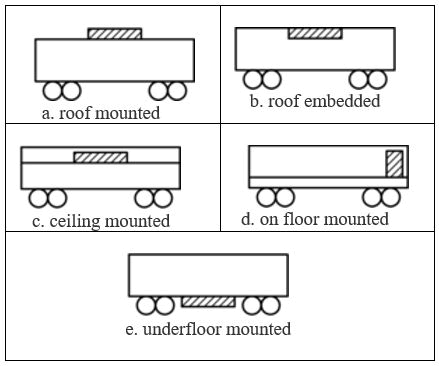
Figure 1: Diagram explaining the HVAC unit location.
LRV and rapid transport mostly uses roof mounted, roof embedded whereas high speed train prefer underfloor mounted HVAC system.
Literature Review
The most important aspect of understanding HVAC design is to understand psychrometry. It is that branch of Physics which deals with the study of moist air, i.e., dry air mixed with water vapour or humidity. Though the earth’s atmosphere is a mixture of various gases such as Nitrogen (N2), Oxygen (O2), Argon (Ar), and Carbon-Dioxide (CO2), water vapour, yet for the purpose of psychrometry, it is a mixture of dry air and water vapour only.
There are many psychrometric terms but the following are important from the HVAC design point of view [3].
Dry air: The pure dry air is a mixture of number of gases such as nitrogen, oxygen, carbon-dioxide, hydrogen, argon, neon, helium etc. where nitrogen and oxygen have the major portion. The molecular mass of dry air is taken as 28.966 g/mol, and the gas constant for air (Ro) is equal to 0.287 kJ/KgK.
Moist air: It is a mixture of dry air and water vapour. The amount of water vapour present in the air, depends upon the absolute pressure and temperature of the mixture. Moist air is lighter and less dense than dry air when measured at same temperature and pressure.
Saturated air: It is a mixture of dry air and water vapour when the air has the maximum amount of water vapour diffused into it.
Humidity: It is the mass of water vapour present in 1 kg of dry air, and expressed in terms of gm per kg of dry air. It is also known as specific humidity or humidity ratio.
Absolute humidity: It is mass of water vapour present in 1 m3 of dry air, and is generally expressed in terms of gm per cubic metre of dry air. It is also expressed in terms of grains per cubic metre of dry air. Mathematically, 1 kg of water vapour is equal to 15,430 grains.
Relative Humidity (RH): It is the ratio of actual mass of water vapour in a given volume of moist air to the mass of water vapour in the same volume of saturated air at the same temperature and pressure. The term is widely used to express the humidity content in the climate.
Dry bulb temperature: It is the air temperature measured by a thermometer, when there is no further influence of moisture present in the air. It is generally denoted by td or tdb.
Wet bulb temperature: It is the air temperature measured by the thermometer, when its bulb is surrounded by a wet cloth exposed to the air. It is generally denoted by twb.
Dew point temperature. It is the air temperature measured by a thermometer, when the moisture (water vapour) present in it begins to condense. It is usually denoted by tdp.
Sensible heat: It is that heat which when applied to a body, results in a rise of its temperature. It is the heat which is sensed by a thermometer.
Latent heat: It is that heat which when applied merely changes the state of substance, whether solid, liquid or gas, without causing any change in its temperature. Latent heat of fusion of ice 80 k.cal/kg which is 144 BTUs/lb.
Critical pressure: The critical pressure is defined as the pressure above which liquid and gas cannot coexist at any temperature. The critical temperature for a pure substance is the temperature above which the gas cannot become liquid, regardless of the applied pressure.
Psychrometric charts [4]. The state of the atmospheric air at given pressure is given by two independent intensive properties. The sizing of a typical air-conditioning system, involves numerous calculations, which is tiresome for engineer. Therefore, there is the data in the form of easily readable chart known as psychrometric charts, which is used extensively in air-conditioning applications. Heating or cooling process in the chart appear as a horizontal line if no humidification or dehumidification is involved. Any deviation from a horizontal line indicates that moisture is added or removed from the air during the process.
Impact of refrigerant on environment
The Global Warming Potential (GWP) of a refrigerant is global warming impact relative to the impact of the same quantity of carbon dioxide over a 100-year period. R410A, R407C and R134a have GWP of 2088, 1650 and 1430 respectively. R407C is widely used refrigerant for railway application [5,6].
Heat load calculation of rolling stock
Heat load calculation consists of following 5 type of heat load and is expressed as Q in (kW). Calculation methods of each heat load are discussed separately.
- Heat transfer load through car body (Qc)
- Solar Heat Gains Factor (SHGF) (Qr)
- Calculation of equipment heat load (Qe)
- Calculation of passenger heat load (Qp)
- Calculation of fresh air ventilation heat load (Qv)
The total heal load generated in the passenger area Qt is the summation of the above individual heat load.
Qt=Qc+QrQe+Qp+Qv (kW) (1)
Heat transfer load through car body (Qc): This is the thermal load induced in the system through the thermal conductivity of carbody also known as steady-state heat transfer caused by indoor/ outdoor temperature difference. Two aspects must be taken into account when calculating the transferred heat load, as it changes when the train is stationary and when it is moving at high speeds.
Heat transfer is calculated for the area shown in the Figure 2.
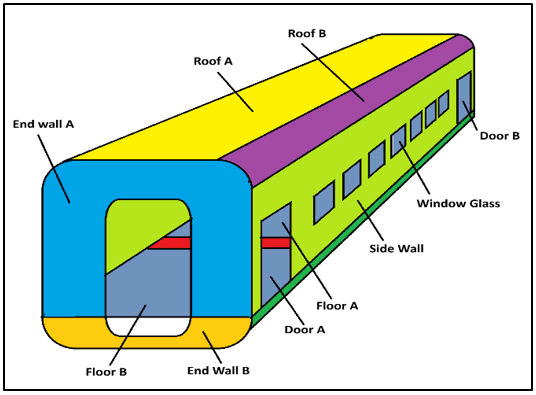
Figure 2: Car body segregation for heat transfer calculation purpose.
The high-speed train car-body are generally made of aluminium extruded section with various cross section, multi-layer thermal insulation materials, filler etc.
Insulation wall material coefficient of thermal conductivity for various material used in side wall is shown in Table 1.
| Material | c-thermal conductivity (W/m-K) |
| Superfine glass wool cotton | 0.033 |
| Glass fibre reinforced plastic | 0.3 |
| Aluminium honeycomb floor | 0.12 |
| Glass | 0.76 |
| Aluminium body | 143 |
Table 1: Wall material coefficient of thermal conductivity.
Heat transfer load through car body is calculated using below equation
Qc=Σ(k × Aw × ΔT) (2)
Where;
k: heat transfer coefficient, (W/(m2.K))
Aw: Surface Area of each part, (m2)
ΔT: Temperature difference (Outside surface temperature ‘to’ – interior temperature ‘ti’)
k=1/(Ri+Ro+ΣRc)
Where;
Ri: Heat resistance of inside air film, =0.044 m2.K/W
Ro: Heat resistance of outside air film, =0.12 m2.K/W (ASHRAE Handbook 2021, Chap.26, Table 1)
Rc: Heat resistance of each component, m2.K/W
Rc=t/c
Where; t: Thickness of material, (m)
c: Thermal conductivity, W/(m.K)
In absence of any standard value for surface temperature the calculation of surface temperature with respect to temperature rising at the sunlit and shade surface as per ASHRAE process shall be considered. The following steps are involved in the calculation of ΔT. Any other value may lead to the increase in heat load.
Surface temperature calculation involve the following three steps:
- Calculation for solar irradiance at receiving surface.
- Calculation for temperature rise by using solar irradiance at receiving surface.
- Calculation for ΔT.
Calculation for solar irradiance at receiving surface: The surface temperature depends on the angle falling on coach. For clear sky solar irradiance incident on receiving surface Equations are as described in ASHRAE Handbook 2021, Chap. 14. It has two component i.e., total clear sky irradiance at horizontal surface, represented as Et,h and total clear sky irradiance at vertical surface represented as Et,v.
Et,h=Eb,h+Ed,h+Er (3)
Et,v=Eb,v+Ed,v+Er (4)
Eb,v/h: Beam component at vertical/horizontal surface originating from solar disc, W/m2
Ed,v/h: Diffuse component at vertical/horizontal surface originating from sky dome, W/m2
Er: Ground-reflective component originating from the ground in front of receiving surface, W/m2
(a) Beam component (Eb,h and Eb,v) for New Delhi
(a.1) Clear sky Beam (Eb) for summer and monsoon is 517 and 468 (reference: ASHRAE 2021).
Considering actual vertical or tilted surface as per New Delhi position is calculated for Summer (S) and Monsoon (M).
Horizontal surface (Eb,h)
Eb,h=Eb × cos θh (5)
Where,
θh: Angle of incidence for calculation of horizontal (90-Solar altitude β),°
(a.2) Vertical or Tilted surface (Eb,v)
Eb,v=Eb×cos θt (6)
Where,
θt: Angle of incidence at vertical/tilted surface (Solar altitude β– (90-tilted angle A)),
Note: for vertical surface A is 90°
(a.3) Solar altitude, β
β=90-(90-(NL–D)) (7)
Where
NL: North Latitude of New Delhi, =28.6 °N
D: Solar declination angle, =Summer +20.1°, Monsoon -11.8° (ASHRAE Handbook 2021, Chap.14,)
Figure 3 shows the geomtrical angle of incidence for solar radiation for New Delhi during Summer and Monsoon calculated from Figure 4.
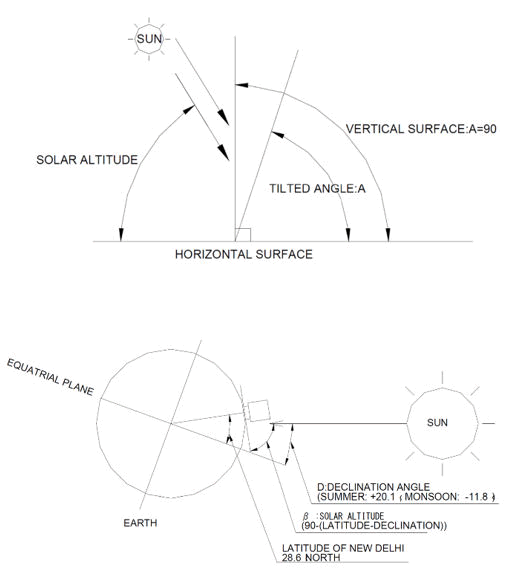
Figure 3: Various angle of solar irradiance w.r.t vertical and horizontal surface and angle of incidence for New Delhi.
- Horizontal, θh: 8.5° (S), 40.4° (M)
- Vertical, θv: 81.5° (S)
- With tilted side with angle A as 83°, θv will become: 74.5° (S), 42.6° (M)
(b) Diffuse component (Ed,h and Ed,v)
(b.1) Horizontal surface (Ed,h)
Ed,h = Ed
Where,
Ed: Clear sky diffuse
(ASHRAE Handbook 2021, Chap.14) Climatic Design Information for New Delhi
Summer: 396
Monsoon: 325
(b.2) Vertical or Tilted surface with angle A
Ed,v=Ed × (Y × sin A + cos A) (8)
Where,
Y=max (0.45, 0.55+0.437×cosβ+0.313 × cos2β (9)
(c) Reflected component (vertical or tilted surface only)
Et,r=(Eb ×sin β + Ed) ×Pg × (1-cosA)/2 (10)
Where
*Weathered concrete, ASHRAE Handbook 2021, Chap.14 (Table 2).
|
Horizontal: (W/m2)
|
Et=907
|
Ebh |
511 |
|
Edh |
396 |
||
|
Er |
0 |
||
|
Vertical: (W/m2)
|
Et=456
|
Ebv |
138 |
|
Edv |
246 |
||
|
Er |
72 |
Table 2: Calculation result for New Delhi (Summer).
(ii) Sunlit surface temperature rise (ASHRAE Hand Book 2021Chap.18).
Te = To+α/ho × Et – ε × ΔR/ho (11)
Where
To: outside temperature (ambient temperature
α: absorptance of surface for solar radiation
ho: coefficient of heat transfers by long wave radiation and convection at outer surface
W/m2.K
Et: total solar irradiance on receiving surface, W/m2
(for New Delhi Summer Horizontal 907 W/m2, Vertical 456 W.m2)
ε: hemispherical emittance of surface: 1 (horizontal and vertical)
ΔR: difference between long-wave radiation incident on surface from sky and surroundings and radiation emitted by blackbody at outdoor air temperature, W/m2
(R/ho: Horizontal surface: 4 K Vertical surface: 0 K α/ho: 0.026 of light colour surface. Ref: ASHRAE Handbook 2021, Chap.18)
With the above equation (11) for Delhi condition horizontal temperature raise is 19.6°C and vertical temperature raise is 11.8°C.
Considering ambient temperature (To) 50°C the surface temperature (Te) on horizontal surface will be 69.6°C and on vertical surface temperature will be 61.8°C.
Calculation of ΔT
The ΔT is the difference between saloon temperature and surface vertical/horizontal temperature (Te).
For the above case considering cabin temperature as 25â?? the ΔT vertical will be 36.8 °C and the ΔT horizontal will be 44.6°C.
stationary train can be considering to have condition for free or natural convection heat transfer. Whereas moving train can be equated with forced convection heat transfer of the surface temperature of car body. Heat transfer co-efficient increases with velocity of air [7,8] and thus help in reducing the surface temperature of car body.
The influence of relative air velocity can be simulated as influence relative air velocity (with respect to Train velocity) as circular boundary.
Solar Heat Gains Factor (SHGF), kW (Qr)
This heat load is solar radiation heat (beam, diffuse, reflectance) passing through glazing (ASHRAE Handbook 2021, Chap.15)
Qr=ΣQr,s + ΣQr,sh (12)
Where;
Qr,s: Solar irradiance passing through glazing of sunlit side, W/m2
Qr,sh: Solar irradiance passing through glazing of shade side, W/m2
Calculation for Qr,s and Qr,sh
Qr,s = (Qr,sb + Qr,sd+Qr,sr) × Ks ×Aws (13)
Where;
Qr,sb: Beam component of SHGF on sunlit vertical/tilted surface
Qr,sd: Diffuse component of SHGF on sunlit vertical/tilted surface
Qr,sr: Reflectance component of SHGF on sunlit vertical/tilted surface
Qr,sb =Eb,v × Cs,s (14)
Where
Cs.s: Solar Heat Gain Coefficient (SHGC) for sunlit side glazing
*If glazing is assembly type with air layer between two kinds of glazing,
Cs,s=Cs,s1 × Cs,s2
Where
Cs,s1: SHGC of outside window determined according to the kinds and angle of incident
Cs,s2…: SHGC of middle/inside window=SHGC for hemispherical diffuse
Qr,sd +Qr,sr = (Ed,v+Er)×Cs,sd (15)
Where
Cs,sd: SHGC of diffuse hemispherical
*If glazing is assembly type with air layer between two kinds of glazing,
Cs,sd = Cs,sd1 × Cs,sd2 (16)
Where
Cs,sd1: SHGC of hemispherical diffuse for outside glazing
Cs,sd2…: SHGC of hemispherical diffuse for middle/inside glazing
Ks: Coefficient of shading (=1.0)
Aw: Window area of sunlit side, m2
Qr, sh: Solar irradiance passing through glazing of shade side, W/m2
Qr,sh = Ed,v × Cs,sd × Awsh (17)
*If glazing is assembly type with air layer between two kinds of glazing,
Cs,sd=Cs,sd1 × Cs,sd2・・・・・
Where
Cs,sd1: SHGC of hemispherical diffuse for outside glazing
Cs,sd2…: SHGC of hemispherical diffuse for middle/inside glazing
Calculation of equipment heat load (Qe)
Qe =Σ(M × qf × Uf) (18)
Where;
M: Number of equipment
qf: Heat generated by equipment
Uf: Usage factor:100%
Calculation shall consider all the potential equipment include which have potential to add heat load in to the cabin such as various cabin light, door control unit, fan, control unit, blower motor etc.
Calculation of passenger heat load (Qp)
This is the heat load generated from the passenger body
Qp =Σ(N × qh) (19)
Where;
N: Number of passenger
qh: Heat load emitted from one person (W/one person)
Calculation of passenger ventilation heat Load (Qv)
Heat load for fresh air ventilation mainly depends on the passenger availability. Amount of fresh air required for passenger to be selected carefully which can be from 8 m3/hr/passenger to 15 m3/hr/passenger.
Fresh air ventilation heat load (kW)
Qv =m × Δh/0.86 (20)
Where;
m=mass flow rate of fresh air.
Δh: Difference of enthalpy, kcal/kg
m=V/v
Where;
V: Fresh Air Rate to A/C unit=fresh air intake per passenger x no of passenger. m3/hr.
v: Specific Volume, m3/kg (depends on temp and humidity)
To understand this let’s assume an inside temperature in the passenger area as 25°C and outside temperature as 45°C. The fresh air intake as 15 m3/hr/passenger for 150 passengers will result in heat load to the system 29 kW. Whereas if fresh air intake per passenger is reduced to 8 m3/hr/passenger for same condition and for 150 passengers will add up heat load of 16 kW only.
Determination of the cooling capacity of the system
To understand the cooling capacity, it becomes important to wisely select the interior heat exchange temperature of the conditioning Unit.
Even if the HVAC is having higher cooling capacity, the high ambient temperature and low humidity will not allow the cooling to utilise the equipment to its maximum as Lesser enthalpy will cause less inside heat transfer by evaporator coil.
Thus defining the requirement become more important. The cooling capacity calculation is the product of “enthalpy difference at inlet and outlet temp of interior heat exchanger(evaporator) and air volume passes through interior heat exchange equipment.
The cooling capacity, Qca on intake fresh air of the air conditioning is governed by:
Qca = m (Δh)/0.86 (21)
Where;
m=mass flow rate of fresh air.
Δh: Difference of enthalpy, kcal/kg
m=V/v
Where;
V: Fresh Air Rate to A/C unit=fresh air intake per passenger x no of passenger. M3/hr.
v: Specific Volume, m3/kg (depends on temp and humidity)
Cooling capacity calculation at given ambient temperature of 50°C for Delhi region and varying the humidity 11.6% RH (0.4% of occurrence) to 13.6% (10% of occurrence as per ASHRAE and corresponding RH for 50°C) shows significant improvement in enthalpy and hence cooling capacity. Table 3 shows the improvement in Δh with increase humidity.
| At evaporator coil | DB (°C) | RH (%) | enthalpy (h) | Δh (Kcal/kg) | |
| Ambient temp 50 RH=11.6%* | Inlet side | 29 | 43 | 56.64 | 14.7 |
| Outlet side | 19 | 66 | 41.91 | ||
| Ambient temp 50, RH=13.6%* | Inlet side | 29 | 45 | 58.82 | 16.9 |
| Outlet side | 19 | 66 | 41.91 | ||
| Note: *RH value for 50â?? is derived from Psychometric chart taking reference value of 0.4% and 10% of occurrence at 44.4â?? considering equivalent steam quantity (ASHRAE 2021). | |||||
Table 3: Cooling capacity calculation at different humidity.
Figure 4 shows the RH value at 50â?? considering the reference to ASHRAE data at 0.4% of occurrence. In a similar way RH value of 10% occurrence (40.7â??, RH 21.9%) at 50â?? is arrived and shown in Table 2.
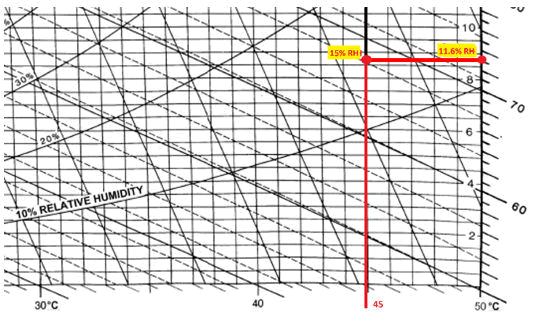
Figure 4: RH value at 50â?? on psychometric chart.
Although, the outside humidity is low the inlet side heat exchanger gets mixed with the inside air whose humidity is higher than then the outside humidity. The combine effect humidity is generally calculated using software and varies with HVAC manufacturer.
Further, ISO 19659-2 may also be considered for considering ambient temperature and humidity for calculation purpose for Indian condition which will make the heat load and cooling capacity calculation a bit relaxed.
Discussion
Passenger comfort criteria
Most people feel comfortable when the temperature of the airconditioned space is between 22â?? and 27â?? [9]. The relative humidity, play a significant role on comfort as it affects the amount of heat a body can dissipate through evaporation. Relative humidity is a measure of air’s ability to absorb more moisture. In case of high relative humidity, it slows down heat rejection from body by evaporation, and low relative humidity speeds it up. relative humidity of at a range of 40 to 60 % is preferable (ASHARE).
Comfort index: Relative humidity of air in the comfort areas:
Whatever the interior temperatures of comfort areas are, the relative humidity of the air shall be within the value in below Figure 6.
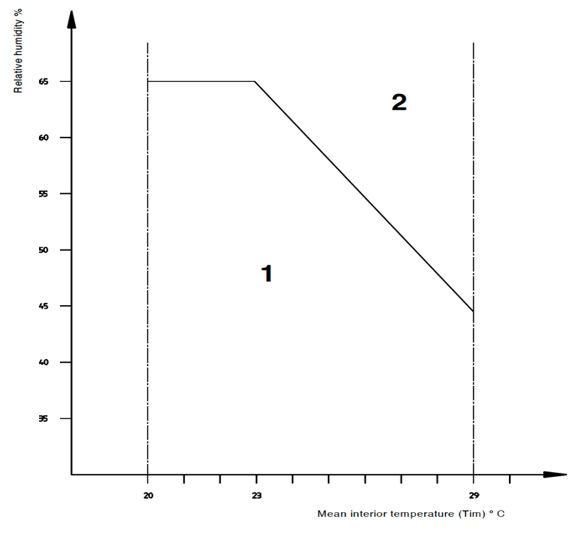
From Figure 5 the admissible comfort zone is situated in section 1, comfort criteria at different temperature and Relative Humidity are as follows
- At 25°C ≤ RH 60%
- At 26°C ≤ RH 55%
- At 28°C ≤ RH 50%
Figure 5: Relative humidity of air in the comfort areas.
Comfort criteria according to ISO 19659-2:2020: PMV (Predicted Mean Vote) and PPD (Predicted Percentage Dissatisfied) indicators are used for comfort index.
- PMV (Predicted Mean Vote): The PMV is an index that predicts the mean value of the votes of a large group of persons on the following 7-point thermal sensation scale: +3 (hot), +2 (warm), +1 (slightly warm), 0 (neutral), -1 (slightly cool), -2 (cool), -3 (cold). The PMV index is based on heat balance of the human body. Man is in thermal balance when the internal heat production in the body is equal to the loss of heat to the environment. The PMV index predicts the mean value of the thermal votes of a large group of people exposed to the same environment. But individual votes are scattered around this mean value and it is useful to predict the number of people likely to feel uncomfortably warm or cool. Regarding the permissible range of PMV, ISO 19659-2:2020 recommends -1.
- 0
In addition, since there are individual differences in how people perceive heat and cold, it shows the tendency of how many people in the group are likely to feel that way (Figure 6).
The PPD-index predicts the number of thermally dis-satisfied persons among a large group of people. The rest of the group will feel thermally neutral, slightly warm, or slightly cool. The predicted distribution of votes is given in Table 4.
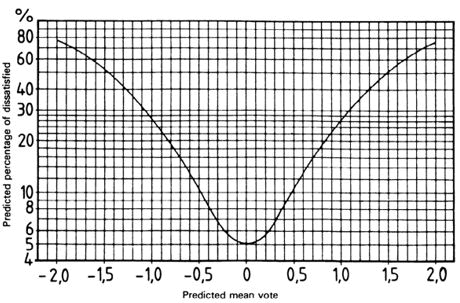
Figure 6: Predicted Percentage of Dissatisfied (PPD) as a function of Predicted Mean Vote (PMV).
Table 4 distribution of individual thermal sensation votes
| Percentage of persons predicted to vote | ||||
| PMV | PPD | 0 | -1, 0 or + 1 | -2, -1, 0, +1 or +2 |
| +2 | 75 | 5 | 25 | 70 |
| +1 | 25 | 27 | 75 | 95 |
| 0 | 5 | 55 | 95 | 100 |
| - 1 | 25 | 27 | 75 | 95 |
| - 2 | 75 | 5 | 25 | 70 |
Table 4: Shows the distribution of individual thermal sensation votes based on experiments involving 1300 subjects for different values of mean vote.
Permissible air speed: Higher circulation air is also important in case of comfort. It carries away the warm, moist air that builds up around the body and replenish it with fresh air. Continuous air circulation with regulated humidity improves heat rejection by both convection and evaporation process. Circulating air speed shall be strong enough to remove heat and moisture from the vicinity of the body, and also gentle enough to be unnoticed. Most people feel comfortable at an air-speed of about 15 m/min.
The desired air speed at various temperature as per EN13129 is shown in the Figure 7.
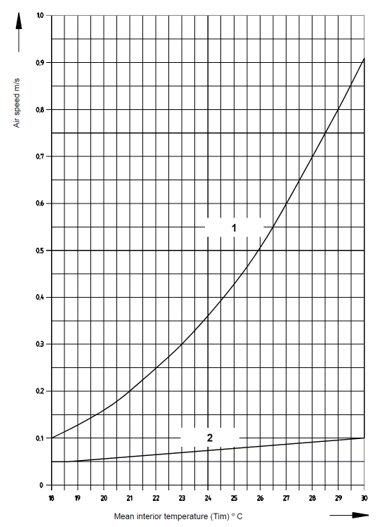
Figure 7: The permissible air speed (1 maximum, 2 minimum).
Conclusion
This paper highlights the critical role of ambient temperature, relative humidity, and solar irradiance (affected by geographic location) in determining the heat load and cooling capacity requirement of an HVAC system. The widespread discussion on various calculation procedures emphasises their significance in accurately assessing heat load and cooling capacity in diverse applications.
- Ventilation heat load depends on number of passenger and the fresh air intake. Hence the balance between fresh air and air intake is important for passenger comfort. Fresh air intake can be in between 8-15 m/hr/passenger and to be wisely considered in the calculation depending upon the number of passenger and duration of travel. For rapid transport it can be taken as the minimum requirement as the number of passenger are in large number and travel is for shorter, whereas high speed and intercity shall consider higher air flow as the number of passenger are less and travel time is more. Balancing fresh air intake with number of passenger and travel duration will lead to efficient HVAC design.
- Selection of ambient temperature, accordingly humidity as per ASHARE with 0.4% of occurrence may become more stringent due to less humidity. Considering this value and designing of HVAC will lead to overdesign and may demand in increase of HVAC unit/ weight. Since the occurrence rate is very low, the addition of humidity at given ambient temperature can be considered and calculated in conjunction with the ASHARE 10% occurrence rate and ISO19659.
- The ambient temperature internal temperature requirement and humidity considering comfort for load calculation may be referred from ASHRAE and ISO19659-2:2020 and EN13129-1-2002 Additionally, Table 2 clearly identifies the impact of humidity on cooling capacity calculations. Table 2 recommends criteria for cooling requirements for ambient temp of 50°C. This may also be used for ambient temp and relative humidity as per Figure 7. Even if the system is capable of cooling, further cooling may not be possible due to the selection of unrealistic climate conditions and may result in an over-design of the HVAC system with high energy consumption and low COP. in long time it will add up high operation cost.
- Case of Monsoon is not discussed as the summer temperature is most stringent in India for heat load and cooling capacity calculation. Though the humidity will increase the ventilation load on the other hand it will also increase cooling capacity of HVAC system.
- Careful consideration of temperature humidity and air flow rate can significantly optimise the HVAC design, and which in turn reduces the weight impact of HVAC on overall weight for high speed train.
Recommendation
Recommendation of specifications to be specified in the technical specification for HVAC design:
- Ambient temperature and related humidity conditions as per ASHRAE 2021 for Summer and Monsoon with 10% occurrence rate.
- Solar radiation values/calculation method as per ASHRAE 2021.
- Fresh air intake as per international standards such as EN 14750-1 or equivalent international standards.
- Heat gain/surface temperature raise calculations as per ASHRAE 2021.
- Passenger comfort parameters such as permissible air speed as per EN13129 or equivalent international standards and PMV (Predicted Man Vote)/ PPD (Predicted Percentage Dissatisfied) as per ISO 19659-2:2020 or equivalent international standards.
References
- Barone G, Buonomano A, Forzano C, Palombo A (2019) HVAC systems for trains, metro and tramways: dynamic simulation modelling for an energy efficient design and case study. In SDEWES 2019-14th Conference on Sustainable Development of Energy, Water and Environment Systems. HRV.
- Khurmi RS, Gupta JK (2008) A Textbook of Thermal Engineering, New Delhi.
- Yunus AC, Michael AB (2002) Thermodynamics: An Engineering Approach. McGraw-Hill.
- Pardo P, Mondot M (2018) Experimental evaluation of R410A, R407C and R134a alternative refrigerants in residential heat pumps.
- Shi S, Gao HX, Li M, Liu B (2013) Calculation of coach body heat transfer coefficient for the high-speed railway train in China. Adv Mater Res 805: 562-569.
- Langebach R, Haberstroh C (2014) Natural convection in inclined pipes-A new correlation for heat transfer estimations. In Aip conference proceedings (Vol. 1573, No. 1, pp. 1504-1511). American Institute of Physics.
- Yasuo M, Wataru N (1965) Study on forced convective heat transfer in curved pipes: (1st report, laminar region). Int J Heat Mass Transf 8: 67-82.
- Wane SS, Nagdeve MB (2012) Design of air cooling system for college auditorium. J Environ Res Dev 6: 562-568.
- Fountain M, Arens EA (1993) Air movement and thermal comfort. ASHRAE J 35: 26-30.