Spanish
  Chinese
  Russian
  German
  French
  Japanese
  Portuguese
  Hindi
Hindi Research Article, J Fashion Technol Textile Vol: 13 Issue: 1
Sustainable Fashion Need to Promote in Apparel Industry
Sukhvir Kaur1, Sparsh Manhas1 and Ranjit Singh2*
1Department of Fashion Designing, Modern Group of Colleges, Pandori Bhagat, Punjab, India
2Department of Research and Development, Modern Group of Colleges, Pandori Bhagat, Punjab, India
*Corresponding Author: Ranjit Singh
Department of Research and Development, Modern Group of Colleges, Pandori Bhagat, Punjab, India;
E-mail:ranjitsinghpunjab@yahoo.com
Received date: 07 November, 2024, Manuscript No. JFTTE-26-151988; Editor assigned date: 12 November, 2024, PreQC No. JFTTE-26-151988 (PQ); Reviewed date: 26 November, 2024, QC No. JFTTE-26-151988; Revised date: 07 March, 2025, Manuscript No. JFTTE-26-151988 (R); Published date: 14 March, 2025, DOI: 10.4172/2329-9568.1000394
Citation: Kaur S, Manhas S, Singh R (2025) Sustainable Fashion Need to Promote in Apparel Industry. J Fashion Technol Textile 13:1.
Abstract
Sustainable fashion is an initiative that combines fashion with sustainable development. The term "sustainable fashion," often known as "eco-fashion," refers to steps the fashion industry has taken to protect the rights of garment workers, respect animal welfare and reduce its detrimental effects on the environment. This essay discusses methods to make the fashion business more environmentally friendly as well as how sustainable materials affect fashion. Thirty distinct research papers have been reviewed for this review paper. The outcome demonstrates that biodegradable materials made from natural or recycled fibers are incorporated into sustainable clothing. These materials are cultivated without the use of pesticides or fertilizers, consume less energy and water and do not undergo chemical treatment, minimizing the overall carbon footprint. We cannot overlook the serious environmental issue of textile waste. In order to lessen the impact of waste clothing or the waste of natural resources utilized in the fashion business, it is imperative that the garment sector promote sustainable fashion.
Keywords: Sustainable fashion; Handcrafting; Textile; Massmarketing manufacturing
Introduction
The term "sustainable fashion," often known as "eco-fashion," refers to efforts made by the fashion industry to protect the rights of garment workers, respect animal welfare and reduce its detrimental impact on the environment. Biodegradable materials made from natural or recycled fibers are used in sustainable clothing. These materials have a smaller overall carbon footprint because they are cultivated without the use of fertilizers or pesticides, use less energy and water and are not chemically treated [1].
In fashion, "sustainability" has emerged as a key concern for longterm development and environmental impact. Being the second most ecologically destructive industry with 1.5 million tons of waste, the fashion industry discharges into landfills every year. The primary goal of sustainability is to maximize the benefits of things by prolonging their life before discarding them. Increasing waste prevention and recycling is necessary, according to research by economists and environmentalists on the technological and financial requirements for sustainability [2].
Materials and Methods
Scope of sustainability
Sustainable development has gained attention in recent years due to growing worries about the environment and climate change, poverty, growing social inequality and tensions brought on by these issues. Social and environmental sustainability has received more attention globally thanks to national and international organizations, policymakers, cross-national initiatives, practitioners and scholars.
Environmental sustainability is becoming a priority for management. It is a primary emphasis for a lot of fashion labels. It all comes down to maximizing favorable benefits while lowering negative ones [3].
Why there is a need of sustainability
Since clothing is a basic human requirement, the garment industry is one of the largest in the world. Therefore, the necessity for clothes is expanding along with the population. As this sector require big quantity of natural resources like water, soil, air etc. In 2015, 79 billion cubic meters of water, 1715 million tons of CO2 emissions and 92 million tons of trash were created globally by the T and C business. The numbers are predicted to rise by at least 50% by 2030. There is a great need to conserve water because it is used excessively in industry and agriculture. Therefore, in order to save water and other natural resources, sustainable approaches or procedures must be introduced [4].
Meeting "the requirements of the present without compromising the ability of future generations to fulfill their own needs" is the definition of sustainable development, which is frequently associated with the term sustainability. The term "Triple Bottom Line" (TBL), which focuses on a company's management of economic, environmental and social responsibilities and represents an attempt to coordinate them for a comprehensive picture of business performance, is helpful in understanding the concept of sustainability applied to businesses. Even so, TBL has given numerous businesses the groundwork to create viable business models [5].
Results
Environmental impact of textile waste
"Fulfilling the demands of existing generations without damaging future generations and their needs" is the definition of sustainability. The idea of sustainable fashion first emerged in the 1960’s when customers asked that the apparel industry improve its practices after learning about the impact it had on the environment. Waste clothing has an adverse effect on the environment since, in recent years, globalization has increased the use of modern fashion items. Between 1999 and 2009, the amount of textiles consumed in the USA alone increased by 40%. Additionally, the manufacturing and consumption of apparel and fashion produce unmanageable solid waste and deplete natural resources. According to the nation's perspective, clothing is responsible for 5-26% of household water use, up to 14% of household trash and between 7% and 10% of environmental effects. Additionally, each household produces 0.8 tons of Carbon Dioxide (CO2) annually from the purchase, use and disposal of clothing or 8000 bags of CO2. In addition, the production, distribution and use of clothing utilize excessive amounts of groundwater, soil and air, all of which contribute to additional environmental issues. Large-scale clothing production also depletes natural resources and produces solid waste that is bad for the environment (Figure 1) [6].
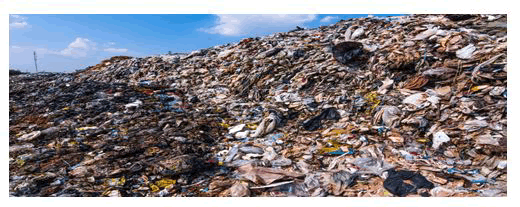
Figure 1: Household trash.
Methods to increase sustainability or to reduce wastage
There are numerous ways to create sustainable products, such as upcycling and recycling discarded or unused items. While upcycling entails turning undesired objects into more useful products, recycling refers to reusing items. While recycling is frequently a chemical reconstruction of the components to generate a whole new product, upcycling is the act of turning discarded items into a product of higher utility by minimizing waste. This can increase the product's value and lifespan [7].
Sustainable fashion can also incorporate handcrafting. In modern mass-market manufacturing, hand-made production can save energy, but it cannot be a necessary technique for sustainable production. On a symbolic level, nevertheless, it can increase admiration and loyalty to a clothing [8].
Sustainable fashion cycle
According to the theory of the fashion product lifecycle, each fashion product goes through a bell-shaped cycle of many stages, including introduction, growth, maturity and decline, each of which has a specific time period. However, eco-friendly apparel and textileslike handloom weaves-are regarded as timeless or classic. Sustainable fashion items are long-lasting and neither "get out of fashion" nor "in fashion" very often [9].
Conclusion
The wellbeing of the environment and the safety of workers in developing nations are significant concerns while making the shift to more ethical fashion.
Encouraging ethical fashion is essential to a future that is sustainable, safe and healthy. Sustainable growth and prosperity depend on valuing our artisan heritage and the environment. Unsustainable methods may be advantageous in the short term, but they will ultimately backfire. In order to ensure that the recycling process is successful, governments, organizations and individual consumers all play critical roles. There are many interesting recycling techniques and concepts in textile recycling. For an environmentally sustainable economy, it is advantageous to consider the long-term possibilities of material usage. Only when recycling is connected to the long-term goal of material conservation can the incentive for avoiding waste and pollution be fully understood. The outcome demonstrates that biodegradable materials made from natural or recycled fibers are incorporated into sustainable clothing. These materials have a smaller overall carbon footprint because they are cultivated without the use of fertilizers or pesticides, use less energy and water and are not chemically treated. We cannot overlook the serious environmental issue of textile waste. In order to lessen the impact of waste clothing or the waste of natural resources utilized in the fashion business, it is imperative that the garment sector promote sustainable fashion.
References
- Aakko M, Koskennurmi-Sivonen R (2013) Designing sustainable fashion: Possibilities and challenges. Res J Textile Apparel 17: 13-22.
- Renukappa S, Egbu C, Akintoye A, Suresh S (2013) Drivers for embedding sustainability initiatives within selected UK industrial sectors. J Int Real Estate Constr Stud 3: 51.
- Wilson JP (2015) The triple bottom line: Undertaking an economic, social, and environmental retail sustainability strategy. Int J Retail Distrib Manag 43: 432-447.
- Slaper TF, Hall TJ (2011) The triple bottom line: What is it and how does it work. Indiana Bus Rev 86: 4-8.
- Peters J, Simaens A (2020) Integrating sustainability into corporate strategy: A case study of the textile and clothing industry. Sustainability 12: 6125.
- Cuc S, Vidovic M (2014) Environmental sustainability through clothing recycling. Oper Supply Chain Manag Int J 4: 108-115.
- Jung S, Jin B (2014) A theoretical investigation of slow fashion: Sustainable future of the apparel industry. Int J Consum Stud 38: 510-519.
- Pedersen ER, Andersen KR (2015) Sustainability innovators and anchor draggers: a global expert study on sustainable fashion. J Fashion Mark Manag 19: 315-327.
- Ruppert-Stroescu M, LeHew ML, Connell KY, Armstrong CM (2015) Creativity and sustainable fashion apparel consumption: The fashion detox. Cloth Text Res J 33: 167-182.