Spanish
  Chinese
  Russian
  German
  French
  Japanese
  Portuguese
  Hindi
Hindi Research Article, J Neurosci Clin Res Vol: 15 Issue: 1
Essay on the process of creation of the psyche and its modeling
Dr. Camelet Pierre*
Received: 30-Jan-2026, Manuscript No. JNSCR-26-183595; Editor assigned: 02-Feb-2026, PreQC No. JNSCR-26-183595 (PQ); Reviewed: 16-Feb-2026, QC No. JNSCR-26-183595; Revised: 20-Feb-2026, Manuscript No JNSCR-26-183595 (R); Published: 27-Feb-2026, DOI: 10.4172/jnscr.1000479
Citation: Camelet P (2026) Essay On the Process of the Creation of the Psyche and Its Modeling. J Neurosci Clin Res 15:479
Abstract
This essay is based on a twofold intuition: the psyche is linked to the loss of instinct and it is possible to model it. After studying biology and working as an IT consultant, retirement gives me the opportunity to delve deeper into this subject that I had set aside for several decades. First, I needed to base my approach on a solid framework. Psychoanalytic psychology appeared to me as the ideal path for this. I audited the entire undergraduate and master's program in psychoanalytic psychology at Lyon 2 University. From the very first tutorials, the texts we were given appeared to me as...a process that can be modeled. I started to draw some initial diagrams. The difficulty quickly became apparent to me due to the diversity of authors. This led me to develop a unified model. I built it with the help of my teaching assistant during my undergraduate studies. I shared my ideas with her. She told me she had to deconstruct her existing knowledge to follow my lead. I thank her for her persistence. Subsequently, I continued on my own, using the methods of an IT consultant who approaches a client's business with an open mind to assist them in their transition project. I re-established regular contact with a master's level professor to validate my ideas and compare them to clinical situations.
Epistemology
Psychoanalytic psychology was created by Freud at a time when the dominant culture was literary. This culture prevailed until the mid-20th century before undergoing a scientific evolution.
Literary culture consists in observing reality to deduce the laws of nature. Scientific culture proceeds in the opposite way, by defining theoretical models and then assessing their application in reality.
This essay follows the second approach. Although an organizational approach might initially seem contradictory to psychology, the model it proposes can be used to describe real cases and communicate with the patient. This idea came to me from my university teaching assistant.
Indeed, a profound analogy exists between psychic representation and computer data. Both are based on the association of a tangible fact of reality with the meaning attributed to it, and both share the semantic processes of symbolization and memory. The individual is defined here as a system, a set of actors collaborating toward a common goal. These actors are the instances described by Freud. In this volume, the number of actors is two: the psyche and instinct.
The advantage of this approach is that it overcomes the limitations of observation. Basing knowledge on observation presents two limitations. The first is practical. The absence of a method of observation leads to areas of unknown knowledge, as is the case with the fetus. The second is the isolation of knowledge. The method can only be practiced by a qualified professional; it does not factor in the contribution of an external observer acting with an open mind.
The concepts of the essay are drawn from biology and systems theory in addition to psychoanalytic psychology.
Comparing humans with animals such as apes highlights the uniqueness of our species and defines the original function of the psyche: processing. Approaching the psyche as an information system allows us to define its emergent functions: the representation of reality, communication, and the expansion of the domain of experience.
Two graphic models of object relations are proposed. The first is conceptual, based on systems theory. The second is organizational, based on anatomy of the brain.
Creation of The Psyche
Chapter summary
The link between the psyche and the immaturity of the new-born has been addressed by Freud, Lacan, Bernard Golse and Denis-Robert DuFour who described it as a case of neoteny.
The essay follows on from their work by proposing a hypothesis that makes it possible to link neoteny and psyche.
The reasoning is conducted according to several models:
- Biology defines the evolution of the species, fatal life and neoteny,
- Ethology defines the instinct, including human instinct,
- Neurology defines the brain functions and the mirror neurons,
- Systems theory defines the conceptualization of analysis, the meta-system, reasoning by analogy, and graphical modeling,
- The information system defines intangible resources, the link with reality and emergent properties,
- Psychoanalytic psychology defines the psyche and its development.
Linking psyche to neoteny is tantamount to saying that it is absent from the fetal phase and that pregnancy is managed by instinct following the animal model.
Neoteny introduces a break in motor development. Unlike animals, human new-borns are unable to reach for objects to satisfy their needs.
He reacts by mobilizing intangible resources to merge with their mother. This is where psyche is created. The object relation is established, but to the detriment of a dependency that structures the human life cycle
The Hypothesis of Loss of Instinct
The historical of an intuition
Freud
The link between the psyche and the immaturity of the new-born is addressed by Freud in several writings.
It seems that a fourth trimester would not suffice. Louis Bolk, the Dutch biologist who described neoteny, suggests 18 months. Adolf Portmann, for his part, estimates that 21 months would be needed to place the human new-born within the norm for great apes.
Lacan
Lacan highlights the link between prematurity, the loss of contact with reality, and the role of the cortex in its temporal function of anticipation to reconstruct it.
Bernard Golse
The theme of neurological construction by the new-born and its relationship with Behavioral diversity is addressed by Bernard Golse.
Dany-Robert DuFour
The philosopher makes a connection with the duration of childhood and culture.
“In terms of neoteny, we are therefore all premature.
This specific prematurity of man results, among other consequences, in a considerable lengthening of the maternal period and in a two-stage sexual development, with a long latency period between stages.
[After the physical (Bolk) and moral (Freud) aspects, Sloterdijk insists on culture as a means of compensating for immaturity.”
Denis-Robert Dufour. What is human neoteny?
Limits of historical hypotheses
These hypotheses allow us to define the framework for the origin of the psyche.
Their limitation is that they do not offer a process through which to describe the transition from instinct to psyche.
Basis of the hypothesis of the loss of instinct
The approach
The essay further develops these hypotheses by proposing a process of transition from instinct to psyche.
The pivotal phase is the new-born. It begins in instinctual mode and ends in psychic mode.
The original function of the psyche is to replace the loss of instinctual processing due to neoteny.
Contribution of psychoanalytic psychology
The essay accords with the genetics of Freudian metapsychology by extending the life cycle of the psyche to pregnancy.
The concepts used are the psyche, object relations, new-born distress, positive illusion, fusion, weaning, transfer, representation, development, dependence, internal tensions, and identity.
Contribution of other disciplines
Biology defines the instinctual management of fatal life, the innate and the acquired. Ethology defines the functions of instinct.
Neurology defines the apoptosis of unused neural circuits, mirror neurons, and the reserve of cortical neurons available at birth.
Systems theory defines the conceptualization of the analysis (functions), the metasystem, the reasoning by analogy.
The information system defines the use of information, meaning and time and the association of the psyche and instinct.
Hypothesis of the loss of instinct
The instinctual management of pregnancy
The human species is part of the animal kingdom and therefore possesses an instinct that is innate and specific to the species.
Its role is to ensure the proper functioning of the object relationship in connection with the physical constitution of the individual and the objects in the environment.
The hypothesis that the psyche is created in the new-born allows us to infer that it does not exist in the fetus and that pregnancy is governed by instinct. This instinct ensures the physical development of the fetus.
Protopsyche is an initiatory phase of the psyche within an instinctual framework. It complements instinctual management but does not replace it.
The functions of instinct
Ethology defines the two functions of instinct: the definition of the action leading to satisfaction of a need and the definition of the process to execute it.
Defining an action involves specifying the action that must be performed to satisfy a need. It does not involve motor skills. For example, eating does not prejudice the actions necessary to prepare the food.
Processing involves defining the modalities of an action in relation to the physical constitution. It involves motor skills. For example, preparing food requires cooking.
The new-born
The new-born is the central phase of the model because it is the phase in which the psyche is created.
It begins in instinctual mode through neonatal reflexes and ends in psychic mode through fusion.
The triggering event for the psyche is the failure of neonatal reflexes. The physical distress they cause creates a life-threatening crisis for the new-born, forcing it to draw upon new resources to survive.
These resources are of two kinds: The first is personal, involving the investment of intangible resources, while the second is organizational, involving the mother's assistance.
The loss of the instinct elaboration function
Failure of neonatal reflexes is caused by the new-born’s physical inability to perform coordinated actions to reach an object.
It generates physical distress, the dramatic sensation of facing life-threatening danger with no means of avoiding it. For example, a new-born feels hungry but cannot know what to do to stop it.
The disconnect between need and perception gives rise to an absurd quality of strangeness. New-born is not welcomed into the world. It feels the need without being able to make sense it reality. In turn, it perceives environmental stimuli without being able to understand them.
The consequence of the lack of motor skills is the loss of the processing function of the instinct according to the neurological rule that a Behavior is based on a neural circuit and is lost if the circuit disappears.
Conversely, defining an action, which is not concerned by motor skills, remains instinctual. The term used in this essay is residual instinct. What remains of instinct when the elaboration function has gone?
Restoration of the object relationship through fusion
Restore the object relationship involves two types of actions. The first is to mobilize new resources while the second is to seek assistance from the mother. Together, they constitute fusion.
The new resources are personal elaboration functions, transmitted, identity, and consciousness. They are underutilized in instinct and can be mobilized without external intervention. The reason for which they are not used with instinct is they are not necessary to define Behavior in basic situations. For example, instinct suffices for animal life.
Cortical neurons support the functions of personal development. At birth, these neurons are poorly connected to each other and to the limbic brain. They represent the potential for creating new neural circuits to associate, in the representation, the action to be performed and the need for assistance.
The mother's role is to shift the elaboration function onto a third party. The mother perceives the representation of the action to execute, proceed it, accesses the object, and presents the breast to the new-born to secure and nourish it. Subsequently, she transmits to the new-born her satisfaction with caring for it. This transmission is used by the new-born to reinforce the satisfaction of its need. This is the positive illusion (Roussillon). The new-born has the illusion he is capable to reinforce the satisfaction of its need by its own abilities. The positive is that this process is the basis of the capacity to live despite the narcissistic wound of the loss of instinct.
The support for maternal assistance is provided by her mirror neurons and her instinct of taking care of one’s offspring. Mirror neurons allow the mother's Behavior to be synchronized with that of the new-born. The exchange process is transmission. The new-born transmits the representation of the action to be proceeded and executed to its mother. The mother realizes the action and transmits back the representation of her satisfaction with taking care of it. The return flow is used by the new-born to reinforce the satisfaction of its need.
These exchanges make it possible to re-establish the object relationship, this time in psychic mode. The psychic mode is defined using mother’s psyche to proceed with the action and intangible communication of representations.
Fusion helps put an end to distress. The downside is to put the new-born in a situation of dependency.
Essay terminology
Individual: a living being, human or animal of the great ape type.
Object relationship: process of satisfying a need. The object is an inert thing or another individual.
Living things: the entirety of individuals presents on Earth. The term is synonymous with nature. Living things stipulate that individuals must satisfy their needs by their own means (independence required).
Fusion, shoring: parental assistance, where the parent makes their psychic functions available to enable the child to develop object relationships. It is a violation of the independence required for living things and generates strong unconscious tensions.
Instinct: innate and stereotyped Behavior, specific to the species. In humans, it manages pregnancy. Fetal protopsyche is an addition to instinct, it doesn’t change pregnancy instinctive management.
Residual instinct: what remains of instinct after the loss of processing function, the definition of the action to be carried out to satisfy the need.
Psyche: acquired Behavior, specific to humans. Its construction involves a developmental process that requires a third party.
Entity: internal structure of the psyche. An entity is defined by its function in psychic processes. Equivalent to a Freudian instance.
Life project: psychic entity comprising all the structuring choices of the individual.
Memory: a collection of memories. Dynamization is the personal organization of memory through judgment criteria.
Instinct, The Prerequisite of the Psyche
Instinct
Instinct is the set of innate behaviours that allow an individual to satisfy his vital needs.
It is defined at species level. All species possess it, including humans. It is created by evolution of the species.
It defines the methods of satisfying the individual's needs. It adapts to the physical constitution of the species and the resources of the environment.
It generates automatic Behavior. The individual does not need to pay attention to it.
The instinct system
Instinct is a physical system. It is based on tangible biological components such as DNA, sensory and motor organs, and the nervous and hormonal systems.
DNA defines an individual's physical makeup. Physical makeup determines the possibilities for interaction with the environment. For example, if an animal has claws, it is a hunter.
It allows the individual to realize the totality of the object relationship by its own capacities. Therefor it satisfies the required of independence.
It manages the entire life cycle of the animal on its own. In humans, it manages both gestation and birth and collaborates with the psyche after its creation in the new-born.
It represents an economic optimum for the species. Its efficiency is such that personal factors influencing Behavior, education, experience, and consciousness play only a secondary role and can be ignored initially. This makes it the benchmark for living things.
The functions of instinct
The functions of instinct are defined by the ethologist Konrad Lorenz.
“Within this "functional unit" [instinct], Lorenz distinguishes two different physiological mechanisms. First, an "innate triggering mechanism" that gives the animal an "innate knowledge" of the biologically appropriate environmental situation in which to use of the Behavior in question. Second, a phylogenetically programmed "hereditary motor coordination" which, once set in motion by the triggering mechanism, masters this situation through innate knowledge (Lorenz, 1984, p. 198).”
Jean-Pierre Sylvestre. Man and animal, the question of boundaries 2009. Chapter 7 - Humanity and animosity in humanist thought.
The innate triggering mechanism defines the action required to satisfy a need. Each need corresponds to a specific action. This action is automatically activated when the need arises.
The hereditary motor coordination refers to the development and definition of the motor and cognitive means to be implemented to perform an action. Instinct allows the action to be performed automatically, without the need for a period of reflection.
The instinctual object relationship of the fetus
Instinctual object relationship is an object relationship that is based on instinct in the absence of psyche.
This is the object relationship of the fatal phase. It is defined on the model of animal pregnancy.
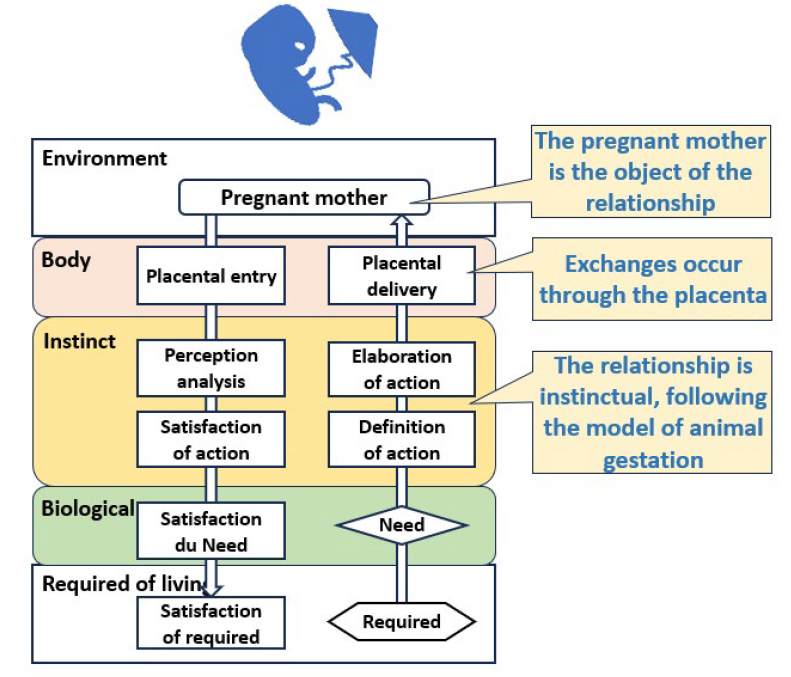
Instinct determines the action and its processing. The object of this action is the pregnant mother. The fetus exchanges with her via the placenta. The action performed is transmitted in hormonal form. In return, the fetus receives the nutrients necessary for its physical growth and the hormones that ensure its safety.
Fetal protopsyche is an external addition to instinct, it doesn’t change pregnancy instinctive management.
Fatal protopsyche
Protopsyche
Protopsyche is an intermediate stage between instinct and the psyche.
It involves the initialization of the psyche in the fetus. It complements instinct without challenging it. The fatal phase is fundamentally a biological process. Instinct ensures its proper development, independent of the mother’s intention.
The pregnant mother is a psychic being. She continuously communicates psychically with the fetus. In the last weeks, when the fatal brain can pick up these messages through mirror neurons, she initiates the fetus into the psychic life it will experience later.
In the essay, this initiation includes creating a communication channel and the proto psychic object relation.
The communication channel
A communication channel is defined as a shared semantic framework between interlocutors to give meaning to the messages exchanged.
In the essay, the function is transmission. Its neurologic support is mirror neurons. In the analytical model, the entity is the transmitted. It is created in the last weeks of gestation.
It is used by the exchange of representations between the fetus and the mother of the proto- psychic relationship.
The protopsychic relationship
The protopsychic relationship is an instinctual relationship augmented by the psyche.
The foundation lies in the instinctual relationship of the fetus in the first months. The fetus defines and develops the action to be performed through its instinct, then directs it to the pregnant mother via the placenta. It analyses the return flow again through its instinct and satisfies its need. Since the relationship is carried out by the fetus, it fulfils its required for independence.
The complement of the protopsychic process consists, for the fetus, in perceiving the representation of maternal satisfaction in caring for its gestation and using it to reinforce its own satisfaction of need.
The positive illusion rests on the foetus’s appropriation of this representation. It is because it believes itself to be the source of this representation that it does not feel dependent on its mother. This develops in it a sense of empowerment that initiates its proto-identity and allows
it to satisfy its need for independence.
The psychic flows of receiving the representation, reinforcing need satisfaction, and constituting proto-identity constitute a first psychic experience. The memory traces that compose it will later serve as the basis for the creation of the psyche by the new-born when it must replace the loss of the elaboration function of instinct.
From Instinct to Psyche
Neoteny
Animal neoteny
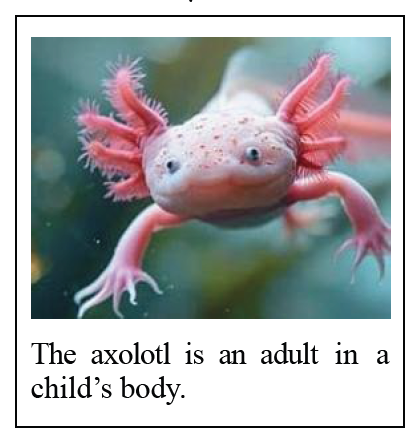
Neoteny is a biological peculiarity, whereby physical development is interrupted while the life cycle continues.
It leads to the retention of juvenile characteristics in adulthood.
It has been observed in the axolotl, a marine amphibian with a physical constitution that is larval but which is nevertheless capable of reproducing. The axolotl is an adult in a child's body.
In the case of the axolotl, neoteny is linked to a deficiency of the thyroid function. This deficiency is not lethal, it can be corrected by natural circumstances or by chemical stimulation, allowing the animal to reach an adult stage comparable to that of a salamander
Human neoteny
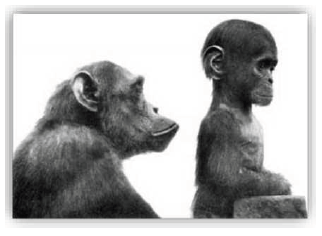
Humans have morphological characteristics similar to those of young chimpanzees: the vertical stature of the head, flatness of the face, size of the brain.
The specificity of human neoteny compared to that of the axolotl is related to the difference in reproductive methods between amphibians and mammals.
The equivalent of the fetus in amphibians is the tadpole. The tadpole has a physical existence involving movement and interaction with a diverse environment. This allows it to mature its instinctive Behavior.
The equivalent of birth is the tadpole's metamorphosis. The experience it acquired at the tadpole stage is directly usable by the mature organism. Mammalian reproduction differs from that of amphibians due to gestation. Fatal development involves neither mobility nor environmental diversity. The consequence is a defect in the maturation of instinct compared to that of the amphibian. Maturation can only occur after birth.
In mammals, in the absence of neoteny, the maturation of instinct appears at birth. The new-born’s first act is to get on its feet and move toward its mother. With instinct and motor skills, the individual then has what is needed to establish object relations and satisfy its needs. The required for independence is naturally met.
In humans, neoteny means that the new-born is physically incapable of any voluntary movement. The short-term consequence is the inability to satisfy needs, which manifests as physical distress (Freud). In the long term, instinct cannot mature and provide a fall back solution in case of psychic deficiency, which is reflected in certain somatic pathologies.
Loss of instinct
The failure of neonatal reflexes
Birth occurs instinctively according to the model of placental animals. The new-born tries to perform the movements that will allow its instinct to mature. These are the neonatal reflexes: grasping, walking, swimming, clinging, grasping
(Babinski), orientation towards touch, protection (Moro). These movements are described as minimal gestures because they are hindered by physical immaturity.
The motor deficit leads to the loss of the function that drives it, elaboration. This loss is permanent. Neurology explains that a nerve circuit that is unused disappears spontaneously through apoptosis and that the loss is irreversible.
The loss of instinct is only partial. The definition of the action is not affected because it is not directly linked to motor function. The term of the experiment is residual instinct, what remains of instinct after the loss of elaboration.
Transition to the psyche
The investment of personal functions
An animal rarely calls on personal factors in its Behavior for an economic reason: instinct naturally provides a Behavioral solution for all vital needs. The animal is satisfied with this.
Humans are in a different situation. They must absolutely re-establish their capacity for processing to survive. Personal Behavioral factors constitute a readily available potential. To harness this potential, they must invest heavily in it.
Personal factors are transmitted, identity, and consciousness. The new-born has already experienced two of these factors during protopsyche in the last weeks of pregnancy: transmitted to create the channel of communication and identity with positive illusion.
The mother's assistance
For a new-born, the first step is to get someone else to do what they cannot do themselves. The mother is the obvious choice for this.
The flow is of the transfer type. The new-born defines the required, the action to be performed, and the expected result: the satisfaction of the need. He asks his mother to perform the intermediate operations on his behalf, which are the processing and access to the object.
The mother is herself guided by an instinct to care for the new-born. This instinct is not specific to humans; it exists in all mammals. It takes on a particular meaning in humans because, unlike animals that simply respond to the physical required of their youth, the human mother responds to its intangible psychic messages (Winnicott's Primary Maternal Preoccupation).
Short term of fusion
The communication channel
The relationship between a new-born and its mother involves intangible communication.
New-borns do not yet have speech. They must base their interactions on the precursor to speech, which was representation. The communication channel is the shared semantic framework with the mother, a framework that allows them to define the meaning of the representations exchanged.
The fusion exchanges
The first flow is the transmission by the new-born of the representation of the operation he wants his mother to perform.
The mother deciphers the message, performs the expected actions and presents the object to the new-born who receives it.
The second flow is the transmission by the new-born of the representation of perception to its mother so that she can assign meaning to it.
The mother performs the expected operation and returns the meaningful representation to the new-born, who uses it to reinforce the satisfaction of his need.
Need satisfaction reinforcement is described by Rene Roussillon as positive illusion. The illusion describes the new-born’s feeling of being able to create a psychic flow independently (even though the flow originates from the mother), while the adjective "positive" describes the creation (in the fetus) and reinforcement (in the new-born) of its identity, which will serve it later.
The fusion exchanges allow the object relation to be re-established and the new-born’s need to be satisfied.
Long term of development
Dependency
Delegating to someone else functions that one should perform oneself generates dependency.
The new-born cannot avoid it because the creation of the psyche involves the support of a third party who provides the psychic functions that he cannot manage on his own. In doing so, he loses control of his life, as will later be shown by weaning.
In the essay, the required of independence refers to the necessity for the individual to carry out all the operations of the object relationship by their own means. It is fulfilled in two cases: in the fetus through instinct, and in the adult through the combination of the psyche and the residual instinct. Conversely, it is only partially fulfilled during childhood, during which the child needs the parent's assistance.
Failure to meet this required generates strong unconscious tensions, the function of which is to encourage the individual to return to the framework of independence inherent in life.
Construction of Psyche
The information system
An information system is a set of intangible functions that compensate for the deficiencies of an underlying tangible system or increase its potential.
This definition applies to the psyche.
The underlying tangible system is instinct, what is lacking is the processing function. The original function of the psyche is processing to compensate for the lack of instinct.
Emergent functions are those that arise from the processing, the representation of reality, communication and the life project. They enhance the individual's potential.
Intangible resources
Information
Information is the result of the symbolization of reality. The internal object is a representation of the reality object, of its own characteristics that distinguish it from other objects and from the functions through which it intervenes.
The object is constituted by perception. It is reworked when new relations confirm it, modify it and associate new properties and functions with it.
It is also reworked by internal processes that align memory with structuring life choices made during a crisis. For example, the "never again" that follows an awareness leads to the modification of memories relative to the situation that generated the crisis to prevent its recurrence.
Meaning
Meaning is the result of applying a structuring rule of life to information to give it an operational character.
Meaning is given by the individual to allow them to situate their existence in reality. Meaning provides the capacity to interact with reality and defines the individual as a legitimate actor in the world around them.
Time
The psyche brings the human being into time. The past with the importance of lived experience, the present of awareness of processing, the future of structuring life choices.
Time as a resource allows us to simulate an action before carrying it out, to delay the expression, to suspend the relationship to give ourselves the means to succeed, to prioritize the long term to smooth out the effort.
The original function of psyche
Elaboration
Elaboration is the function for which the psyche is created.
Its function is defined by the instinctual elaboration it replaces, the definition of the modes of action, and the analysis of perception.
The objective is the same. Means are different.
During development, processing is facilitated first by the mother (fusion) and then by the parent (shoring). The role of the child is to communicate the action to be performed to the parent so that they can carry it out on their behalf.
During fusion, the resources mobilized for the exchange of representations are information and meaning. Time does not come into play because the mother’s breast is considered an organ that is always available, like the placenta.
It is weaning that introduces time. The mother and later the parent are not permanently
available. The infant, and later the child, must develop autonomy to reduce dependency. Psychic transformation consists in reinforcing identity through an analysis of perception in the infant and access to the object in the child.
The final stage of development involves adolescent becoming independent of parental care. Identity development continues by internalizing chosen values of the parent and validating the set of personal values through experience.
Adult can then carry out processing by their own means and thus return to the living organism’s required of independence.
Emergent functions of psyche
The life project
The life project is the concept that in this essay brings structuring life choices together.
It is created in the context of crisis with the aim of preventing a return of the situation that created it.
It involves processing daily to provide a general orientation to relationships. To maintain its efficiency over time, it must not be altered by day-to-day life.
The unconscious has a masking function that allows the life project to play a role in processing without being altered by the attribution of meaning returned by the object. It is activated in crisis situations to enable the project to be modified.
Communication
Communication is the use of intangible resources in exchanges, for example, speech, writing.
Speech is a precursor to action. It has the same meaning as action while allowing us to reduce its material constraints. It is a medium for exchange.
Psychic representation is a precursor to speech. It has the same meaning as the latter, while allowing us to do without processing and expression. The absence of processing limits its precision; the representation must be interpreted by the receiving party.
The communication of representations is the primary function of fusion and transfer.
Identity
Identity is the definition of the unique, original character of an individual, a personality
independent of external circumstances.
Identity is initiated in the fetus during the last weeks by the positive illusion in which the fetus appropriates the action of the pregnant mother.
It is created all through life by means of the appropriation of experience.
Extension of the domain of experience
Using intangible resources makes it possible to define action modalities that are free from the constraints of reality.
The approach is that of a tool. It distinguishes between the functions of command and action, where command is an immaterial process, based on knowledge and decision-making while action is a material process, based on the modification of reality.
The Human Model
Psychic structure
Life project, transmitted, identity, consciousness
Psychic entities are derived from the functions of the psyche.
A life project defines the major guidelines of processing. It is created during crisis situations, the loss of the function of proceeding instinct, weaning, the Oedipus complex, adolescence.
The unconscious is a mask that allows us to protect the life project in situations of calm (the project is then read-only). It is taken off in crisis situations to update the project.
What is transmitted is created through the integration of external influences related to the creation of the psyche (including the protopsyche). It cannot be modified by the individual (it is read-only).
Identity is created through relationships initiated by the individual throughout their life, including their protopsychic stage. It can be modified by the individual to align it with their life project and give internal coherence to their psyche.
Consciousness is created by external perceptions and can also be modified by the individual to give the psyche internal coherence.
The unconsciousness
The unconscious acts as a masking mechanism, to protect the life project in situations of calm (the project is then read-only). The mask is taken off in crisis situations to reveal the life project.
The required of the psyche
The information system has its own meta-system.
By analogy with the required of living things, the required of the psyche are constraints that the same psyche imposes on the individual.
These are the representation of reality, consistency with instinct, the personal value reference system, the social reference system (sharing symbols with those around you), and psychic energy.
They define a second objective of the object relation, in addition to the required of living things.
They are integrated into the life project.
Psychic memory
The memory functions
The function of memory is to retain content regardless of the passage of time.
Psychic memory is the internal reference point for an individual's originality.
Records
A record is the memory of a recollection.
Its creation process depends on the entity. The memory of transmitted is fed by a third party, while those of the life project, identity, and consciousness are fed by intentional relationships of the individual.
The data recorded depends on the individual's maturity. In foetuses, new-borns, and infants, memories are emotional, while in children, adolescents, and adults, they are structured by speech.
Emotional memories are meant to be verbalized later to facilitate elaboration.
Distress comes from the impossibility of defining a Behavior on account of an absence of records corresponding to the situation.
Memory Dynamization
Dynamization consists in structuring memories according to personal criteria with the aim of generalizing their reuse in situations that present analogies with the initial situation in which they were created.
Criteria evolve continuously. Individuals define and redefine them throughout their lives as they become aware of the importance of a fact that was previously minimized or ignored. This fact then becomes a judgment criterion, leading to a reorganization of historical memories.
Dynamization is an energy-intensive process. It leads the individual to adopt a position of internalization, to momentarily suspend relationships with those around them.
Example: the depressive position (Klein)
In the depressive position, Melanie Klein describes the reorganization of an infant's memory during weaning. The mother's absence initially generates an aggressive reaction linked to the infant's disappointment (the schizoid-paranoid position). This is followed by a depressive phase that the infant emerges from with a reinforced sense of identity. This process can be modelled by dynamiting memory.
The initial situation is the fusion of the new-born with the mother. The new-born’s understanding of the world is that the mother is constantly available to meet all its needs.
The corresponding memory consists of a single record: for every need, call upon the mother’s breast and rely on the mother to define the modalities of interaction with reality.
During weaning, the infant is confronted with the absence of the mother. The single record does not allow us to define the infant's Behavior when face to face with this absence. The infant senses impending distress. After a while, the mother's return reassures him.
He reacts by defining a criterion of mother presence/absence. He can wait in case of absence and ensure that she is psychically available when she is present.
Clarifying the situation gives him a sense of control over his life, which fills him with an intense feeling of containment and integration into reality.
Example: adolescence
Adolescence is the phase during which the individual separates from their support system and becomes autonomous.
Initially, it incorporates chosen criteria from the parent to appropriate their judgment. Later, he uses these criteria in new relationships that update his childhood memories.
The presence of parental criteria in the individual's psyche allows the individual to do without the parent's presence.
Example: mourning
Mourning is the process by which an individual accepts the absence of the deceased. The process is analogous to that of adolescence.
Initially, it incorporates chosen criteria from the deceased to appropriate his judgment. Later, he uses these criteria through new relationships that update his own memories.
The presence of the deceased's characteristics in the individual's psyche makes the absence tolerable.
Association of the psyche with instinct
The dialectic between psyche and instinct
Instinct is the foundation upon which the individual creates their psyche. Initially, the effort to ensure coherence between the two lies with the psyche, as only the psyche can demonstrate adaptability.
The role of the life project is to translate the needs of instinct into psychological objectives while considering the specific constraints of the psyche.
The Three Sequences of Human Life
The combination of the psyche and instinct defines three sequences of human life.
The first is fatal life. It is governed solely by instinct. Protopsyche is an addition to the instinctual object relationship. It does not change its nature.
The second is childhood. It is governed by the combination of the psyche and the individual's residual instinct under the control of the parental psyche.
The third is adolescence and adulthood. It is governed by the combination of the psyche and the individual's residual instinct.
By comparison, an animal's existence includes only a single sequence that covers the entire life of the individual.
Meeting the required
Meeting the required of the living
The required of living beings are existence of the individual, independence in interaction with the environment and reproduction.
In the context of the essay, the focus is on independence because it highlights the
tensions related to the creation of the psyche. Dependence on the mother and later the parent means that the child is not in control of their life. They must rely on a third party, whom they do not control, to ensure their existence. This results in strong unconscious tensions.
The peak of these tensions is the distress of the new-born. The physical inability to establish object relationships reveals a deeper required: the existence of the individual. The physical inability to satisfy their needs puts the very existence of the new-born at stake.
The profound crisis associated with the loss of neonatal reflexes leads to the new-born’s intense involvement in creating their psyche.
Conversely, instinct naturally satisfies the required of existence and independence. This applies to fetal life. The absence of tension allows for harmonious growth of the fetus.
Meeting the psychic required
The creation of the psyche implies for the individual the required to ensure its proper
functioning. He must define an efficient representation of reality, link the materiality of instinct with the immateriality of the psyche, develop his personal abilities, build a life plan, evolve his judgment at each developmental transition, and become autonomous.
These required can only be met by the mature psyche of an adult. This makes all of childhood a complex sequence involving ceaseless work marked by dependence. Hence the emphasis in the essay on the required for independence.
The hypothesis of the essay is that the dissatisfaction of the required for independence is the origin of infantile sexuality. The child associates the end of tensions with the
sexual maturity of the adult. This turns sexuality into a totem that encourages him to sexualize his Behavior to relieve tensions. The peak is Oedipus during which he adopts adult Behavior at the expense of his own balance.
Similarly, adult sexuality is overvalued by a mechanism of positive illusion. The illusion is that the individual feels responsible for ending their dependence, whereas it is due to the completion of developmental processes. The positive aspect is the reinforcement of identity, which allows the individual to face the uncertainties of reality.
Adult sexuality, however, encounters the required for independence. The endurance of the human couple over time, necessary for supporting the child, is ensured by the
elimination of the animal periodicity of mating.
A particular case is proto-psychism. In the essay, it is described as an instinctual relationship enhanced by the maternal psyche. This can be disquietude.
Graphic Modeling
Chapter Summary
Graphic Design
The basic model of systems theory
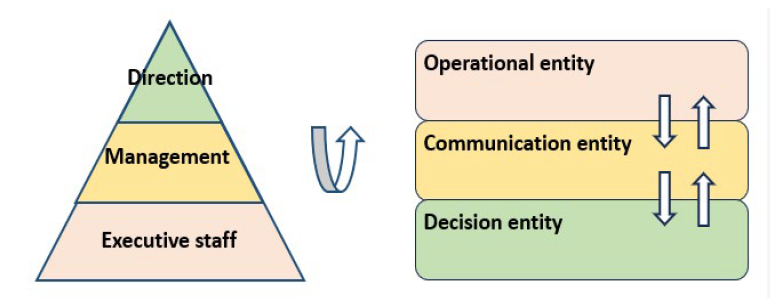
The basic model of systems theory is derived from the pyramid model of a business enterprise.
The system consists of three entities: The decision entity defines the objective; the communication entity defines the action to be taken to achieve the objective and evaluates its result; the operational entity carries out the action.
An entity can be broken down into sub-entities according to the needs of the analysis. The entities of the psyche are the life project, the inherited, identity, consciousness, and the unconscious.
Models of the essay
The analytical model
The analytical model is based on the systems theory model.
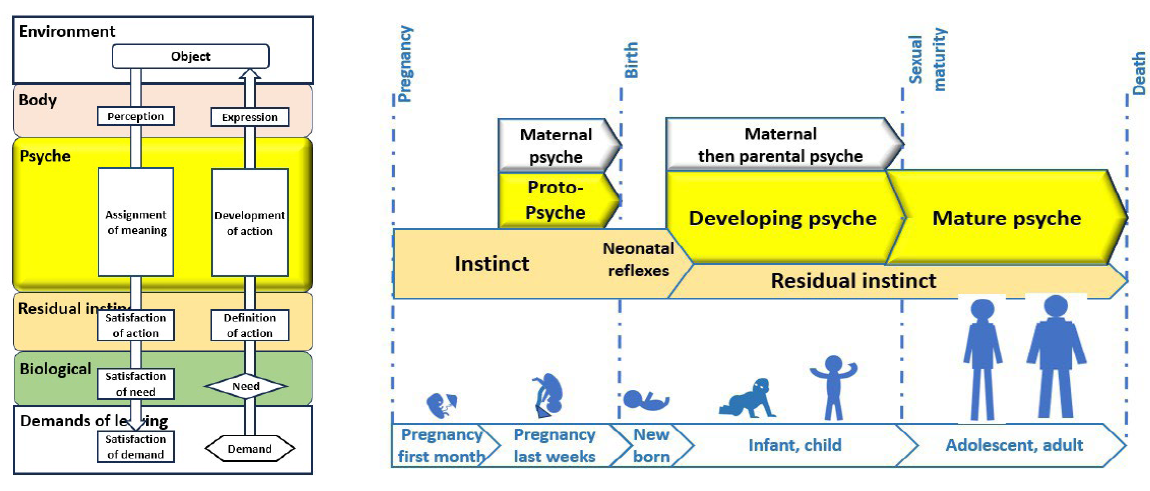
The life cycle diagram illustrates the association of instinct and psyche throughout the individual's existence.
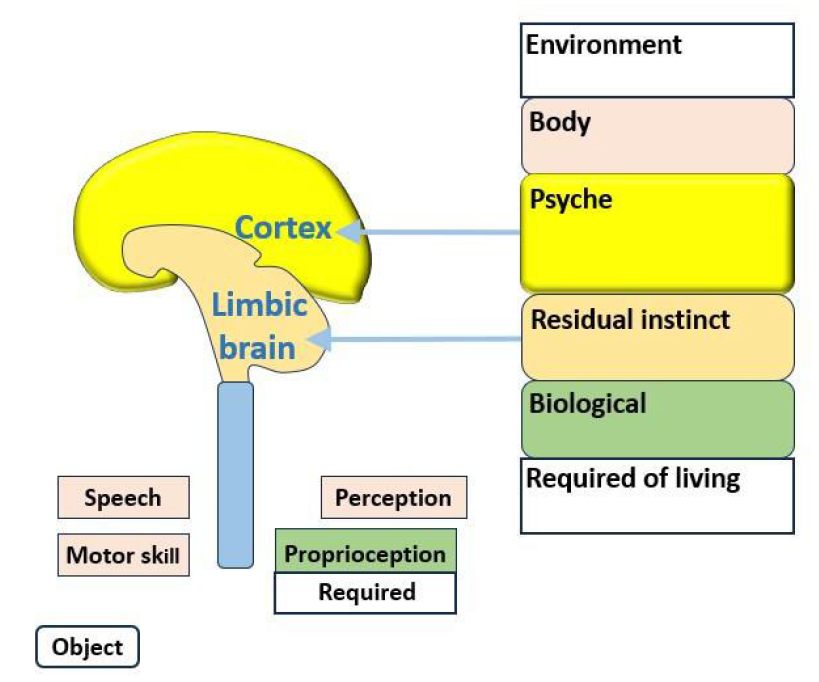
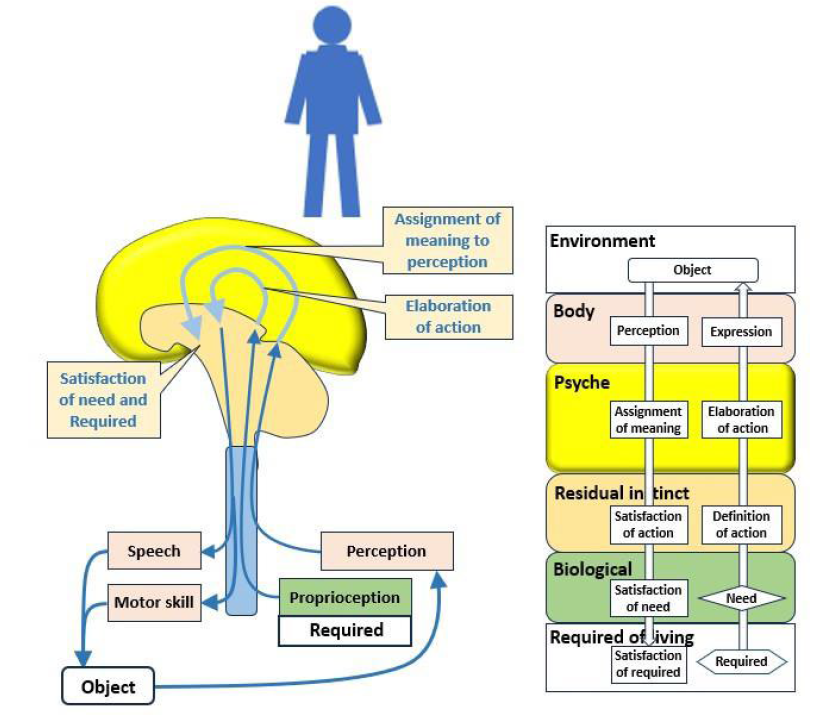
The neurological model
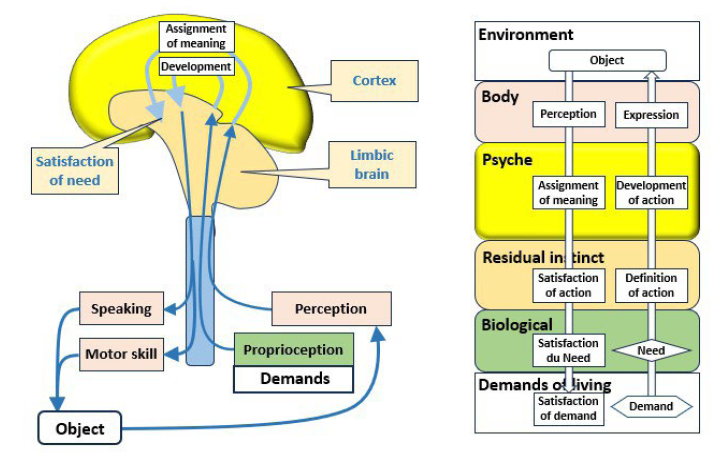
The neurological model is based on modeling instinct as represented by the limbic area of the brain and the psyche as represented by the cortex. The analytical model is presented alongside it for easier understanding.
Analytic Model
Chapter Summary
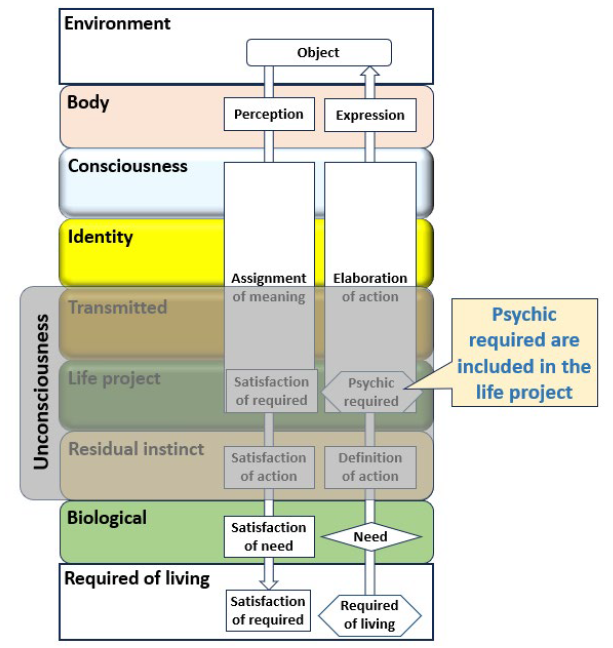
The model is based on the conceptualization of interactions.
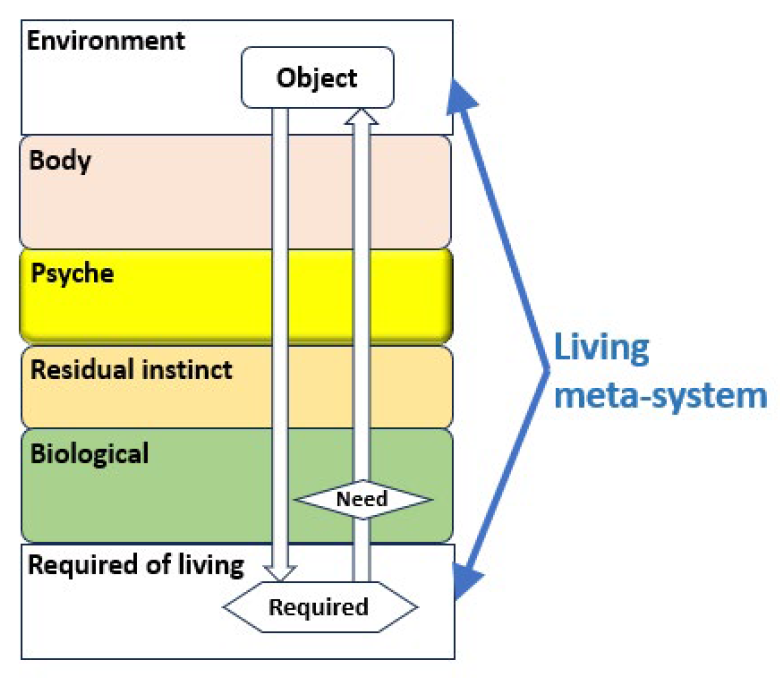
The entities in the model represent the internal actors of the human system. The body is represented by two entities: the body as the support for the sensorimotor
organs in contact with the object, and the biological entity that manages the need.
In central position, instinct and the psyche ensure the link between the need and the interaction with the object.
The requirements of living things include independence of the individual. Their non-satisfaction, even partial, represents the dependence of the child.
The process is the object relation.
The life cycle model describes the evolution of the structure over its lifetime.
The individual
Position in life
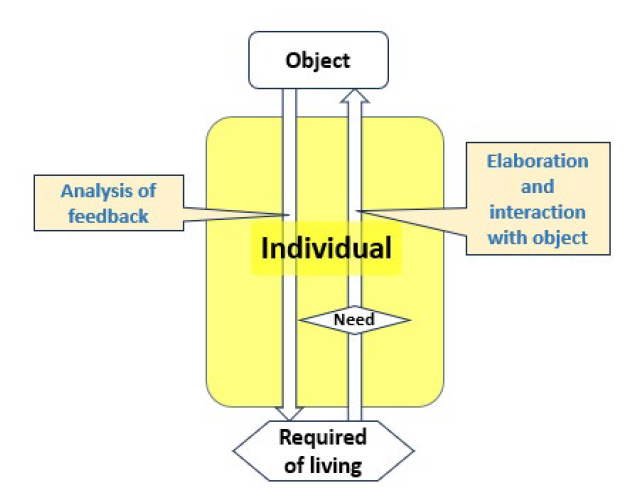
The individual is situated between the required of living and the object of the environment.
Body modeling
Conceptualization of the object relationship leads to a separation of bodily functions between physiology and interaction with the object.
The systemic study of the psyche involves modeling the body as two entities.
- In the background, the biological entity manages the need.
- In the foreground, the body manages the interaction with the reality through the sensorimotor organs
The psyche links the two by defining the ways in which the individual interacts with reality.
The object relationship is modelled by simple flows. The upward flow is the Freudian drive.
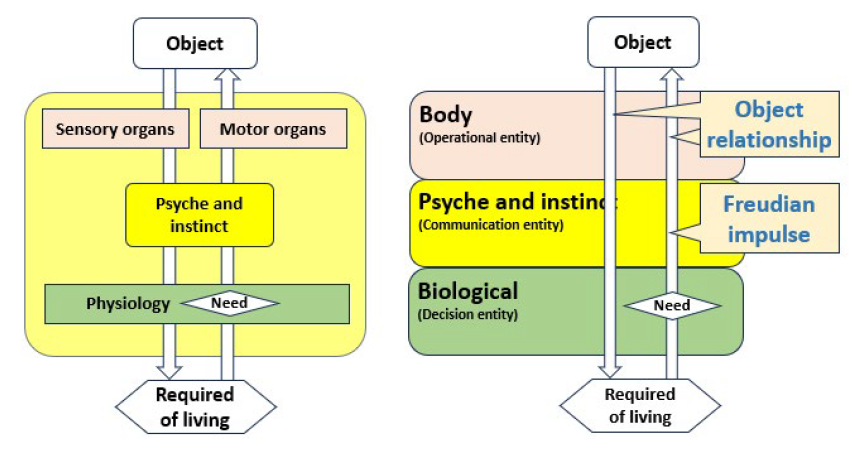
Association of the psyche and instinct
The psyche collaborates with instinct to ensure the functions of the communication entity (elaboration, exchanges).
Residual instinct is the function that defines an action. This function remains instinctual during creation of the psyche.
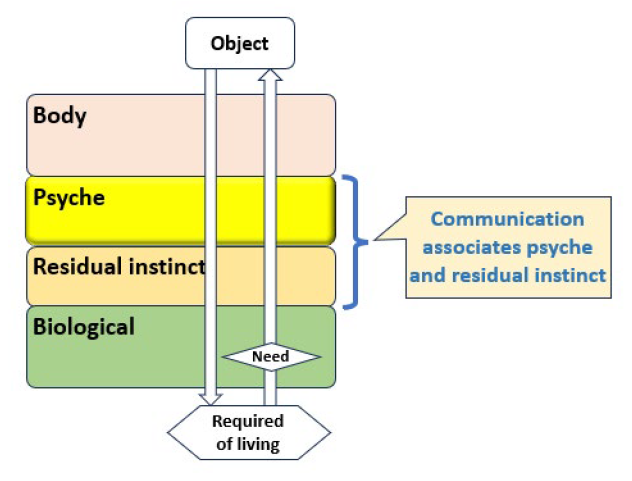
The meta-system of living things
The meta-system defines the framework of the system.
The requirement of independence means that the individual must carry out all the operations of the object relationship by his own means.
Object relationship
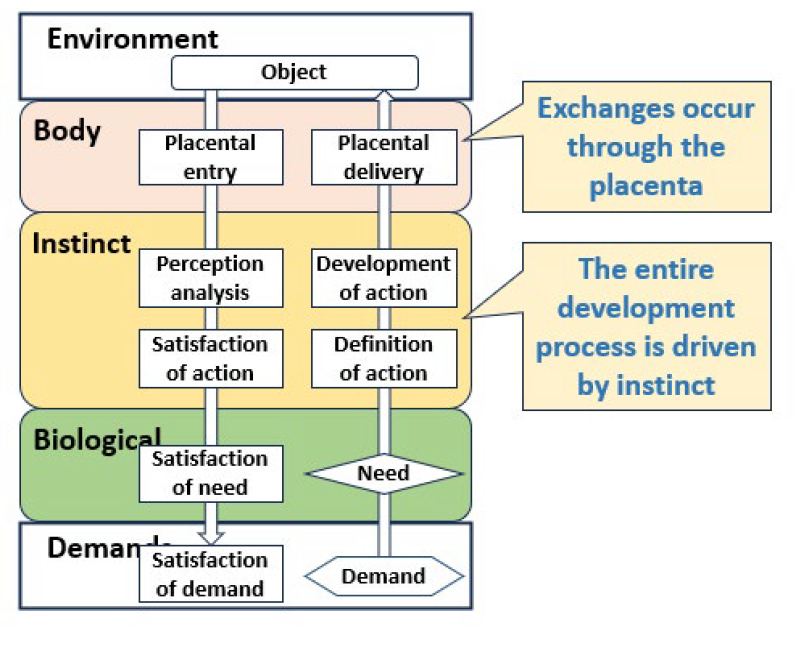
The instinctual object relationship
The relationship is managed by instinct alone, in absence of the psyche. The fatal object relationship is instinctual.
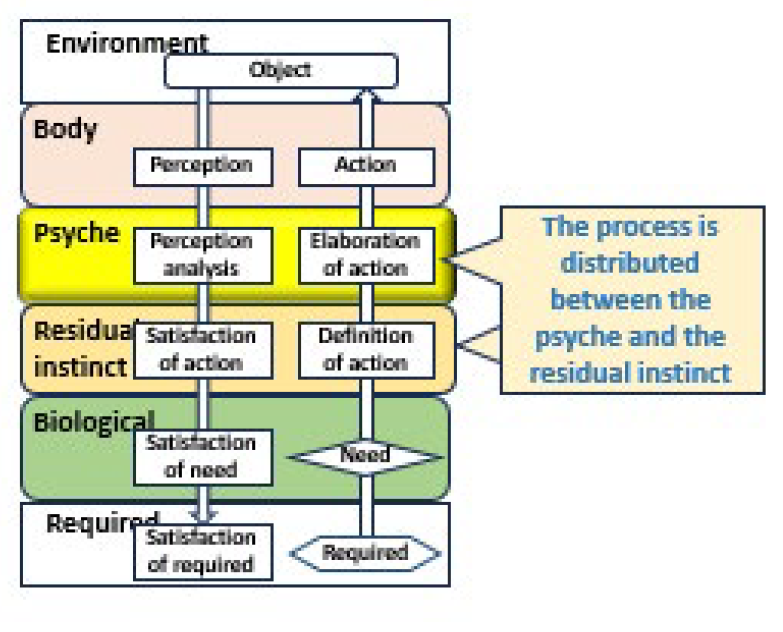
The psychic object relationship
The relationship is managed by the association of instinct and psyche. The adult object relationship is psychic.
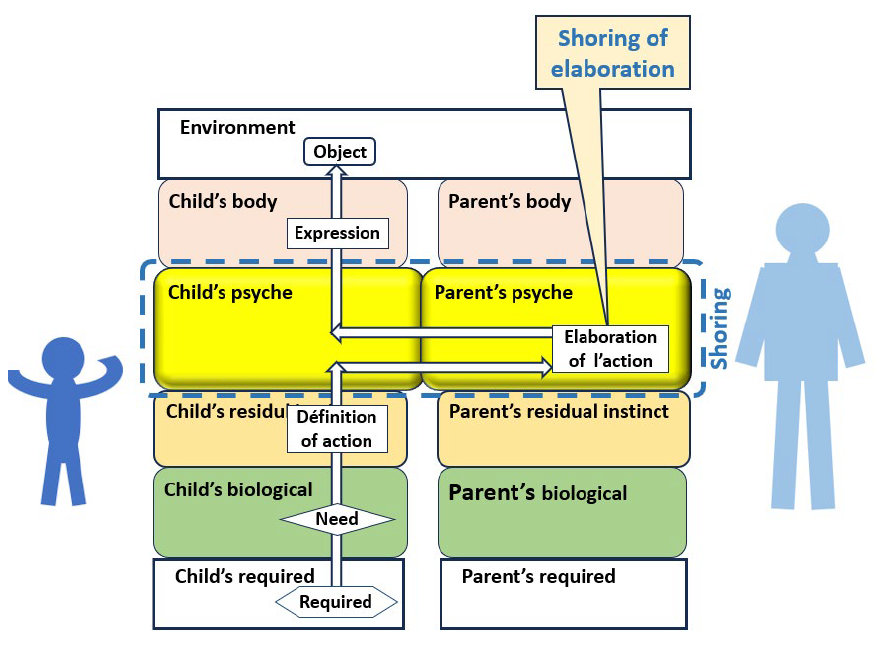
Shoring
The relationship is psychic and managed with the involvement of a third party. The infant and child’s relationship involve shoring.
Shoring is defined by the delegation of psychic functions to a third party.
Shoring is a temporary function that corresponds to the parent's assistance during the creation of the psyche.
Shoring is represented by the diagram of the third party next to the individual, the horizontal exchange flows of demand and provision of psychic assistance, and the partial satisfaction of the required for independence.
The functions of shoring are transmission, action elaboration, and the assignment of meaning to perception. The delegated functions depend on the stage. They are more numerous in the newborn and infant than in the child, in relation to their gaining autonomy during childhood.
Shoring induces dependency. The individual places their object relationship in the hands of a third party.
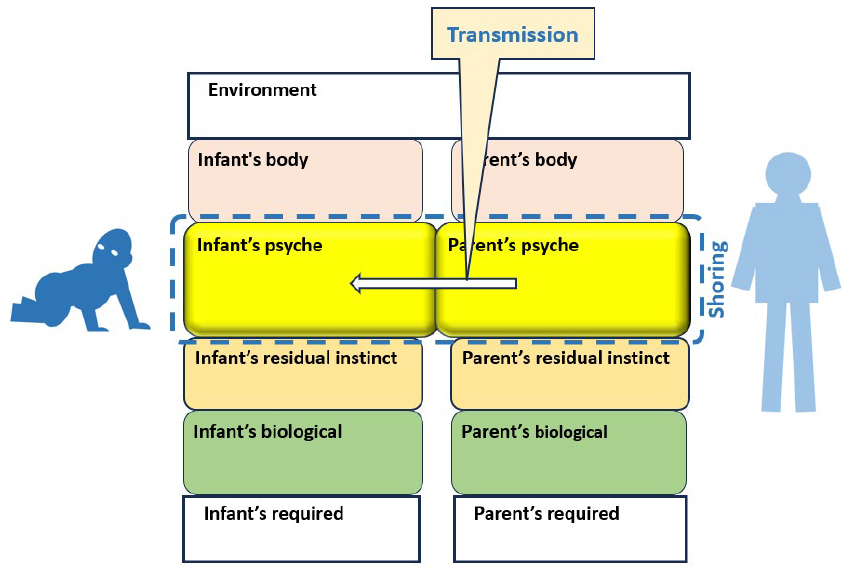
Example: shoring transmission in the infant.
Example: shoring of elaboration in children.
Development
The phases of the essay
The phases are chosen according to the objective of the essay, i.e. the creation of the psyche.
- The fetus in the first few months represents the instinctual management that precedes the psyche.
- The fetus in the final weeks represents the protopsychic stage.
- The new-born phase is detailed because this is the phase in which the psyche is created.
- The infant and child phases describe the process of construction of the psyche.
- The adolescent phase represents automation.
- The adult phase represents the mature psyche.
The fetus in the first few months
In the first few months, pregnancy in animals is like that of humans. Process is driven solely by instinct.
The requirement of independence is satisfied because the relationship is carried out entirely by the fetus's own means. The pregnant mother is the object of the relationship.
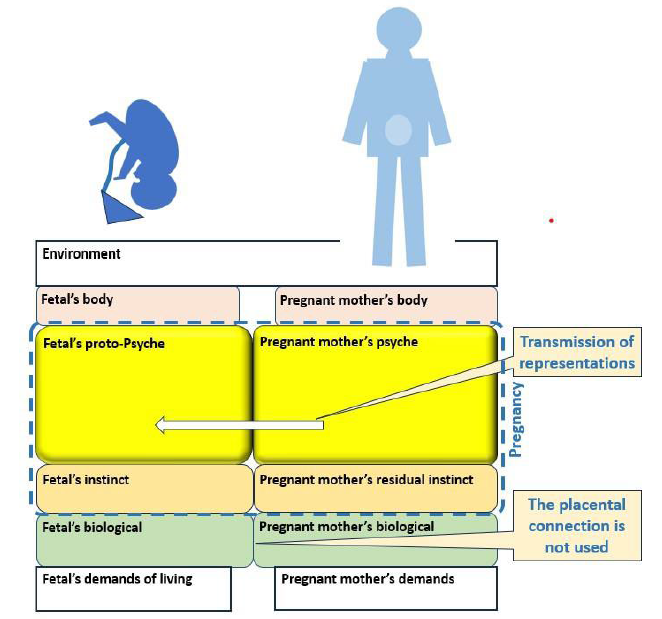
The fetus in its final weeks-creation of the communication channel
The communication channel is the medium for psychic exchanges between the fetus and the pregnant mother.
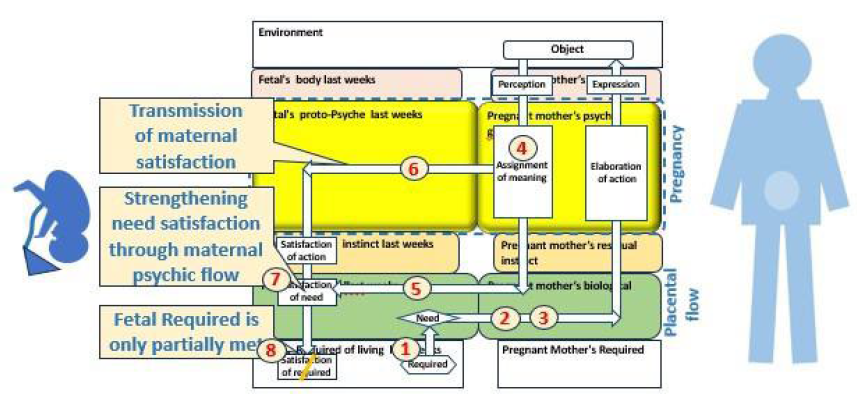
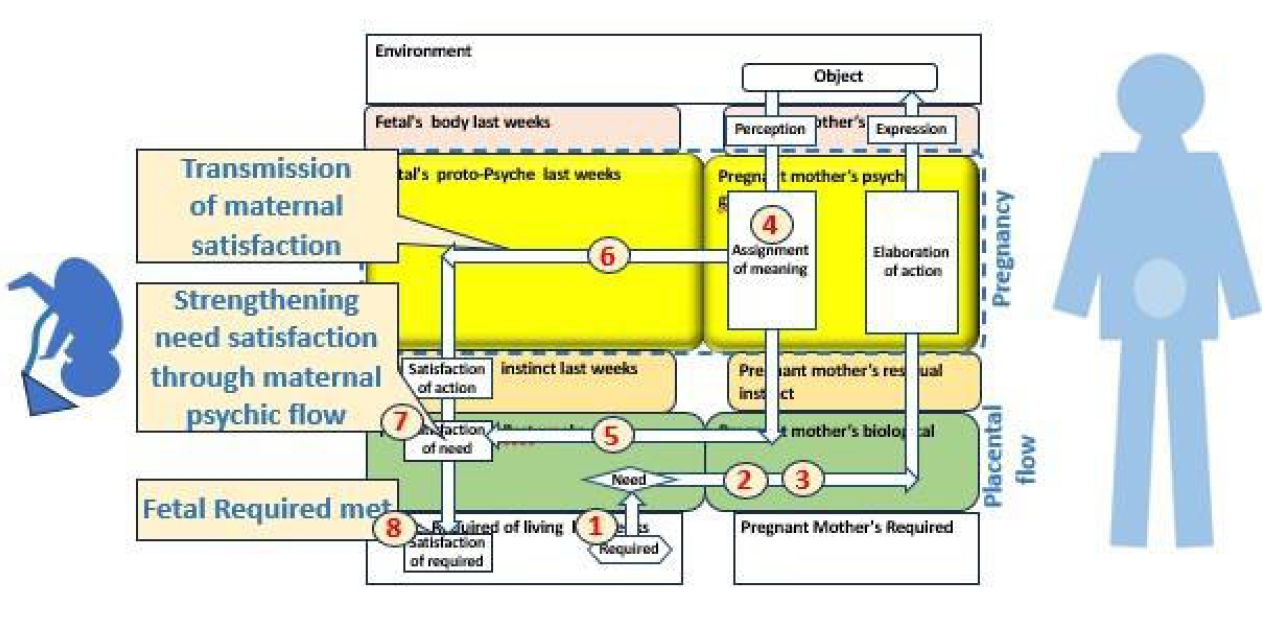
The fetus in its final weeks - the protopsychic object relationship
The protopsychic object relationship is an instinctual object relation in which satisfaction of the need is reinforced by the maternal psychic flow.
It initializes proto-fatal identity.
- The initial fact is the creation of the need from the required by the fetus.
- The action is transmitted hormonally via the placenta to the pregnant mother.
3, 4, 5The mother processes it, accesses the object, and returns to the fetus a double flow: 4 a flow of hormones and nutrients via the placenta and 5 a psychic flow of satisfaction from taking care of her pregnancy.
- The fetus fulfils its need by combining the placental flow and the maternal representation (positive illusion).
- The required for independence is partially unmet because the relationship is not fully realized by the foetus’s own means.
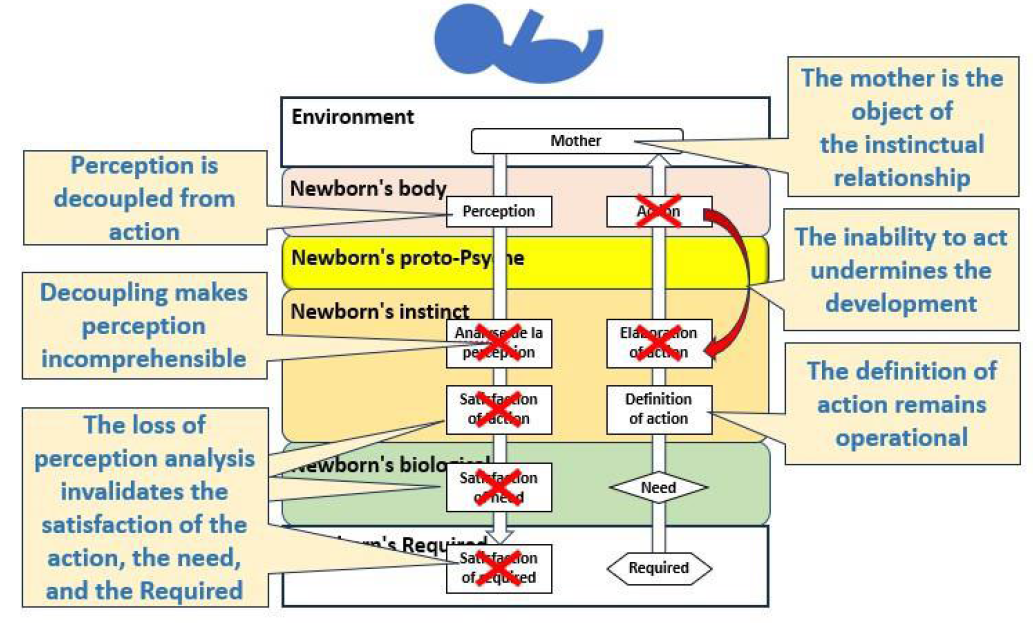
The new-born - failure of neonatal reflexes
Neonatal reflexes are an attempt to create instinctual object relationship.
Physical immaturity of the new-born leads failure to access an object. The consequences are loss of the instinct elaboration function and non-satisfaction of need and required.
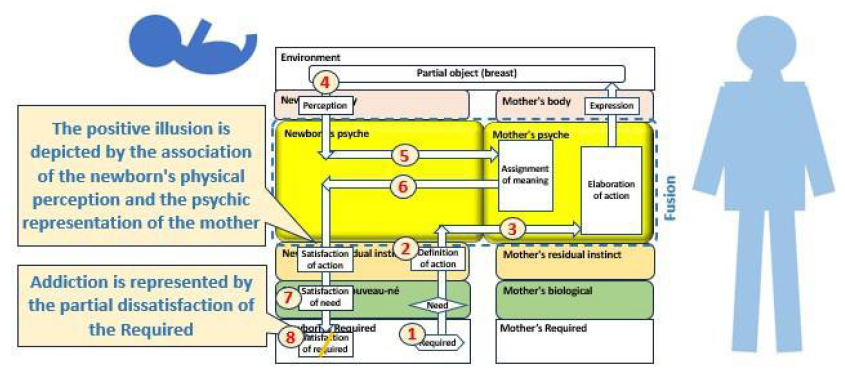
The new-born - the fusional relationship
The fusional relationship is based on the delegation of the new-born’s psychic functions to the mother. The mother performs these operations on behalf of the new-born.
- The initial fact is the creation of the need from the demand by the fetus.
- The action is created by the residual fatal instinct.
- It is transmitted psychically to the mother.
- The mother processes it, obtains the object, and presents the object to the newborn.
- The new-born receives it and transmits the representation of the reception (meaningless representation) to the mother.
- The mother gives meaning to the perception and returns it to the new-born.
- The new-born satisfies its need by combining physical perception with the maternal representation (positive illusion).
- The required for independence is partially unmet because the relationship is not fully accomplished by the foetus’s own means.
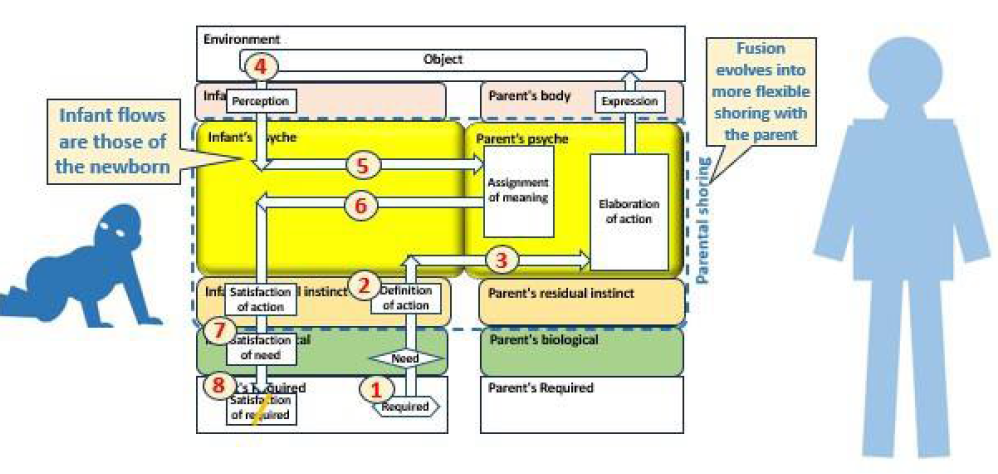
The infant
The flows are like those of fusion.
The infant's psyche is immature and needs the assistance of the parent to elaborate need and assign meaning to perception.
- The initial fact is the infant's proprioception of need.
- The action is instinctively defined by the infant's limbic brain.
- It is transmitted to the mother through a senseless representation (thing representation).
- The mother elaborates the action, accesses the object, and presents the object to the infant (complete object, shared by the infant and the mother).
- The infant realizes the perception and transmits to the mother a senseless perception representation.
- The mother assigns meaning to the perception representation and returns a meaningful representation to the new-born.
- The new-born satisfies their need by combining their perception with the maternal representation (positive illusion).
- The required for independence is partially unmet because the relationship is not fully realized by the infant's own means.
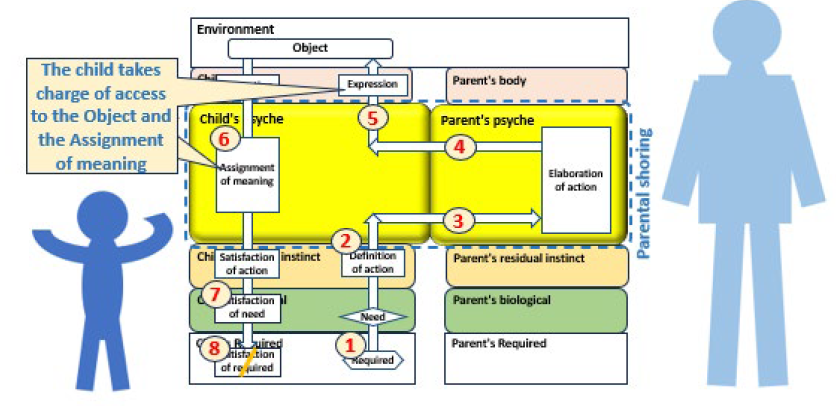
The child
The child takes responsibility for accessing the object and assigning meaning to perception.
Elaboration remains the responsibility of the parent.
- The initial fact is the creation of the need from the demand by the child.
- The action is defined by the child's residual instinct.
- It is transmitted to the parent through a senseless representation (representation of a thing).
- The parent elaborates the action and returns the meaningful representation to the child (representation of words).
- The child gains access to the object.
- The child perceives it and assigns its meaning.
- The child satisfies their need by associating perception with its representation.
- The required for independence is partially unmet because the relationship is not fully realized by the child’s own means.
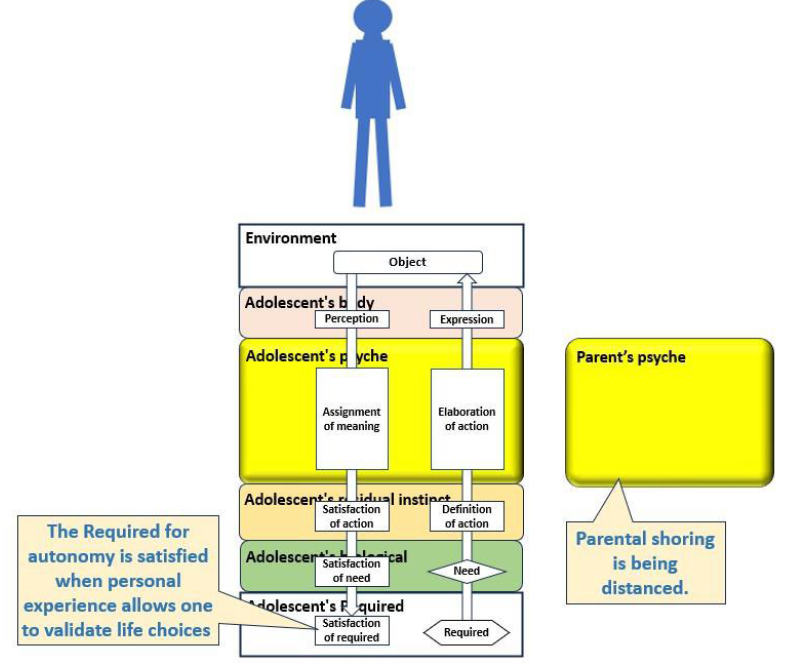
The adolescent
Sexual maturity allows the adolescent to abandon parental shoring.
The required for independence is only satisfied when experience allows an adolescent to confirm their life choices.
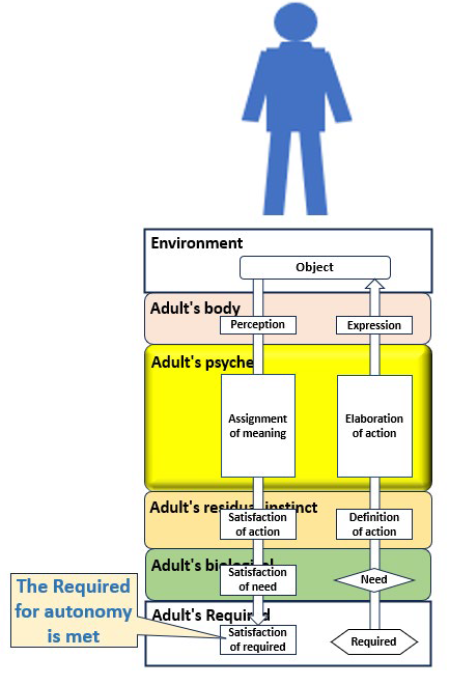
The adult
The adult carries out all the operations of the object relationship according to their life choices. Autonomy satisfies the required of independence.
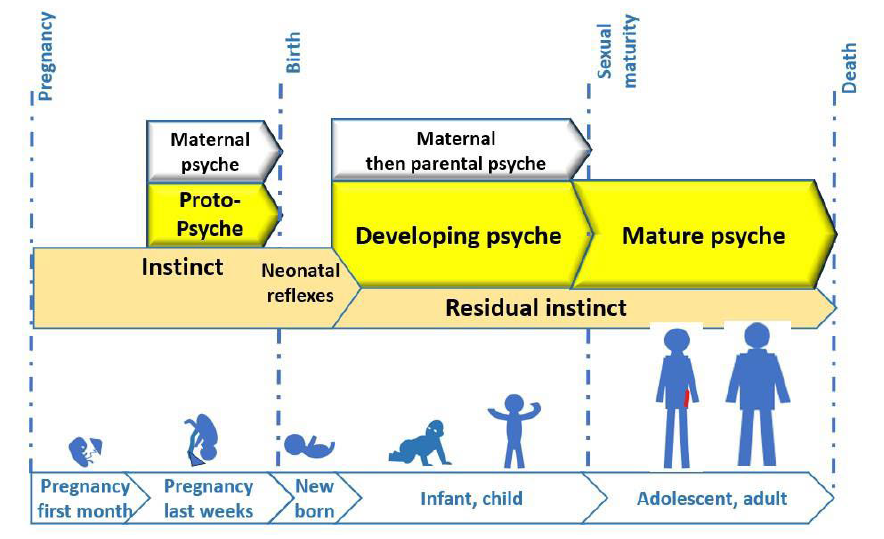
Life cycle of the psyche
The diagram summarizes the association of the psyche and instinct all through their existence.
Thickness of the instinct arrow represents, at the bottom, the definition of the action and at the top, elaboration of this action. Residual instinct represents the definition of the action that remains in the presence of the psyche.
Thickness of the psyche arrow represents, at the bottom, the elaboration and at the top, the emergent functions. Note that psychic elaboration is a continuation of instinct elaboration.
The white arrows represent the parental shoring.
Note that the protopsyche does not modify instinct-based management of pregnancy.
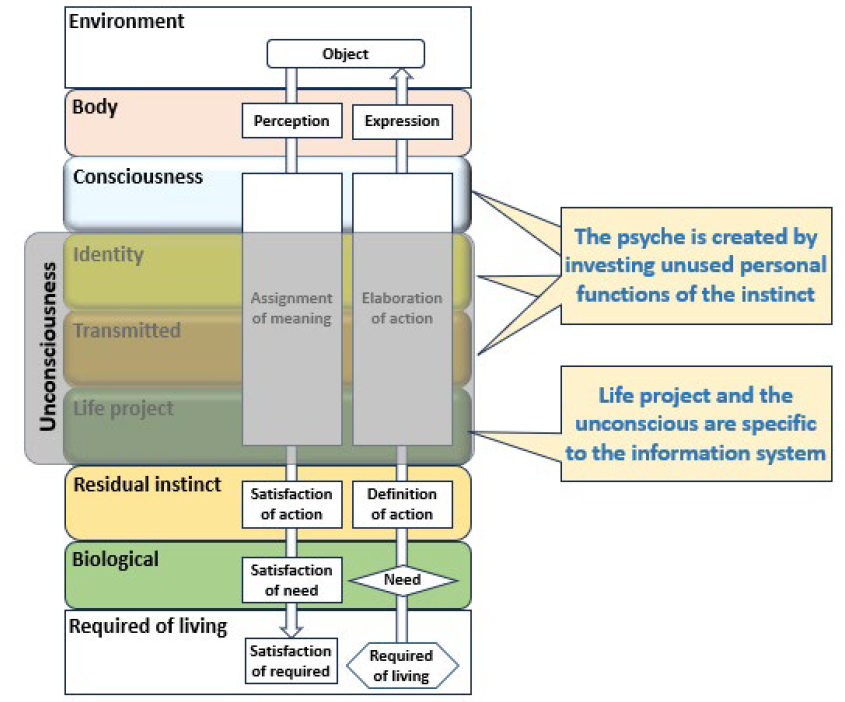
Psychic entities
Psychic entities are life project, transmitted, identity and consciousness.
Unconsciousness is a mask protecting these entities, apart from consciousness.
Psychic required
Structure
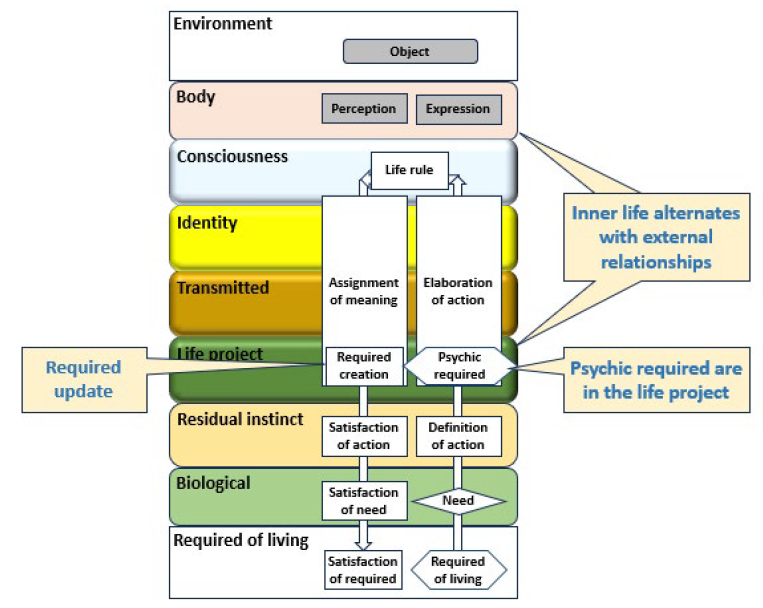
Psychic required is in the life plan.
The object relationship reshapes the required of the living being through the constraints of the psyche. For example, defining a personal value framework reshapes independence into autonomy.
Update of the psychic required
The psychic required is updated following a crisis. The goal is to introduce a life rule to prevent the recurrence of the crisis.
For example, Oedipus introduces the constraint of reserving reproductive sexuality for adulthood.
Updating psychic required involves refocusing the individual and temporarily reducing relationships with environmental objects. Example: the depressive phase described by Klein.
The new required comes into play in subsequent relationships.
Neurological Model
Chapter Summary
Information management
The neuron
The neuron is the basic building block of the system.
It defines the logic of association of incoming flows and the production of outgoing flows.
The synapse
The synapse defines the biological link between two neurons. It is the biological support of information.
Knowledge
Knowledge is the circuit formed by the association of neurons during learning. For example, perception creates the nerve circuit of psychic representation.
Memory is a set of nerve circuits. Its function is to make knowledge available for reuse. For example, elaboration uses previous representations of perception.
Memory
Memory is an ordered set of representations with which search criteria are associated, allowing the representation(s) corresponding to a specific context to be selected. For example, in elaboration, the context is defined by the need, and the representations selected are those created by similar needs.
The neural plate
The neural plate is the biological tissue at the origin of the creation of the brain. In animals, it disappears quickly. In humans, it persists throughout childhood.
The hypothesis of the essay is that the persistence of neural plates promotes the links between the limbic brain and the cortex, which support the association of the psyche and instinct.
The individual
The limbic brain is the seat of instinct. The nerve circuits between neurons are part of the individual's innate physical constitution.
The cortex is the biological basis of the psyche. At birth, neurons are sparsely connected. They constitute a reserve available for the creation of the psyche.
The sensory and motor functions and the object are located on the periphery. Their color is that of the analytical model (pink for the body, green for the biological).
Object relationship
Independent relationship
The processing flow is initialized by proprioception (biological entity). The action is defined by the limbic system, elaborated by the cortex, and expressed by motor skills and speech towards the object.
The feedback flow begins with perception of the object's response, it continues with the assignment of meaning and satisfaction of the need and required. For the sake of clarity, the feedback flow to proprioception is not shown.
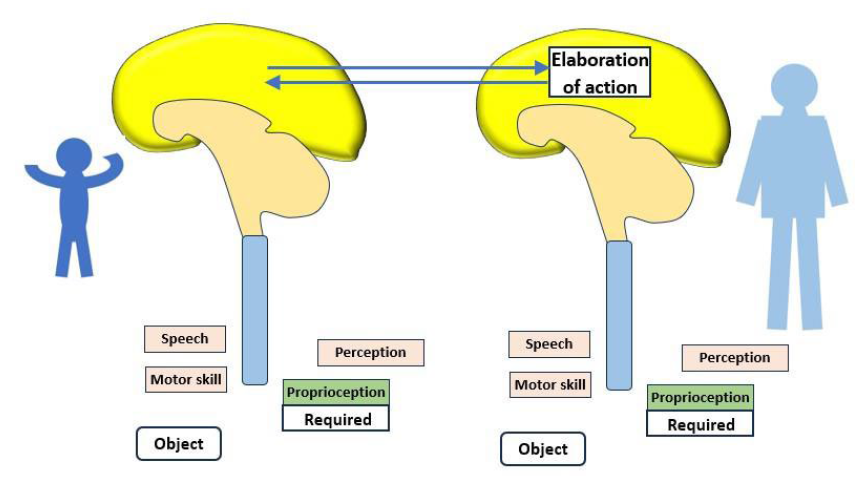
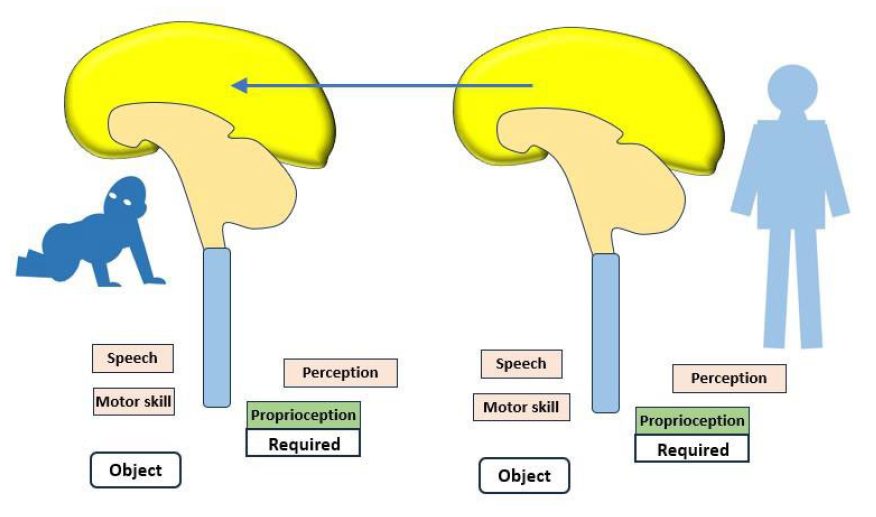
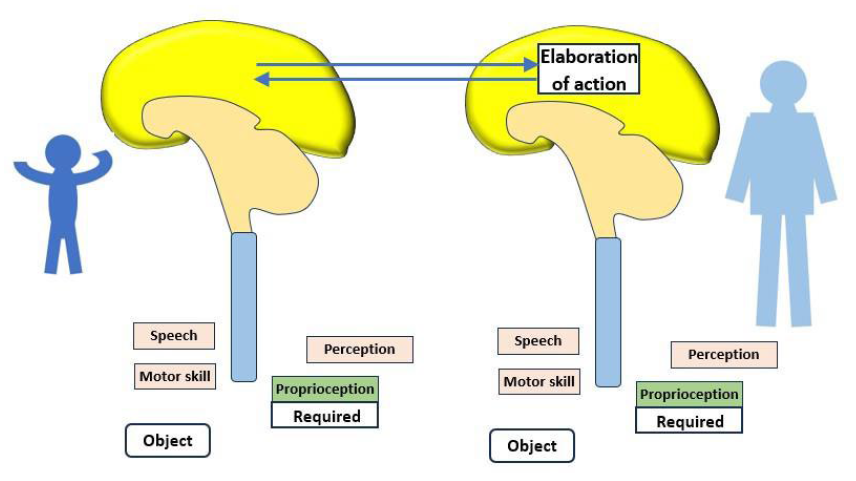
Shoring
Shoring is illustrated by the triangular diagram and the exchanges between the cortex. Example: transmission between the parent and the infant.
Example: shoring of elaboration in child.
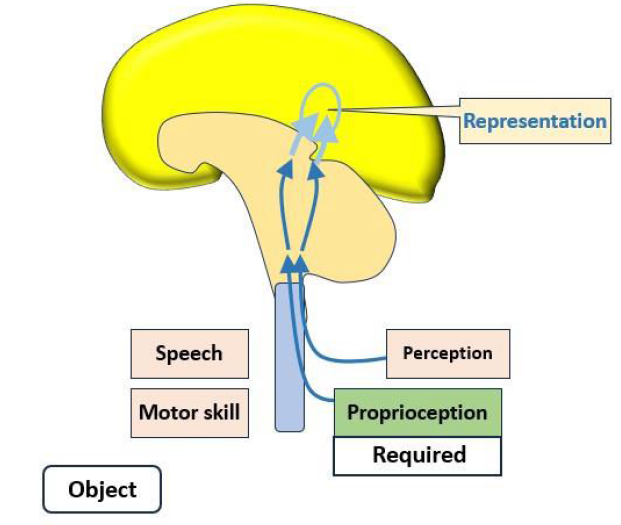
Representation
Creation of the representation
The representation is created by an input flow to the cortex.
The flows involved are proprioception and perception.
The cortex is depicted in relief to describe its mental function.
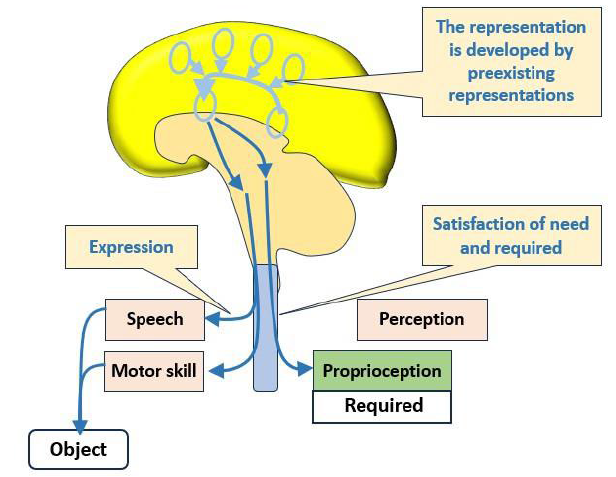
Elaboration
The representation is processed by other representations created previously. Processing of the need leads to speech and motor skills, while processing of the perception leads to satisfaction of the need (proprioception).
Transmission
The representation can be transmitted between two previously agreed individuals (fusion, parental shoring).
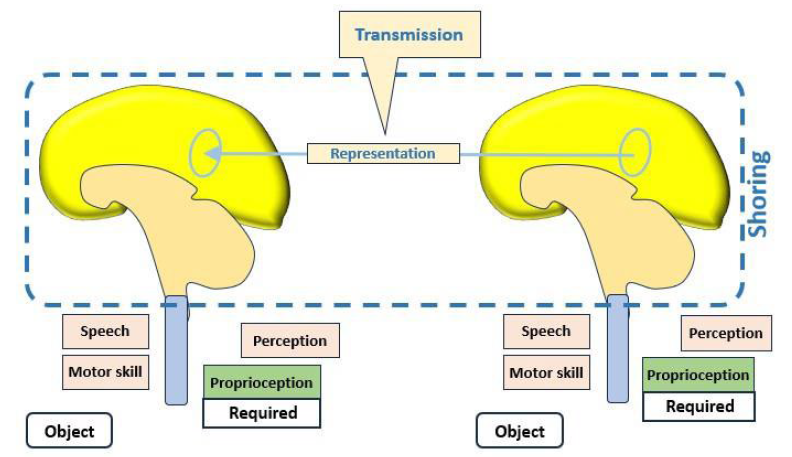
Development
The fetus in the first few months
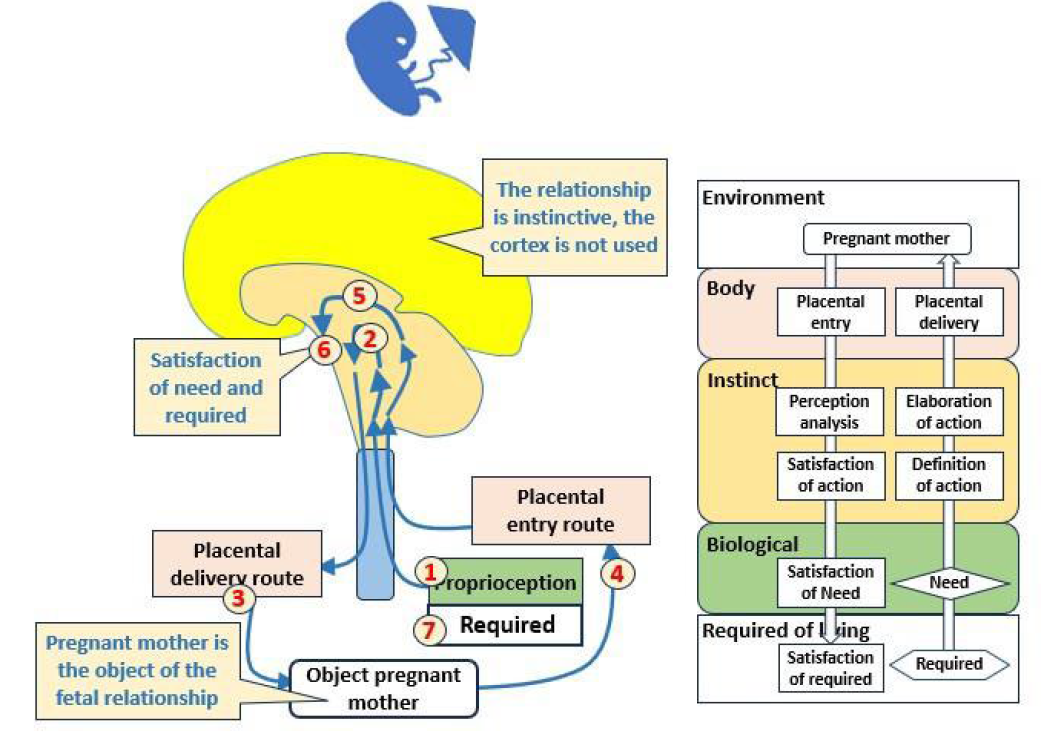
The fetus in the first few months is managed by instinct alone.
Elaboration and analysis of perception take place in the limbic brain. Cortex is not used.
1) The need is generated by proprioception.
2) The action is created and developed instinctively by the limbic brain (the psyche is absent).
3) The action is transmitted to the pregnant mother by placental means.
4) Nutrients and hormones are transmitted by the mother through the placenta.
5) They are instinctively analyzed, which allows the action to be satisfied.
6) Satisfaction leads to the fulfillment of the need. The required for independence is satisfied because the entire relationship is carried out by the fetus's own means. Due to graphical constraints, this flow is not represented.
7) The required for independence is satisfied because the relationship is fully realized through the fetus's own means.
The fetus in the final weeks - the psychic communication channel
The communication channel is created by the maternal transmission of representations.
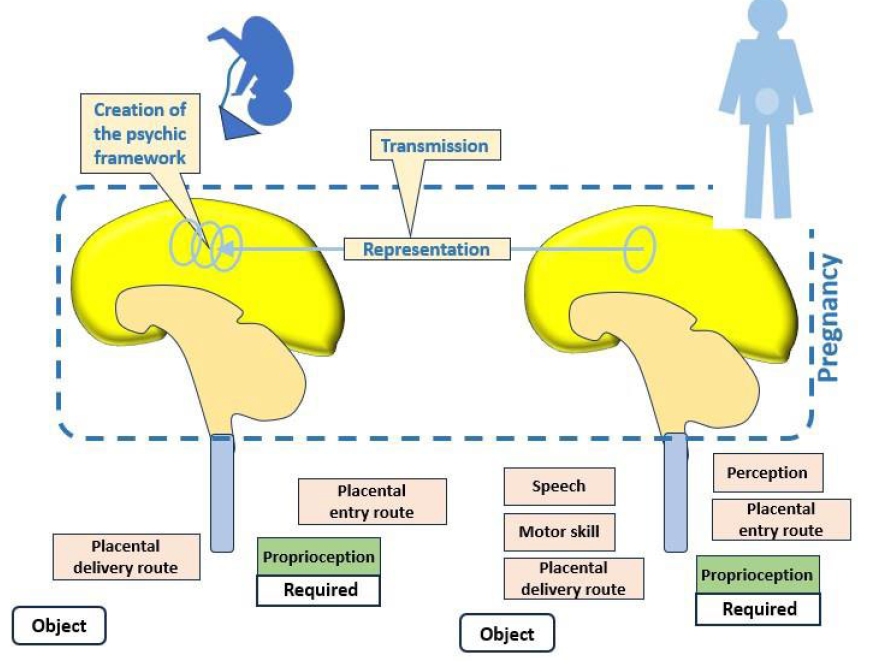
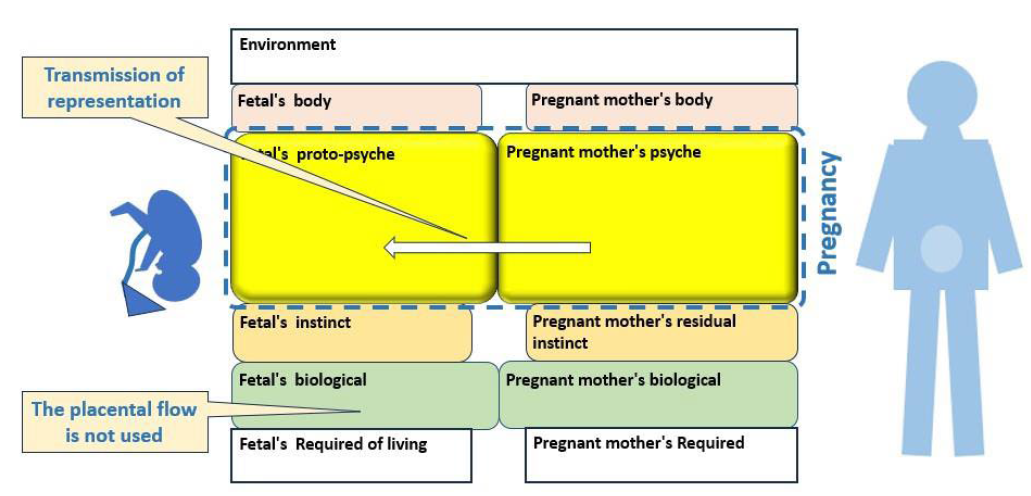
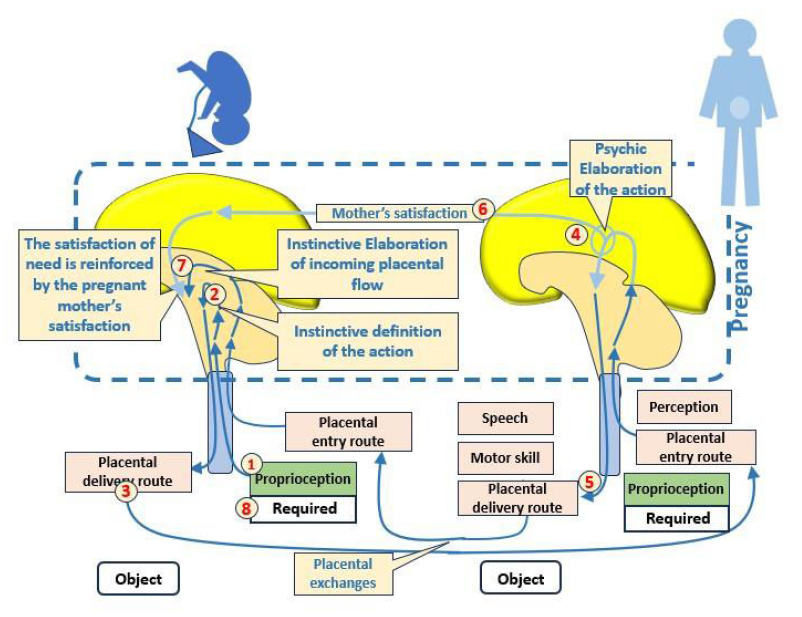
The fetus in the final weeks - the protopsychic object relation
The relation is an instinctual relationship of the fetus whose satisfaction of need is reinforced by a maternal psychic flow (positive illusion).
The relationship is shared between the fetus and the pregnant mother.
1). The initial fact is the fetus's need created by its proprioception.
2-3). The fetus processes it in instinctive mode by its limbic brain and send hormonal message to its mother by placental flow. Note that the mother is here the object of the relation.
4). The mother receives the demand, processes it and returns two flows to the fetus: nutriments by placental route (5,6). and representation of her satisfaction to take care of her pregnancy by psychic route.
7)The fetus receives both. It processes the nutriments in instinctual mode and uses mother's representation to enhance the satisfaction of its need (positive illusion).
8)The required of independence is met because the relationship is instinctual. It is entirely carried out by the fetus.
Note that the pregnant mother plays a dual role. She is, on one hand, the object of the fetus's instinctual relationship and, on the other hand, the third-party support who provides the psychic representation. This creates constraints on the graphic of the analytical model. The diagram with shoring is favoured to highlight the exchanges with the fetus. However, unlike flows with shoring, the required for independence is met because the relationship is instinctual.
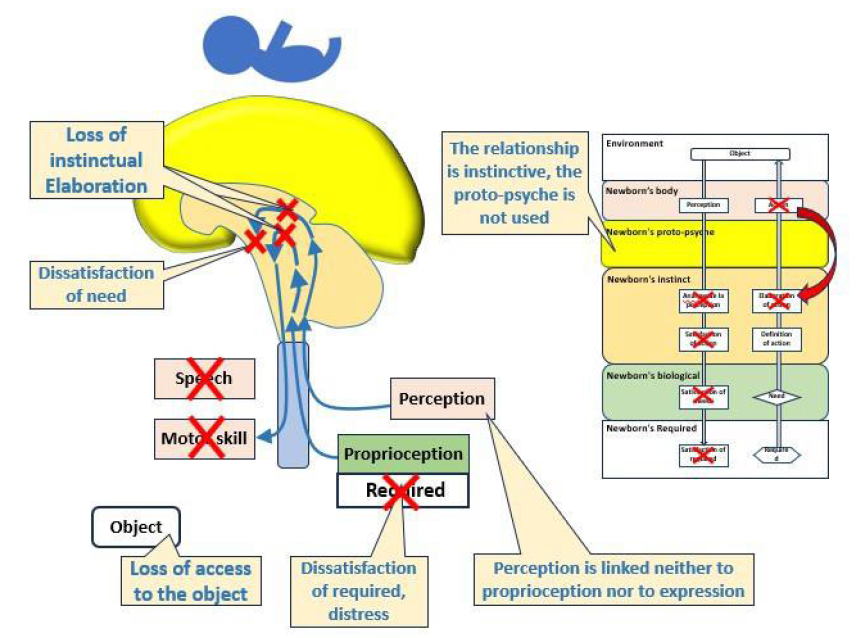
The new-born - failure of neonatal reflexes
Neonatal reflexes are an instinctual relationship. Protopsyche is not concerned.
The failure of these reflexes leads to the loss of the instinctual elaboration function and the non-satisfaction of needs and required. Perception is not connected to any of the flows, which gives it a character of strangeness.
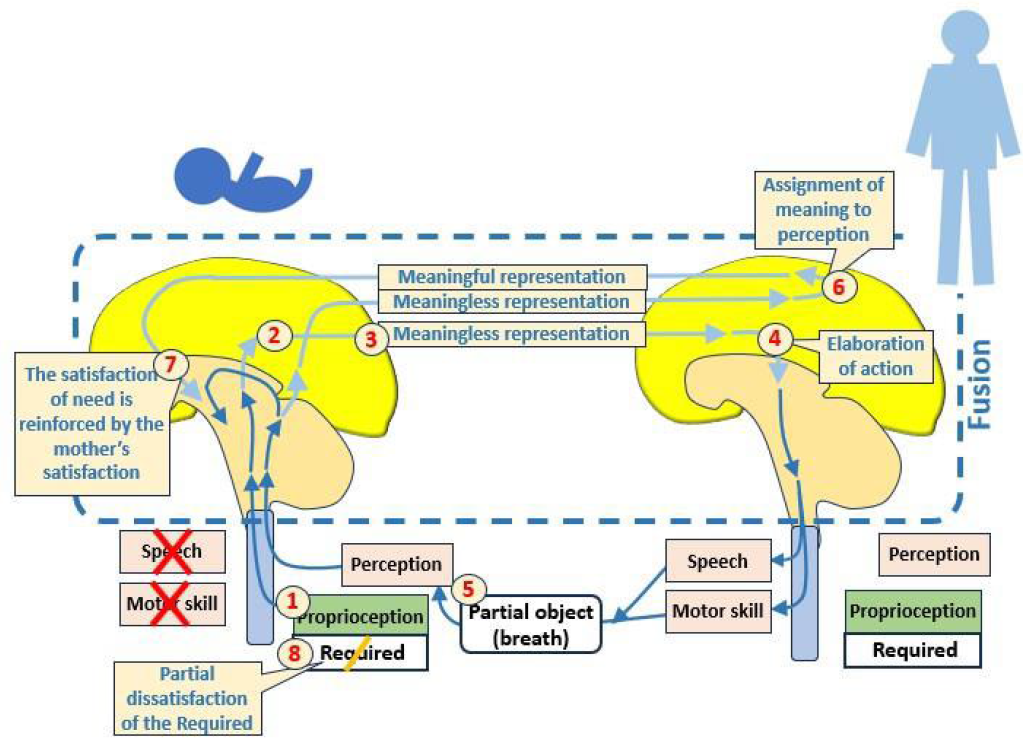
The new-born-fusion
The relationship is shared between the new-born and the mother.
1) The initial fact is the new-born’s proprioception of the need.
2) The action is instinctively defined by the new-born’s limbic brain.
3) It is transmitted to the mother through a meaningless representation.
4) The mother elaborates the action, accesses the object, and presents the object to the new-born (the breast is a partial object).
5) The new-born perceives and transmits a meaningless representation to the mother.
6) The mother assigns meaning to the perception representation and returns a meaningful representation to the new-born.
7) The new-born satisfies their need by associating its perception with the maternal meaningful representation (positive illusion).
8) The required of independence is partially unmet because the relationship is not fully carried out by the new-born’s own means.
The infant
The object relation model is like that of fusion.
The infant has motor skills The fusion is replaced by a more flexible shoring. The object is a complete object.
1 The initial event is the creation of the need by the infant based on proprioception.
2 The action is instinctively defined by the infant's limbic brain.
3 It is transmitted to the mother through a nonsensical representation.
4 The mother elaborates the action, accesses the object, and presents the object to the infant.
5 The infant perceives and transmits a nonsensical representation to the mother.
6 The mother assigns meaning to the perception representation and returns a meaningful representation to the infant.
7 The new-born satisfies its need by associating its perception with the maternal representation (positive illusion).
8) The required for independence is partially unmet because the relationship is not fully accomplished by the infant's means.
The child
The child gradually gains autonomy, elaborates the action, accesses the object and assign meaning to the response of the object.
The parent helps him to elaborate the action to give the relationship structure and reduce the risk of failure.
- The initial fact is the child’s proprioception of the need.
- The action is instinctively defined by the child’s limbic brain.
- The child processes it and conveys to the parent the representation of what he intends to do.
- The parent reworks the representation and returns it to the child.
- The child gains access to the object.
- The child perceives and assigns meaning to the return of the object.
- The child satisfies his need.
- The required of independence is partially unmet because the relationship is not fully established through the child's means.
The adolescent
Sexual maturation allows the adolescent to become independent from parental shoring.
The withdrawal of support is accompanied by the integration of the parent's life rules according to the adolescent's choice.
The required is only fulfilled after the adolescent has made these rules his own through experience.
The adult
The entire object relation is realized by the individual. The required is satisfied.
Conclusion
The essay addresses the dual objective of linking the psyche to the immaturity of the new-born and of modeling it.
The result is a hybrid system associating instinct and psyche. Biologically, humans are animals enhanced using intangible resources, such as information, meaning, and time.
“Art is born out of constraint” (Gide). The psyche is an art in the sense that it does not define equilibrium on its own and encourages creativity in Behavior. Language, writing, art, science, and cultural, social, and technological productions all set the individual within a narrative of humanity.
The essay proposes a unified approach to the concepts of psychoanalytic psychology in accordance with neurological constitution.
Graphic modeling allows us to conceptualize the subject it represents, even though it remains inaccessible to direct observation. It is tantamount to creating a new meaning that renders perceptible what was not previously so, thereby allowing us to better understand the world.
The paradigms of psychoanalytic psychology, of an abstract inner
world that drives reality, and that of Darwinism, chance and necessity, offer an incomparable support base for reflection and representation of all things human.
This essay is one step in a broader, cross-disciplinary approach to understanding human nature. I beg the reader’s indulgence in accepting its limitations and inaccuracies. This candid exploration serves only a temporary purpose. The topics it touches upon may be further developed later if interest dictates.
ANNEXES
Neonatal reflexes
Use of the term "reflex" to describe human neonatal Behavior appears inappropriate because these behaviours are too evolved to be simple reactions to a stimulus. Besides, they have the adaptive and shared nature of instinct. For example, grasping, walking, swimming, gripping, Babinski reflex, orientation towards touch, and protection (Moro).
Use of the term reflex to designate an instinct has all the appearance of a narcissistic wound. By associating a term not involving the brain with an animal, by contrast we define a state of cerebral being to a human being.
In conclusion, two questions
How does the psyche perceive instinct?
A fossil of evolution?
An attempt to remind humans of their animal nature?
An outdated function, completely superseded by the psyche? What would you add?
How does instinct perceive the psyche?
A terrible child who does whatever he wants?
A proud partner who doesn't listen to what he's told? An effective associate?
What would you add?
Bibliography
- von Bertalanffy L (1968) La théorie générale des systems.
- Conrotto F (2015) La sexualité infantile et le pulsionnel: une remise en question. Revue française de psychanalyse 1:79.
[Crossref], [Google Scholar]
- Conche M (2012) La liberté, propre de lâ??homme. L enseignement philosophique.
- Darwin C (1859) The Origin of Species.
- Doat D (2013) Vers une ontologie humaine intégratrice du handicap et de la fragilité en contexte évolutionniste.
- Dubouchet J (1977) La condition de lâ??homme dans lâ??univers, Déterminismes des instincts et liberté de lâ??homme.
- Dufour D R (2006) Une raison dans le réel: le corps néoténique. Journal français de psychiatrie.
- Dufour DR Quâ??est-ce que la néoténie humaine vidéos.
- Dupuy J.P (2005) Aux origines des sciences cognitives, La fascination pours le modèle.
- Farges N. L (2016) observation psychanalytique (Journal de la psychanalyse de lâ??enfant 6: 203-224.
- Freud S. Introductory Lectures on Psycho-Analysis (1915-1917).
- Freud S. Mourning and melancholia (1917). Freud S. Civilisation and its discontents (1929). Freud S. Outline of psychology (1895).
- Golse B (2019) La situation anthropologique fondamentale au regard de la néoténie 282-290.
- Julien C (2008) Sur les neurones-miroirs Les Lettres de la SPF 2008/2 N° 20 121-141.
- Klein M (1947) Essais de psychanalyse 1921-1947 Payot 341-369.
- Lacan Le stade du miroir Revue français de psychanalyse 13: 449-455.
- Lavallée G. L (1999) enveloppe visuelle du moi, perception et hallucinatoire Dunod.
- Levivier M (2011) Lâ??hypothèse dâ??un homme néoténique comme grand projet sous-jacent Les sciences de lâ??éducation - Pour lâ??ère nouvelle 77-93.
- Lorenz K (1992) On agression 244.
- Missonnier S (2011) Introduction aux connaissances de la psychologie clinique fÅ?tale. EMC (Elsevier Masson SAS, Paris), Psychiatrie/Pédopsychiatrie, 37-200-B-19.
- Missonnier S (2021) Le fÅ?tus/Bébé au regard de la psychanalyse, vers une métapsychologie prénatale.
- Morhain Y. (2019) Les vertiges de la création à lâ??adolescence.
- Morhain Y (2020) Jean Moulin Romanain.
- Morris D. (1967) The Naked Ape.
- Roussillon R (2018) Manuel de psychologie et de psychopathologie clinique générale, chapitres psychologie.
- Roussillon R (2007) La représentation et lâ??actualisation pulsionnelle 339-357.
- Segal J (2012) Le zéro et le un, chapitre 3 Cybernétique et théorie de la communication.
- Soulé M (2015) De la psychiatrie de lâ??enfant à la psychiatrie fÅ?tale, chapitre 4. La vie du fÅ?tus. Son étude pour comprendre la psychopathologie périnatale et les prémices de la psychosomatique.
- Stern D.N (2003) The Interpersonal World of the Infant 181-208.
- Story M. (2020) Au-delà des mots 34-35.
- Winnicott D (1975) The Fear of Breakdown NRP Figures du vide N°11 35-44.
[Crossref], [Google Scholar]