Spanish
  Chinese
  Russian
  German
  French
  Japanese
  Portuguese
  Hindi
Hindi Research Article, Geoinfor Geostat An Overview Vol: 13 Issue: 4
Landslide Hazard Zone Mapping Using Geospatial Technologies: A Case Study of Duna Wereda Hadiya Zone, Central Ethiopia
Dinkineh Abebe Kepeno*, Tariku Kebede Tofu, Adamu Dessalgn Tadesse and Aster Chalichisa Egg
Department of Geometics Engineering, Wachamo University, Wachemo, Ethiopia
*Corresponding Author: Dinkineh Abebe Kepeno
Department of Geometics Engineering, Wachamo University, Wachemo, Ethiopia
E-mail: tarikuke400@gmail.com
Received date: 30 July, 2024, Manuscript No. GIGS-24-143148; Editor assigned date: 02 August, 2024, PreQC No. GIGS-24-143148 (PQ); Reviewed date: 19 August, 2024, QC No. GIGS-24-143148; Revised date: 09 August, 2025, Manuscript No. GIGS-24-143148 (R); Published date: 16 August, 2025, DOI: 10.4172/2327-4581.1000441.
Citation: Kepeno DK, Tofu TK, Tadesse AD, Egg AC (2025) Landslide Hazard Zone Mapping Using Geospatial Technologies: A Case Study of Duna Wereda Hadiya Zone, Central Ethiopia. Geoinfor Geostat: An Overview 13:4.
Abstract
The principle reason of this look at is to assess landslide danger zones for Duna wereda by using the use of Geospatial technology. The causative factors considered to landslide evaluation within the region become, slope, thing, distance from water, soil type, land use land cover and Elevation. Analytical Hierarchy tactics the load of every issue had been calculated and assigned in GIS. to add those elements and produce landslide risk map weighted linear combination turned into, used via using IDRIS software. hence, by using using received weight price Landslide threat map organized changed into, labeled in to high, low and very low hazard zone. consequently, the result of the study found out that the place coverage of the level of landslide risk very low and excessive are 69.63%, 22.94% and 7.43% respectively. As recognized there's high landslide risk region that may motive different 6 effect on the person and on belongings. consequently, the result of evaluation has been established the usage of landslide inventory information this study might also have wonderful importance in giving focus in landslide chance location and also allows to mitigate the landslide effect. ultimately, this landslide hazard zonation of Duna wereda counseled for similarly researcher, land management and concerned frame ought to have primarily based on the existing finding.
Keywords: Landslide, Duna Woreda, GIS, Remote sensing
Abbreviations
GCPs: Ground Control Points; GIS: Geographic Information System; GPS: Global Positioning System; LHZ: Land Hazard Zonation; RS: Remote Sensing; ERDAS: Earth Resource Data Analysis System; DEM: Digital Elevation Model; LULC: Land Use Land Cover; USGS: United States Geological Survey; FAO: Food and Agriculture Organization; GII: Geospatial Information Institute; NMA: National Metrology Agency
Introduction
Globally, Landslides are some of the maximum common natural risks and are the maximum negative, leading to a ramification of human and environmental influences [1]. The term landslide describes a wide style of strategies that result in the movement of slope forming materials including rock, soil, artificial fill, or a cloth might also circulate via falling, toppling, sliding, spreading or flowing. Landslide is the movement of a mass of rock, particles or earth down a slope [2]. Landslides may be omitted in the event that they occur in uninhabited places and locations of no human hobby.
However, if they occur in locations of importance together with highways, railway strains, valleys, reservoirs, human settled regions and agricultural lands, manifestly such times cause blocking off of visitors, collapse of homes, damage to fertile lands and so on other than heavy loss of lifestyles and assets [2]. Those damages may be decreased via knowledge the mechanism of incidence, prediction thru hazard assessment, chance zonation and early caution gadget [3]. In such case, education of landslide chance maps may be an preliminary step towards mitigation and control. Risk evaluation can help authorities save you and reduce harm via right land use control for infrastructural development and environmental safety [4]. The ability location that's liable to slope failure may be identified the usage of Landslide Hazard Zonation (LHZ) mapping. A landslide danger zonation is explaining “the department of the land place in homogeneous domains and their ranked based on diploma of actual hazard purpose by movements of mass” [5]. LHZ mapping is essential to improvement of the planning and disaster management of landslide susceptible area. LHZ mapping is very vital for identifying and predicting the feasible sliding zones [6].
Landslide is a commonplace environmental trouble in highlands of Ethiopia [7]. Rainfall is most important triggering issue for debris/earth slides, debris/earth flows and, medium to huge-scale rockslides [8]. furthermore, lithology, soil deposit, slope perspective, issue, elevation, land use/land cowl and groundwater circumstance have influential factors for the prevalence of landslide [9]. In addition, the steep slope location that protected via deeply weathered rock, intently spaced faults, fractures jointed and sheared basaltic rocks are initiated to slope instability [7]. Further, in Ethiopia, most of the people are populated in the highland areas; due this to they're critically suffered for landslide dangers [10]. In particular, the southern perception is the most susceptible regions for landslide hazards [9]. Inside the ultimate decade’s diverse sorts of landslides have been passed off in southern and southwestern highlands of Ethiopian. This vicinity is the maximum populated part of the U. S. A. and has one of a kind topographies [11].
Especially, Duna Wereda in southwestern highlands is one of the most landslide susceptible areas in Hadiya region. In earlier than one decade, the landslide took place in Duna wereda caused for the dying of human beings, some injured and lack of residences. similarly, it induced damages on infrastructures, crops and lands. The purpose of this have a look at become to map landslide hazard zonation in Duna wereda thru the mixing of GIS and far flung sensing strategies. Landslide risk zonation map of the existing take a look at specifically aimed to discover previously existed landslide chance websites and sensitivity areas that might be show up within the future. The observe will have an crucial position for appropriate sites selection tactics for agriculture practices, production and advocate the way minimize the approaching impact in landslide susceptible regions. in addition to this, it's miles vital to planners, local administrations, and choice makers in disaster planning for reducing the losses of lifestyles and assets.
Materials and Methods
Study area description
The take a look at was carried out in Duna Wereda Hadiya zone, principal Ethiopia. Duna wereda is positioned in valuable Ethiopia place, within the South West vital part of Ethiopia about a distance of 270 km South of Addis Ababa, 211 km from nearby city, Hawassa, in the South West and 42 km from the Zonal city, South away from Hossana, the capital of Hadiya area and it’s far one of the 11 Weredas of Hadiya sector and geographically located between 7°37′19Í´Í´ N latitude and 37°37′ 14Í´Í´E longitudes (Figure 1)
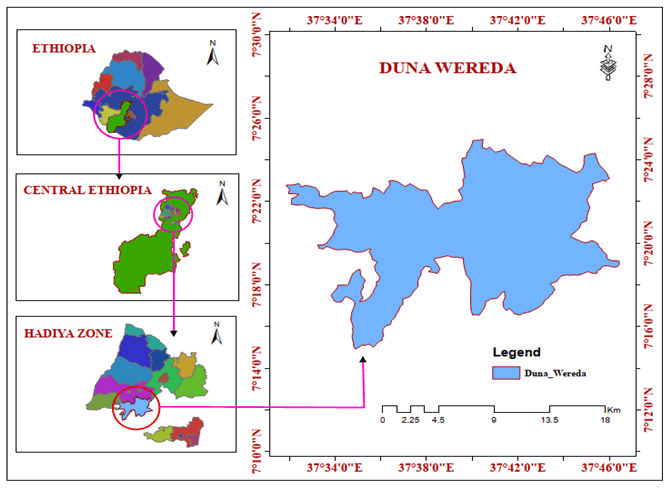
Figure 1: Study area map.
Consistent with the latest Wereda population reviews (2013), the whole range of householdin Duna wereda is 18,752. Out of these, 18,109 (95-57%) are men headed families and 643 (3.43) are ladies headed families. a complete number of households in 30 ruralkebeles is 17,580 (93.75%). Out of those, 17,080 (ninety-seven.15%) are men headed householdsand 500 (2.85%) are ladies headed households and a complete number of households in 2 town kebeles is 1172 (6.25%). Out of those, 722 (61.60%) are men headed families and 450 (38.4) are ladies headed families. the whole population of the Duna Wereda is 148,566, out of these, 75,383 (50.74%) is male and 73,183 (49.26%) is female.
The Wereda has an agriculturally suitable land in phrases of topography. Agro ecologically, the Duna Wereda is classified in to a few classes like as Dega 85%, Weina Dega 10% and kola 5%. the once a year rainfall varies from 1500 mm to 1896 mm, the mean annual general rainfall is set 1896 mm, and has a mean temperature of wereda is 19°C. The big a part of Duna Wereda topographically falls within the southeastern highlands of Ethiopia, records obtained from [12]. In keeping with [13] the elevation within the wereda tiers from 2,970 m imply sea stage Sengiye that is the maximum mountain in Hadiya area and 1000 m imply sea stage on the wagabata above which is the bottom place in the wereda. The average elevation of the wereda is taken as to be 1985 m from the mean sea level.
Data collection
Primary data: This type of information is unprocessed records which is immediately acquired from up-to-date of have a look at area. these datas are up to date updated of a few landslide hazard place, GCP for validation and georeferncing reason and land sat up to date.
Secondary data: Those styles of facts are the processed records which may be very important for this have a look at. a few those datas are written report of landslide chance in the examine place from the wereda verbal exchange workplace page, posted and unpublished articles updated the examine and books.
The summaries of both primary and secondary data used are listed in Table 1 below:
| No | Data to be used | Source | Purpose |
| 1 | Aerial image | GII | LULC classification |
| 2 | Soil | FAO | For landslide hazard mapping |
| 3 | DEM | GII | For landslide hazard mapping |
| 4 | SLOPE | GII | For landslide hazard mapping |
| 5 | Rainfall | NMA | For landslide hazard mapping |
| 6 | Distance from water | For landslide hazard mapping | |
| 7 | GCP | Field | For validation |
Table 1: Data to be used for the study.
Method
Methods are techniques are the set of methods which can be decided on up to date obtain the required objective of the have a look at. For this reason, a number of the strategies updated be implemented for the observe are as discussed beneath.
Image pre-processing: The downloaded Landsat snap shots are not directly used for the specified analysis. Landsat up to date for the required reason up-to-date preprocessing is the first level. Therefore, pre-processing like, layer stake, geometric and radiometric correction are very beneficial up to date the best of statistics up-to-date.
Classification: Regarding the prevailing land use kind of the have a look at place, type of those land use land cover class could be very critical. therefore, the take a look at vicinity can be classified by means of the use of supervised type strategies due the researcher’s previous knowledge about the have a look at vicinity.
Weight overlay: That is the selected method up to date pick out the landslide chance region depending up on the chosen criteria’s, like slope, rainfall, DEM, LULC up to date. Therefore, for the said up to date the weight price will be assigned up to date obtain the required goal of the have a look at.
Results and Discussion
Slope
Slope attitude is a critical up-to-date in landslide chance valuation as such it is often, utilized in developing landslide chance maps [14]. For the modern examine region, slope up to dateupdated, divided inupdated 5 classes lessons: (0-10), (10-20), (20-30), (30-40) and (more than 40).
Slope class and area coverage are, recorded in Table 2.
| S. no | Slope class (degree) | Area(ha) | Area (%) |
| 1 | 0-10 | 4940.55 | 23.98 |
| 2 | 10-20 | 5019.03 | 24.36 |
| 3 | 20-30 | 3805.29 | 18.47 |
| 4 | 30-40 | 3288.33 | 15.96 |
| 5 | >40 | 3545.37 | 17.21 |
| Total | 22273.83 | 100 |
Table 2: Slope and area coverage.
As indicated in the Table 2, most part of the area was, dominated by gentle topography. Thus, 23.98% of the total area was under the scale class of 0-10 and it has less effect on landslide. However, from the slope class greater than 20 the area cover was greater than 50% which has great effect to landslide occurrence. For more clarification it was shown in Figure 2 below.
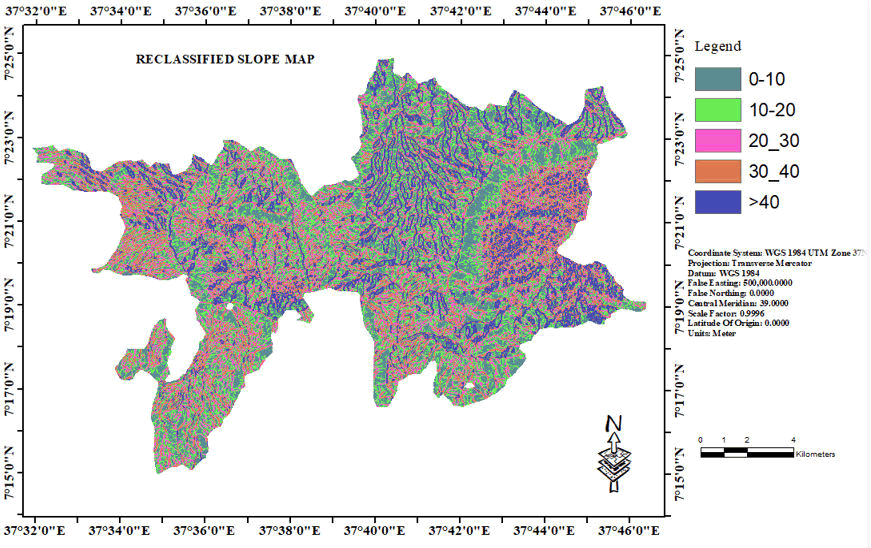
Figure 2: Slope map.
Soil type
Soil type is sizeable parameter in landslide evaluation due updated sort of soil decide tendency of soil particle up-to-date sliding across every other. the nature of the movement is, controlled through the earth materials worried. Soil kind with large debris which includes sandy soils are the maximum cohesive while clayey soils with up-todate particles almost cohesiveness.
Friction force are dependent on the load positioned on soil floor. The more the load the extra the likelihood the force of friction will conquer. This result in the motion of soil debris within the soil layer and potential updated slope failure [14]. Two exceptional soil kind exist inside the take a look at place. although, the presence of various soil kind in the location determine the character of mass movement and slope failure.
The total area coverage and soil type exist was, presented in Table 3.
| S. no | Soil type | Area (ha) | Area (%) |
| 1 | Humic nitisols | 11.8 | 0.06 |
| 2 | Chromic luvisols | 20586.77 | 99.94 |
| Total | 22247.3 | 100 |
Table 3: Soil type and area coverage.
From the Table 3, the less soil type in the area is Humic Nitosols covers (0.06%) of total area. This type of soil was, deep, dark red, brown or yellow clayey soils having a pronounced shiny, nut-shaped structure. The map of all the explained soil are shown in Figure 3 below.
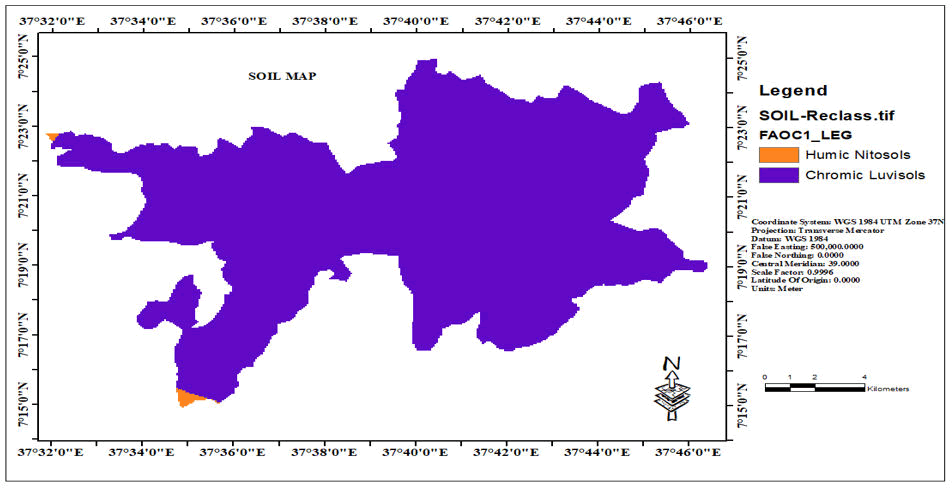
Figure 3: Soil map.
From the desk above, the much less soil type within the region is Humic Niupdatedsols covers (0.06%) of up to datetal updated area. This form of soil changed inupupdated, Deep, darkish purple, brown or yellow clayey soils having a mentioned brilliant, nut-formed structure.
The second soil type dominate the area was chromic luvisols which account simplest 99.04% of up to date vicinity. This soil kind positioned at western a part of the have a look at region by using masking maximum vicinity. This soil kind have loam texture. It up-todate, ruled by medium texture. most a part of the location discovered at northeastern haven't any facts about soil type.
Aspect
Up to dater show the inclination or perspective of slope in a given area. despite the fact that, issue updated strongly impacts capability direct incident radiation and therefore temperature. therefore, the moisture of the soil at the ground may modify. component as a landslide-conditioning up-to-date has been, up to date in various research [15]. component gravely impacts hydrological methods such as evapotranspiration, weathering, and vegetation boom particularly in arid environments and regions with vulnerable soil sorts [16]. As an end result, this parameter up to date, also up-to-date as a conditioning thing for the prevailing study place. The slope component for the look at location up-to-date, divided to five categories: North, Northeast, Northwest, Southwest and south. up to date elegance and place coverage up-to-date shown in desk under. Aspect class and area coverage was shown in Table 4 below.
| S. no | Aspect class | Area (ha) | Area% |
| 1 | North | 3612.24 | 16.23 |
| 2 | Northeast | 4557.96 | 20.48 |
| 3 | Northwest | 4272.75 | 19.2 |
| 4 | Southeast | 4633.47 | 20.82 |
| 5 | South | 3862.62 | 23.24 |
| Total | 22247.3 | 100 |
Table 4: Aspect and area coverage.
From the Table 4 most of the area was, dominated by slope facing to south, which account 23.24% of total area. This aspect class commonly covered southeastern part of the study area. The second aspect class dominate the area was, southeast facing slope, which cover 20.82% of total area. It was, distributed in all part of the study area except northeastern. However, various researcher proves that slope facing to north and northeaster have high probability to leads to landslide. Thus, the combined area of these aspect class are 37%. In present study area, Slope facing to northwest in the study area was, cover 19.2% of total area. This aspect class mainly distributed at northwestern and scattered at all part of the study except northeast. It was the third dominating aspect class in the area. The fourth dominant aspect class in the area was, aspect class aspect facing to north direction. It covers 16.23% of total area. This aspect class in the study area mostly falls on highly elevated area located at western and northwester of the study area. Furthermore, it was illustrated in Figure 4 below.
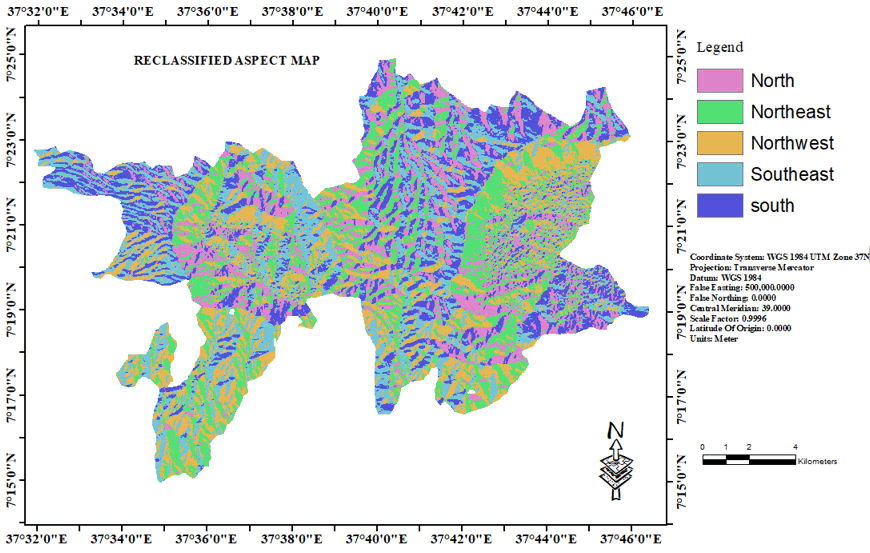
Figure 4: Aspect map.
Land use land cover
Land use and land cover play an important role in influencing landslides. Many landslides occur mainly due to the improper activities such as deforestation and increase in the urbanization over a period. Although, Rapid changes in land use and land cover, as well as land degradation processes, are pioneers to mass movement events. Consequently, for the present study land use land cover was, considered as a contributing factor for landslide hazard analysis. The Identified land cover types that were, reclassified included: Agriculture, open space, built-up, and Vegetation (Table 5).
| S. no | LuLc type | Area (ha) | Area (%) |
| 1 | Vegetation | 5922.72 | 26.59 |
| 2 | Agriculture | 10369.8 | 46.55 |
| 3 | Bare land | 2155.05 | 9.67 |
| 4 | Buit-up | 3826.26 | 17.17 |
| Total | 22247.3 | 100 |
Table 5: LULC type and area coverage.
As indicated in the Table 5, large parts of the study area were, covered by agricultural land, which account about 46.55% of total area. The second land cover dominate the area were Vegetation, which account 26.59% of total area.
The area also characterized by bare land which account 9.67% of total area. It was, mainly found at southeastern of the area and northeaster along water body. In addition, forest have significant contribution to characterize the area. Built-up area cover 17.17% of total area (Figure 5).
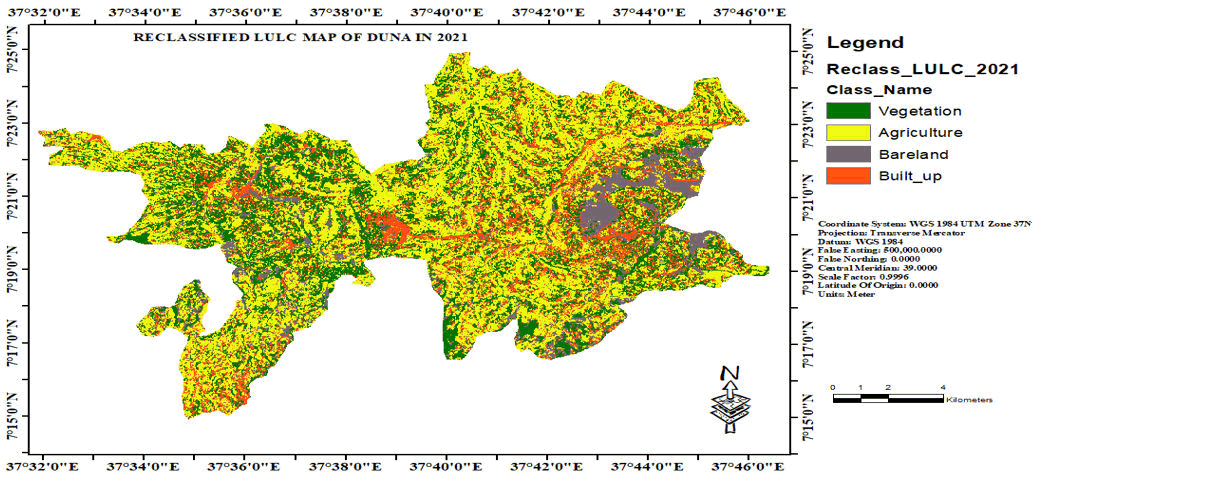
Figure 5: LULC map.
Distance from the stream
Rivers with a number of drainage networks have a high probability of landslide occurrence as they erode the slope base and saturate the underwater section of the slope forming material. Streamline was produced from Digital Elevation Model and categorized depending on stream order classication (Figure 6). Landslides with this study area were typically related in some sort of stream order. The maps were generated from the Euclidean distance extension buffering technique with the spatial analyst tool of Arc GIS 10.1. These maps were ordered into five sub-classes: 0-200, 200-400, 400-600, 600-800 and 800-1000 meters (Table 6).
| S. no | Distance from stream | Area (ha) | Area (%) |
| 1 | 0-200 | 3618.835 | 16.24 |
| 2 | 200-400 | 3276.534 | 14.71 |
| 3 | 400-600 | 2885.234 | 12.95 |
| 4 | 600-800 | 2470.531 | 11.09 |
| 5 | 800-1000 | 10022.7 | 44.99 |
| Total | 22247.3 | 100 |
Table 6: Distance from the stream and area coverage.
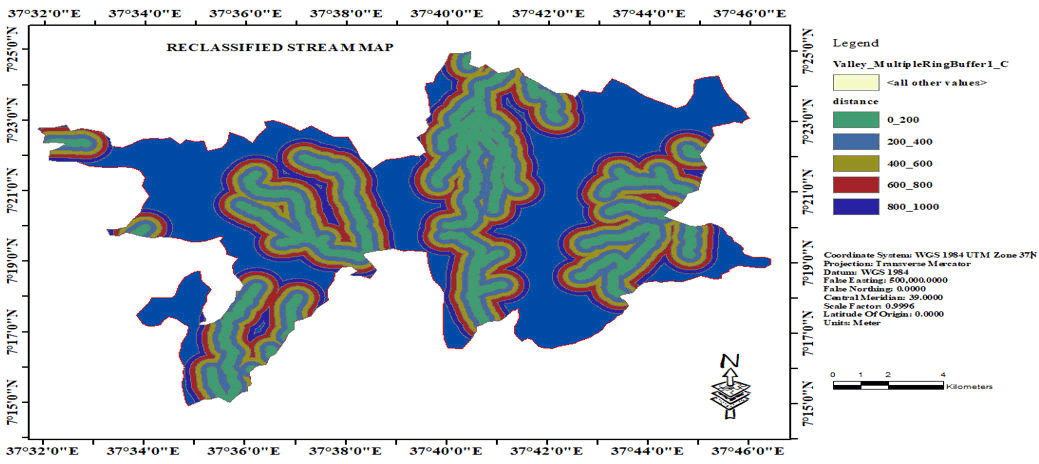
Figure 6: Distance from the stream map.
Rainfall
Rainfall mainly concentrated and protracted precipitations were preventing weights that activate landslide by provided that water thus enhancing underground hydrostatics levels as well as pore water pressures. Once soil undertakes as pressure varies, water with it can be produced pessimistic or upward pressure, as it could not exhaust rapidly. While the pore water pressures are comparable to higher pressures, shearing resistance of material reduces as well as would go ahead to breakdown of materials (Table 7). A data of stations that enclose research areas were gathered from the National Metrology Agency map of Ethiopia. The rainfall map of the research areas was arranged with GIS. The maps of research areas were separated into three annual rainfalls ordered of 900-1200, 1200-1500, and 1500-1800 millimeters (Figure 7).
| S. no | Rainfall/mm | Area (ha) | Area (%) |
| 1 | 0-900 | 4718.835 | 21.28 |
| 2 | 900-1200 | 4486.534 | 20.16 |
| 3 | 1200-1500 | 7883.317 | 35.43 |
| 4 | 1500-1800 | 4998.083 | 22.46 |
| >1800 | 0 | ||
| Total | 22247.3 | 100 |
Table 7. Rainfall.
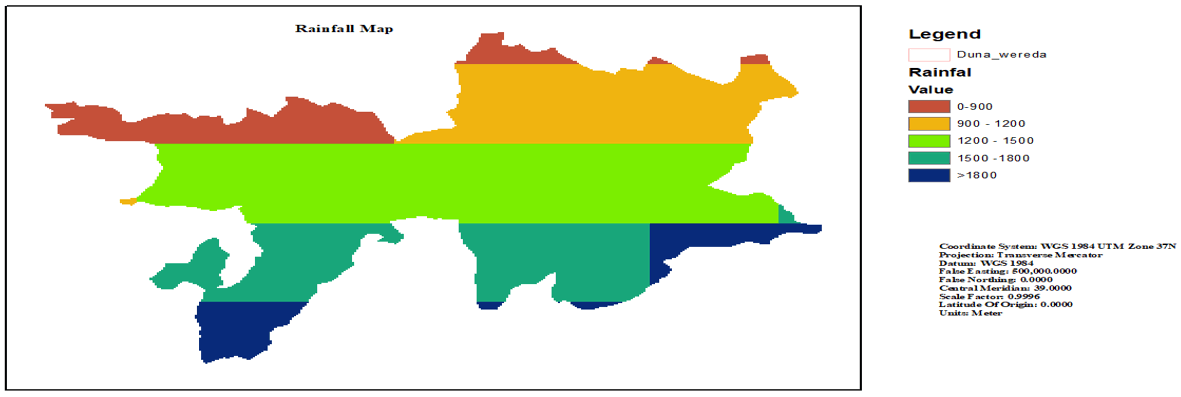
Figure 7: Rainfall map.
Elevation
Topographic-related factors such as elevations were generated from the 30 m × 30 m Digital Elevation Model of research region (Table 8). Elevations are broadly applied for evaluation of landslide susceptibility. Elevation difference might be correlated in the direction of unlike environmental situates like rainfall and plants category. Thus, for this study the elevation was categorized in five categories as shown in below (Figure 8).
Table 8: Elevation.
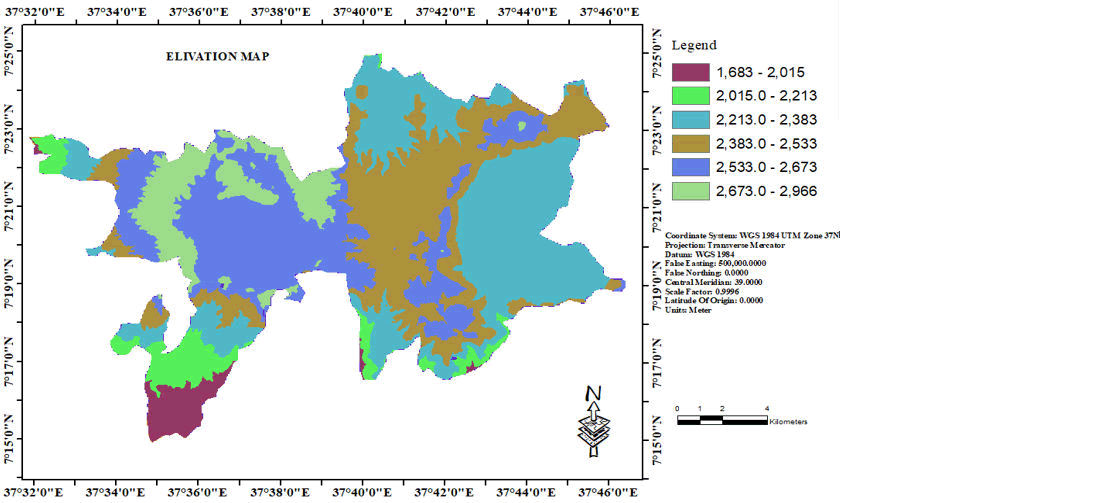
Figure 8: Elevation map.
Landslide hazard zonation
Landslide hazard zonation mainly studies the relation of landslide hazard inducing factors, establish factor analysis models and finally perform hazard zonation. Firstly, the key hazard triggering factors associated with the studied area are selected and integrated into GIS platform (Figure 9).
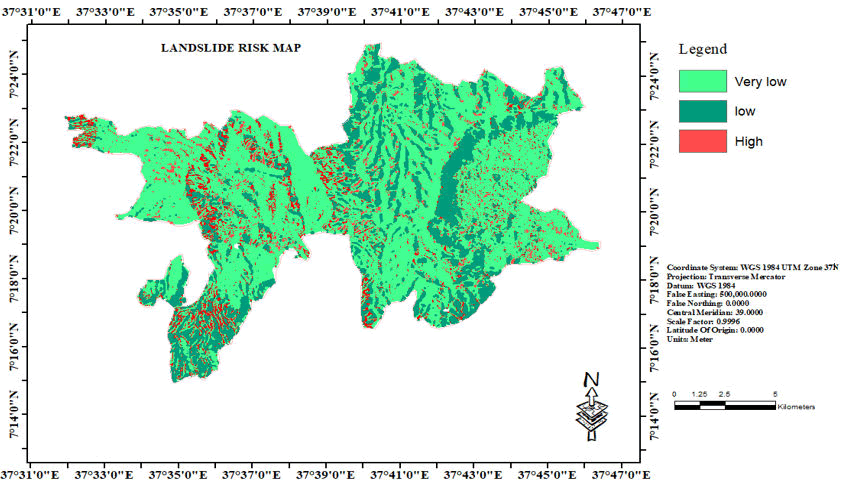
Figure 9: Landslide hazard zonation map.
The result of the landslide hazard zonation revealed that: 7.43% or 1655 ha of the total area is high landslide risk area and 22.292% and 69.63% of the area are low and very low risk areas respect (Table 9).
| S. no | Hazard level | Area (ha) | Area (%) |
| 1 | Very low | 15492.3 | 69.63 |
| 2 | Low | 5100 | 22.92 |
| 3 | High | 1655 | 7.43 |
| Total | 22247.3 | 100 |
Table 9: Area coverage of land slide hazard zonation map.
In conclusion, this research project has successfully achieved its objectives of preparing a landslide hazard zone map of the study area using geospatial technologies. Through extensive analysis and data collection, we have identified the causative factors of landslides in the study area and have identified high-risk areas vulnerable to landslides within the wereda.
Conclusion
Our findings spotlight the importance of utilizing geospatial technology in assessing and mapping landslide dangers. via offering timely and correct information up to date local government and communities about potential landslide dangers, up to date decorate preparedness and reaction efforts, in the end reducing the impact of landslides on human lives and infrastructure.
Recommendation
Based on our research findings, we would like to make the following recommendations:
Continued monitoring and assessment: Landslide hazards are dynamic and can change over time. We recommend implementing a continuous monitoring and assessment system using geospatial technologies to update the landslide hazard zone map regularly. This will ensure that local authorities and communities have access to up-to-date information and can take appropriate measures to mitigate risks.
Capacity building: Given the importance of geospatial technologies in assessing landslide hazards, we recommend providing training and capacity building programs to local authorities and communities. This will enable them to effectively utilize these technologies and make informed decisions regarding land use planning, infrastructure development, and emergency response.
Community engagement: It is crucial to engage local communities in the process of identifying high-risk areas and developing mitigation strategies. We recommend establishing community-based committees or task forces to actively participate in landslide hazard management efforts. This will foster a sense of ownership and empower communities to take proactive measures in reducing their vulnerability to landslides.
Integration with existing systems: To maximize the effectiveness of the landslide hazard zone map, we recommend integrating it with existing disaster management systems and platforms. This will facilitate seamless information sharing and coordination among different stakeholders, enhancing overall preparedness and response capabilities.
Further research: While this study has provided valuable insights, there is still much more to explore in relation to landslide hazards and geospatial technologies. We recommend that future researchers build upon our findings and delve deeper into specific aspects such as the impact of climate change on landslide hazards or the development of advanced predictive models.
By implementing these recommendations, we believe that local authorities, communities, and researchers can collectively contribute to the mitigation of landslide hazards and the protection of lives and infrastructure in the study area.
Availability of Data and Materials
The data and materials used for analysis in this manuscript are available at the corresponding author. It is possible to reasonably request the corresponding author.
Competing Interests
The authors declare that they have no competing interests
Funding
There is no fund provided to publish the research work
Authors’ Contributions
Corresponding author contributed by conducting research and writing the manuscript. The other authors contributed by arranging, organizing, and directing the article starting from research idea up to manuscript full write-up. All authors reviewed the results and agreed the final version of the manuscript.
Acknowledgments
First of all, we would like to thanks our Almighty God for his tireless protection. We would like to express our deepest gratitude to Wachemo University for providing opportunity to conduct our research. Without their generous support, this research project would not have been possible. Lastly, we would like to express our gratitude to all those who have directly or indirectly contributed to the completion of this research project.
References
- Dhakal AS, Amada T, Aniya M (2000) Landslide hazard mapping and its evaluation using GIS: an investigation of sampling schemes for a grid-cell based quantitative method. Photogramm Eng Remote Sens 66: 981-989.
- Negi RS, Parmar MK, Malik ZA, Godiyal M (2012) Landslide hazard zonation using Remote sensing and GIS: a case study of Giri Valley, District Sirmaur, Himachal Pradesh. Int J Environ Sci 1: 26-39. [Crossref] [Google Scholar] [PubMed]
- Sassa K, Canuti P (Eds.) (2008) Landslides-disaster risk reduction. Springer Science and Business Media.
- Dong N, Li Z, Luo M, Fang C, Lin H, et al. (2019) The effects of anthropogenic land use changes on climate in China driven by global socioeconomic and emission scenarios. Earth's Future 7: 784-804.
- Kanwal S, Atif S, Shafiq M (2017) GIS based landslide susceptibility mapping of northern areas of Pakistan, a case study of Shigar and Shyok Basins. Geomat Nat Hazards Risk 8: 348-366.
- Woldearegay K (2013) Review of the occurrences and influencing factors of landslides in the highlands of Ethiopia: With implications for infrastructural development. Momona Ethiop J Sci 5: 3-31.
- Mengistu M, Senamaw A (2020) Remote sensing and GIS based potential landslide hazard zonation in Ambo Woreda: central Ethiopia. J Environ Earth Sci 10.
- Ayalew L (1999) The effect of seasonal rainfall on landslides in the highlands of Ethiopia. Bull Eng Geol Environ 58: 9-19.
- Genene A, Meten M (2021) Landslide susceptibility mapping using GIS-based information value and frequency ratio methods in Gindeberet area, West Shewa Zone, Oromia Region, Ethiopia.
- Tamirat N, Abafita J, Tekalegn E (2016) Adoption and Impact of Row Planting of Wheat Crop on Household Livelihood:-A Case Study of Duna Woreda in Hadiya Zone, Ethiopia. Ethiopian Economics and Ethiopian Strategy S (ESSP). 19.
- Behailu D, Kasa A (2018) Land Governance in Ethiopia: Towards evaluating global trends. J Soc Sci Res 4: 35-46.
- Clerici A (2002) A GRASS GIS based shell script for landslide susceptibility zonation by the conditional analysis method. In Proceedings of the Open source GIS–GRASS users conference 2002 (pp. 1-17).
- Ntelis G, Maria S, Efthymios L (2019) Landslide susceptibility estimation using GIS. Evritania prefecture: a case study in Greece. J Geosci Environ Prot 7: 206-220.
- Sidle R, Ochiai H (2006) Processes, prediction, and land use. Water resources monograph. American Geophysical Union, Washington, 525.
- Akgun A, Kıncal C, Pradhan B (2012) Application of remote sensing data and GIS for landslide risk assessment as an environmental threat to Izmir city (west Turkey). Environ Monit Assess 184: 5453-5470.
- Dou J, Tien Bui D, P Yunus A, Jia K, Song X, et al. (2015) Optimization of causative factors for landslide susceptibility evaluation using remote sensing and GIS data in parts of Niigata, Japan. PloS One 10: e0133262.