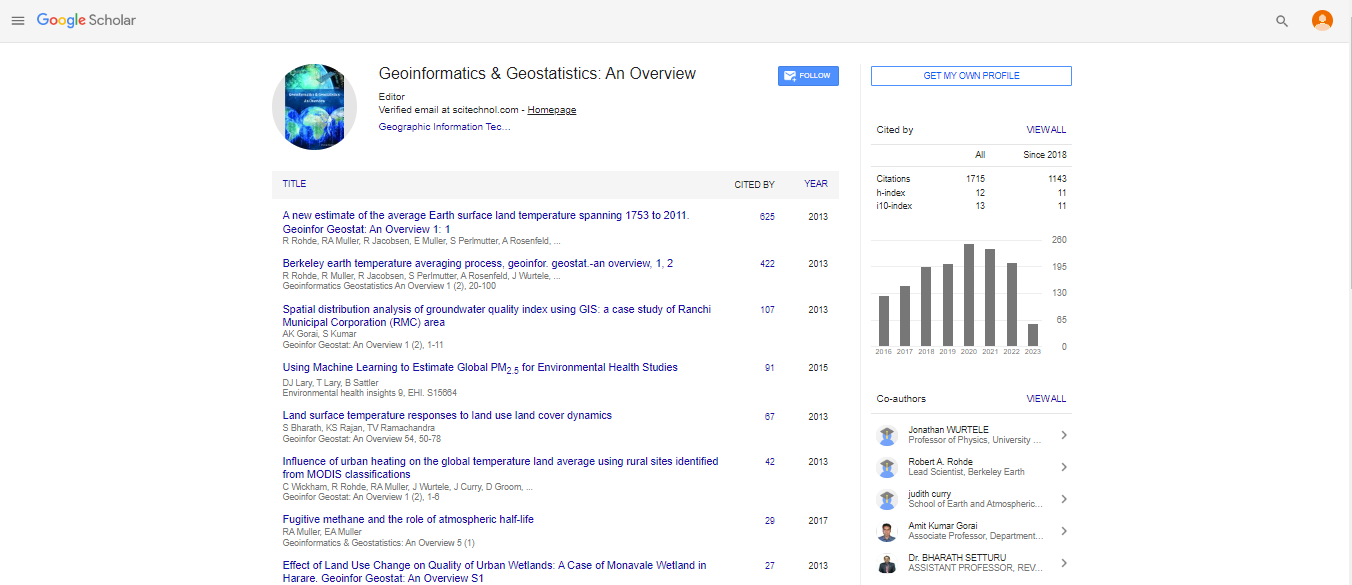
A new mathematical framework is presented for producing maps and large-scale averages of temperature changes from weather station thermometer data for the purposes of climate analysis. The method allows inclusion of short and discontinuous temperature records, so nearly all digitally archived thermometer data can be used. The framework uses the statistical method known as Kriging to interpolate data from stations to arbitrary locations on the Earth.
The effect of urban heating on estimates of global average land surface temperature is studied by applying an urban-rural classification based on MODIS satellite data to the Berkeley Earth temperature dataset compilation of 36,869 sites from 15 different publicly available sources. We compare the distribution of linear temperature trends for these sites to the distribution for a rural subset of 15,594 sites chosen to be distant from all MODIS-identified urban areas.
Spatial Distribution Analysis of Groundwater Quality Index Using GIS: A Case Study ofm Ranchi Municipal Corporation(RMC) Area
The exploration, exploitation, and unscientific management of groundwater resources in the capital of Jharkhand (Ranchi) have posed a serious threat of reduction not only in quantity but also deterioration in quality. The aim of the present study is to provide an overview of current status of groundwater quality and
to analyse spatial distribution of groundwater quality in Ranchi Municipal Corporation (RMC) area for the risk assessment.
Could Local Perceptions of Water Stress be Explained by LULCC?
Mapping land use/land cover changes (LULCC) is essential for a wide range land use planning and adaptation mechanisms to global warming/climate change, impacts of natural hazard and socioeconomic dynamics on the local to global scales. In this study, we seek to investigate whether water stress in the induced savanna of Southwestern, Nigeria as perceived by the various communities can be explained by LULC changes in the region. LULCC was conducted using orthorectified Landsat multi-temporal imageries for 1970/1972, 1986/1987, 2000/2001 and 2006 using maximum likelihood classification and change detection techniques in ENVI 4.4 software.